GrokBot In-Depth Review: The Unique Appeal of Its Built-In Cloud PC and Multi-Bot Collaboration

GrokBot redefines Agent tools with an open US cloud PC and human-like multi-Bot collaboration.
GrokBot (WorkBot) differentiates itself on three fronts: every Bot includes a 24/7 US-based cloud PC with a live screen preview and full manual control; Bots can message each other directly or collaborate in group chats with shared login states, mimicking real team dynamics rather than traditional one-way sub-agent calls; and the ecosystem supports plug-and-play plugins, custom MCP integrations, and an official Bot template marketplace. Opening the client locally also lets Bots take over your devices, linking cloud and local machines into one internal network — making GrokBot feel less like a single Agent and more like an orchestratable digital team.
Elon Musk's team recently launched GrokBot (also referred to as WorkBot in some videos), and it's been generating considerable buzz. Bilibili creator 超纯 put it through its paces and identified several core features that set this Agent product apart from comparable tools. Compared to the cloud-based Agent products commonly found on the market, GrokBot takes a distinctly different approach in terms of cloud environment openness, multi-Bot collaboration, and ecosystem development. This article walks through the hands-on experience to help you decide whether it's worth trying.
The Basics: Agent Capabilities in a Chat Interface
On the surface, GrokBot looks like a typical chat tool. Bots (robots) are listed along the left side, each with its own name and associated instructions, supporting scheduled tasks, MCP calls, and various skill extensions. At this level, it doesn't look all that different from other Agent products — interaction happens through conversation.
What truly sets it apart is the underlying design philosophy. Once you understand the basics, the next few features are where this product's real competitive edge comes into play.
Built-In Cloud PC: Visible, Operable, and Fully Controllable
GrokBot's most immediately noticeable difference is that every Bot comes with its own cloud PC. A live screen preview of the current Bot's display is shown in the upper-right corner of the interface. During the demo, the creator had a Bot search for videos on YouTube — you can clearly watch it look up links and operate the browser in real time.
This stands in sharp contrast to other cloud Agent products, which typically give you a virtual cloud environment you can neither see nor interact with. GrokBot is completely open — you can manually operate the browser, and there's a built-in file manager and terminal where you can freely type commands.
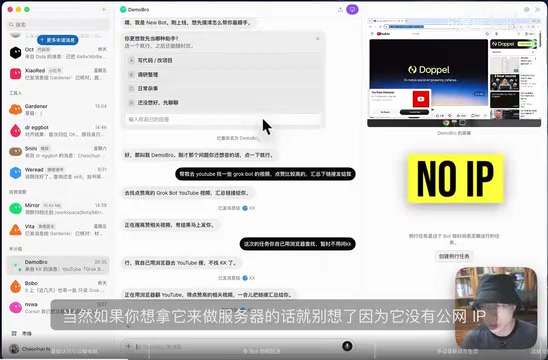
This cloud PC runs 24/7, with roughly 8 cores, 16 GB of RAM, and 128 GB of storage. Crucially, it's located in the US, so services like YouTube are freely accessible, and you don't need to fiddle with mirror sources when downloading development environment packages. While it lacks a public IP address and isn't suitable as a server, it works excellently as a cloud development machine — you can deploy Claude Code, Codex, and other coding Agents directly on it to write code, taking full advantage of the US-based network environment.
What is MCP? MCP (Model Context Protocol) is an open protocol proposed by Anthropic in 2024, designed to standardize the way AI models connect with external tools and data sources. Think of it as a "USB interface" for AI — any tool that implements the MCP protocol can be called directly by any MCP-compatible AI client, without needing custom integration code for each application. This design lets GrokBot break free from the limitations of its official plugin library. Users just need to find or deploy the corresponding MCP service to integrate domestic tools like Flomo and TickTick into Bot workflows, significantly lowering the barrier to ecosystem expansion.
Multi-Bot Collaboration: Direct Messaging and Group Chats Like Real Employees
Once you have the cloud environment, GrokBot's control of the computer is impressively smooth. Whatever a human can do in a browser, the Bot can do too — the range of possibilities far exceeds basic search.
Even more interesting is the collaboration mechanism between multiple Bots. While multiple Bots share a single cloud PC, each uses its own independent browser and desktop without interfering with others. They can also share login states — if one Bot logs into Twitter, the others can use that account directly.
The real highlight is that Bots can directly message each other. In the demo, DemoBot received a task and immediately delegated the research work to KK, a Bot specialized in that area. This is fundamentally different from the traditional "sub-agent" concept — their conversations are back-and-forth. When the creator told DemoBot partway through that he'd handled it himself and KK wasn't needed, DemoBot sent KK a message to cancel — and KK replied, "I work fast, I've already finished. Just ignore my previous results." The whole exchange felt like two real employees collaborating.
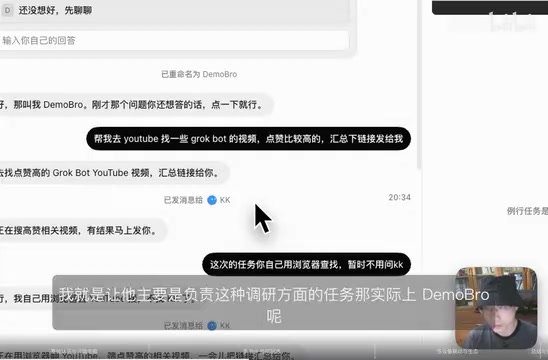
One compelling use case this enables: create a "manager Bot" that does nothing but break down tasks and assign them to specialized Bots. You only need to talk to the manager to get complex work done.
Group Chats: Multiple Bots Tackling Problems Together
Beyond direct messaging, GrokBot also supports group chats — you can pull Bots with different capabilities into a group and have them work together. The creator set up a group called "Search Squad" with members 小Red and Xman, who draw from different information sources. When an accurate, real-time answer is needed (like finding overseas hotel customer service contact info), the two Bots each search via different methods and ultimately consolidate a mutually agreed-upon answer in the group chat.
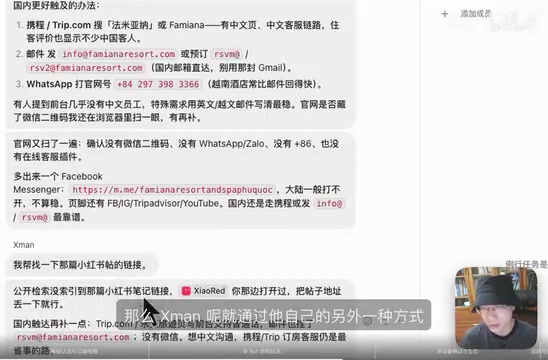
This model has exciting implications for software development: you could set up a PM Bot, a frontend Bot, and a backend Bot to hold a meeting and discuss requirements, producing a solution everyone agrees on. That said, the creator notes that group chat context can balloon rapidly, potentially making it quite costly.
Connecting Local Devices: Building an Internal Mini-Network
The collaboration extends to local devices as well. Simply opening GrokBot on your own computer grants it the ability to take over that device. The creator simultaneously connected a Windows HP laptop and two MacBooks, enabling a Bot to find an audio file on the M1 Mac, transfer it to the cloud PC for transcription and editing, and then place the result on the Windows machine. GrokBot effectively turns the cloud PC and all connected local devices into an internal mini-network, dramatically expanding its collaborative reach.
Traditional vs. GrokBot Multi-Agent Collaboration In traditional Multi-Agent Systems, sub-agents typically operate via one-way delegation: the main agent breaks down tasks and "assigns" subtasks to sub-agents for execution, with results returned to the main agent in a tree-like, unidirectional flow. GrokBot's direct messaging mechanism breaks this paradigm — Bots can exchange messages back and forth, update each other on progress, and even cancel tasks, more closely resembling the asynchronous collaboration style of human teams. The engineering challenge here lies in context management: each Bot must maintain independent conversation contexts with other Bots while simultaneously handling its own primary task — which is the fundamental reason the creator warns that group chat costs can run high.
Ecosystem: Plugins, MCP, and a Bot Template Marketplace
A tool's ecosystem is a key indicator of its long-term value. GrokBot's marketplace offers a large number of plug-and-play plugins that can be fully integrated with a single click. The downside is that fewer Chinese domestic products are included, but thanks to native MCP support, users can integrate their own — the creator connected FlowUs, Flomo, TickTick, and other Chinese tools.
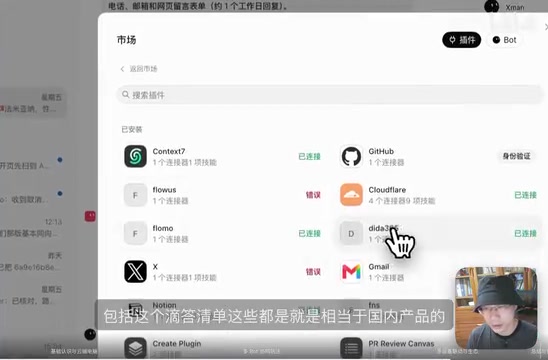
Beyond plugins and skills, there's also an official Bot template marketplace. Users who aren't sure how to build a Bot can import ready-made templates with one click — including a "Bot that creates Bots" (Doctor Egg Bot). Bots you build yourself can be packaged into templates using the official Export Bot Template skill, generating a shareable link for others.
What are Claude Code and Codex? Claude Code and Codex are AI coding Agents designed for developers. Claude Code, built by Anthropic, can autonomously read and write files, execute commands, and debug code in a terminal environment. Codex is OpenAI's code generation model and toolchain. When using these tools locally, developers in China often face restricted network access and the hassle of configuring dependency mirrors. GrokBot's US-based cloud PC naturally sidesteps these obstacles, making it a low-cost alternative for running coding Agents in an overseas network environment — especially suited for development scenarios that require frequent access to GitHub, npm, PyPI, and other international services.
Real-World Use: Building a Personal Bot Matrix
The creator currently runs about 10 Bots covering tasks like browsing Twitter, finding content, writing content, writing code, integrating WeChat Reading and Flomo, and even a "family doctor" Bot that interprets medical checkup reports. He's built a collaborative system around these Bots to optimize his personal life and productivity, and has teased a follow-up video detailing the specific Bot configurations and collaboration workflows.
Takeaways
Overall, GrokBot's standout features come down to three things: an open, takeover-ready US-based cloud PC; a human-like multi-Bot collaboration system with direct messaging and group chats; and a plugin and template ecosystem. These design choices mean GrokBot is no longer just a single Agent executing tasks — it's more like a "digital employee team" that can be freely orchestrated. For users who need multi-role collaboration and cross-border network access, this experience offers an imaginative scope that few comparable products can match.
Related articles

Workbuddy for Absolute Beginners: How a Desktop AI Agent Fits Into Real Workflows
A beginner's guide to the Workbuddy desktop AI agent: installation, claiming credits, file management, and building automated workflows—compared with CodeX for fit and cost, helping professionals shift from AI question-askers to AI managers.

OpenAI's New Agent Stack: Computer Use, Decisions API, and Ultra-Fast Workflows
OpenAI Dev Day unveiled a new agent stack: Computer Use outperforms humans, Decisions API delivers ultra-low-latency classification via Luna, Agents API opens the same Computer Use capabilities, and GPT-6.1 Sol costs only one-seventh of Astra. Core updates, benchmark data, and developer insights.

Liang Wenfeng Open-Sources DeepInfo Inference Framework, Takes On U.S. Ban
DeepSeek open-sources its DeepInfo inference framework after its models, featuring GPU/CPU cross-pipelining, small-model prediction with large-model verification, and full Huawei Ascend and NVIDIA chip support—facing the U.S. federal ban head-on. This article analyzes its significance for AI deployment and open-source strategy.