GrokBot Templates: Build an AI Agent Team for Channel Partner Managers in 5 Minutes

GrokBot uses job templates and MCP to build a 6+1 AI Agent squad for channel partner managers in 5 minutes.
The article explains how GrokBot and templatesgrokbot.com use templated AI Agents to free channel partner managers. GrokBot is an out-of-the-box job Agent ready in about 5 minutes. Users install GrokBot, add a template creator bot, connect the MCP server, and enter a single instruction to auto-match 6 specialized Agents plus 1 coordinator. The site distributes templates by job rather than function. The author sees it as a low-risk starting point, but notes the video does not demonstrate real performance.
A channel partner manager's day is consumed by three things: recruiting new partners, maintaining relationships, and delivering product training. GrokBot and templatesgrokbot.com are trying to pull this role out of repetitive labor with a "building blocks" style AI Agent solution.
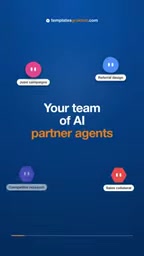
What GrokBot Is: A Job-Oriented AI Agent Assembly Line
According to the video, GrokBot's positioning is not a general-purpose chat assistant, but a set of "out-of-the-box" AI Agents. The official claim is that a GrokBot can be ready in just 5 minutes.

Its approach differs from most Agent products on the market. Many platforms have users define tools from scratch, write prompts, and tune workflows—a fairly high barrier. GrokBot takes the template route: first install a "template creator" bot, then connect it to the GrokBot MCP server of some template, and leave the rest to a single natural language instruction.

MCP (Model Context Protocol) plays the role of the connection layer here, allowing different bots to share context and tools. For channel partner managers without a technical background, this means they don't need to understand the underlying protocol—they only need to complete one connection action.
MCP (Model Context Protocol) is an open protocol proposed by Anthropic at the end of 2024, aiming to establish a standardized communication interface between AI models and external tools and data sources. Before MCP appeared, integrating each tool often required writing customized function-calling code for a specific model, and cross-platform migration costs were high. MCP abstracts these connections as "servers"—tool providers only need to implement an MCP Server once, and any Agent that supports the protocol can directly call the tools and resources within it. Its value is similar to USB-C: once the interface is unified, pairing devices with hosts no longer requires proprietary adapter cables. For templated Agent platforms like GrokBot, MCP allows the "template creator bot" to package and mount an entire set of job-related tools onto a new bot. Users don't need to configure API keys or write function definitions one by one—a single connection lets multiple bots share the same batch of tools and context.
The Practical Path: Summon a 7-Person Squad with One Sentence
The process is compressed into a few actions: install GrokBot, add the template creator bot, connect the MCP server, then enter the instruction—"I am a channel partner manager, find and install all relevant bots."

Then add a coordinator bot to make the whole team work together. The final result is: 6 specialized Agents + 1 coordinator, all in place within 5 minutes.
The clever part of this design is that it automates "selection." Users don't need to know which Agents they need; the system reverse-matches based on the job description. For roles like channel partner management, where responsibility boundaries are blurry and the work spans sales and operations, this "package by job" approach is closer to real needs than selecting by tool.
A coordinator bot is a common role in multi-Agent systems and belongs to the "orchestration layer" design pattern. When tasks are split among multiple Agents with different strengths, there needs to be an entity to decide who goes first, who receives whose output, and how to choose when there are conflicts. The coordinator usually does not directly execute specific business work, but is responsible for task decomposition, dispatch, aggregation, and exception retries. The opposite architecture is "decentralized negotiation," where Agents talk directly to each other and divide work on their own. This is more flexible but less controllable and prone to loops or mutual waiting. GrokBot chooses an explicit coordinator bot; the benefit is that the process is predictable and humans can intervene to supervise at key points. The cost is that the coordinator itself becomes a single point of bottleneck—if its understanding of the job tasks is inadequate, the whole team will go off track. This also explains why the article emphasizes "package by job"—the coordinator's dispatch logic relies heavily on preset assumptions about job responsibilities.
What This Means for Channel Partner Management
Channel partner management is a typical "high communication density, low automation" role. Recruiting requires screening, relationships require maintenance, and training requires repetition—all three consume a lot of time, yet are hard to replace with traditional software.
The value of an AI Agent team is not in replacing judgment, but in absorbing the repetitive parts within it. One Agent responsible for screening candidate partners, one responsible for follow-up communication, one responsible for generating training materials, plus a coordinator to assign tasks—this structure happens to correspond to the role's daily division of labor.
The entry point of the template site templatesgrokbot.com is "for my job"—finding templates by job, rather than finding tools by function. If this positioning holds, it means the distribution logic of AI Agents is shifting from "developer tools" to "job consumer goods."
Channel Partner Management refers to the full lifecycle management when an enterprise sells products or services through third-party agents, distributors, system integrators, and other partners. It spans recruiting (identifying and signing qualified partners), enablement (training, certification, providing sales tools), incentives (rebates, co-marketing), and performance management (tracking lead conversion, handling channel conflicts). The difficulty of this role lies in highly fragmented information: partner qualification data is in the CRM, communication records are in email and instant messaging, training materials are scattered across document repositories, and any follow-up requires manually piecing together context across systems. Therefore, it is naturally suited to being covered by multiple dedicated Agents with division of labor, then uniformly scheduled by a coordinator—essentially externalizing coordination work that used to rely on personal experience and memory into a reusable orchestration structure.
Where to Stay Skeptical
The video does not show actual operating results, nor does it explain how well the Agents collaborate or how they perform in complex recruiting scenarios. Building in 5 minutes is installation speed, not usability.
In addition, the video does not elaborate on exactly which 6 specialized Agents there are or where each one's capability boundaries lie. Whether the MCP connection is stable and whether the templates can adapt to different companies' channel strategies all need real-world verification.
For channel partner managers, this solution is worth treating as a starting point that lowers the cost of trial and error—run it first to see which steps are truly eliminated, then decide whether to hand critical processes over to it.
One-line Summary
GrokBot uses job templates and MCP connections to build a 6+1 AI Agent squad for channel partner managers in 5 minutes.
Paragraph Summary
The article introduces how GrokBot and templatesgrokbot.com use a templated AI Agent solution to free channel partner managers. GrokBot is positioned as an out-of-the-box job Agent, ready in about 5 minutes, taking the template route rather than defining tools and prompts from scratch. The setup process is to install GrokBot, add the template creator bot, connect the MCP server, and then enter the instruction "I am a channel partner manager, find and install all relevant bots." The system automatically matches 6 specialized Agents plus 1 coordinator bot. The template site distributes by job (for my job) rather than by function, positioning itself more like a "job consumer product." The author believes the solution is suitable as a starting point for lowering trial-and-error costs, but the video does not show actual operating results or Agent collaboration quality. Five minutes is only installation speed, and usability still needs verification.
Related articles

iPhone Duo Battery Life Tested: One Charge a Day Is Unavoidable, and the Large Screen Is the Culprit
iPhone Duo battery test: heavy use needs at least one charge a day, and about 30% remains after 6.5 hours of screen-on time. How often the large screen is unfolded is key; a MagSafe battery pack helps, and long-term degradation is also worth watching.

Kimi K3.1 Pro Open-Sourced: 2.8 Trillion Parameters Close In on Opus
Moonshot releases the open-source MoE model Kimi K3.1 Pro, with 2.8T total parameters and 104B activated, trailing Opus 5.5 by under 1 point on Terminal Bench 4.0.

Costco Tech Price Guessing: Are Monitors, Keyboards, Mice, and Bose Speakers Worth It?
A YouTube blogger guesses prices of Costco tech products: 2K 180Hz monitor, Logitech keyboard and mouse, Bose speaker, and CyberPower UPS, revealing warehouse-store selection and brand premium.