GTA VI's Animal Ecosystem Goes Viral: 170 Species Make Players Put Down Their Guns

GTA VI's 170+ animal and 62 bird species observation system gives players non-violent collection fun beyond the crime narrative.
GTA VI has drawn attention for its ecological detail of over 170 animal species and 62 bird species, which players can observe with binoculars and log in a journal, creating a non-violent collection loop. The game continues Red Dead Redemption 2's investment in animal immersion with bioluminescence and feather differentiation serving the observation experience. Reddit birdwatchers say they'll prioritize birdwatching over crime, though the game remains crime-themed. The animal system lowers the barrier to nature observation, and while whether it translates into real biodiversity awareness lacks data support, it at least offers players a breathing rhythm within a high-pressure narrative.
A biodiversity writer's perspective has unexpectedly thrust GTA VI's animal system into the spotlight. According to a YouTube video, the game features over 170 animal species—from alligators and manatees to frogs—plus 62 different bird species that players can observe with binoculars and log in a journal. This detail sent Reddit's birdwatching community into a frenzy, with some saying that in the new game, "a crime spree will rank behind birdwatching."
170 Animal Species and 62 Bird Species: An Ecological Observation Toolkit
The game's main setting is Rockstar's fictionalized take on Miami—Vice City—but players start in a fictional version of the Florida Keys and can also visit national parks like the Everglades. These locations are themselves real biodiversity hotspots, providing natural ground for the animal system.
With over 170 animal species and 62 bird species, the scale already exceeds the decorative wildlife counts of most open-world games. The key is the accompanying observation mechanics: binoculars plus journal logging transform randomly appearing wildlife into collectible, trackable content. For players accustomed to "clearing the map" in games, this system offers a non-violent collection loop.

Wildlife in open-world games is typically categorized as "ambient wildlife"—low-interactivity NPCs used merely to populate scenes and create an ecological feel, which players can usually only shoot or shoo away. GTA VI's binoculars and journal system elevate animals from decoration to "collectible knowledge objects." This design draws from real-world citizen science apps like eBird or iNaturalist, where players accumulate species lists through observation and recording, creating a sense of achievement similar to a "life list." This mechanic replaces the violence loop with an observation loop—a rarity in AAA games.
From Red Dead Redemption 2 to Bioluminescence: Technical Continuity in Immersion
Rockstar already demonstrated its commitment to animal ecology in Red Dead Redemption 2, and GTA VI builds on that foundation. According to the video, the new game adds bioluminescence effects, feather type differentiation, and more accurate hair and fur rendering.
These technical details may seem like graphical showmanship, but they actually serve the observation experience. Different feather types mean birds can be identified more precisely, while bioluminescence gives nighttime or aquatic observation unique visual feedback. For players interested in ecological themes, these are genuine identification cues rather than a texture-resolution contest.
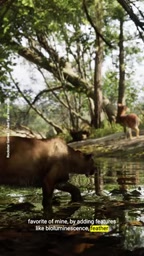
Bioluminescence refers to organisms producing light through chemical reactions, commonly seen in marine life (like dinoflagellates and jellyfish) and some terrestrial organisms (like fireflies). In game graphics, implementing bioluminescence requires dynamic light sources and particle effects, while accounting for water refraction and nighttime ambient light interaction. Feather type differentiation involves more refined material layering: different feathers (flight feathers, down feathers, tail feathers) have varying glossiness, transparency, and geometry, requiring the rendering pipeline to support multi-layered material definitions. These technical details not only enhance visual realism but, more importantly, provide visual cues for species identification—players can distinguish species by feather characteristics or luminescence patterns, deepening the observation gameplay.
Player Community Response: A Second Path Beyond the Crime Narrative
The original video's creator admitted that despite being a gamer, faced with overwhelming marketing and 13 years of anticipation, they weren't sure whether they'd buy it, expecting it to be just another ultra-violent game about crime. This concern was partially addressed in Reddit discussions: the birdwatching community is already planning to prioritize birdwatching over criminal activities.
This doesn't mean GTA VI is no longer a crime game. The video acknowledges that violent crime is part of the game. But the existence of the animal observation system lets players choose to stop and appreciate the natural world at any moment. For a AAA blockbuster, this design choice is uncommon—it hands pacing control back to the player.

Can Games Become an Entry Point for Biodiversity Education?
An open question the video raises is: will this make players care more about biodiversity? Some even joked that after playing, they might be motivated to "touch grass" and step into nature. This speculation currently lacks data support, but from a mechanics design perspective, it at least lowers the barrier to engaging with nature observation.
It's worth distinguishing that the ecological representation in games is ultimately fictionalized and selective. Vice City corresponds to Miami, the starting area to the Florida Keys—these locations are compressed, beautified, and re-arranged. It can spark curiosity but cannot replace real field observation. The video's creator mentioned personally exploring the Everglades for work—perhaps that's the ideal extension direction for this kind of design.
Citizen science refers to public participation in scientific research, where participants help scientists monitor biodiversity through observation, recording, and data submission. The observation journal mechanic in games closely mirrors the logic of citizen science tools like iNaturalist: identifying species, recording locations, accumulating lists. Research suggests such gamified experiences may spark players' curiosity about nature, but whether it translates into real-world conservation behavior still lacks long-term tracking data. Species representation in games is artistically filtered and may overlook ecosystem complexity (such as food chains and habitat fragmentation), so its educational value lies more in being an "interest entry point" rather than a "knowledge substitute."
Editorial View
What makes GTA VI's animal system worthy of discussion isn't the number of animals itself, but that it turns observation into gameplay with feedback. Open-world games have long treated wildlife as background or hunting targets, and the combination of binoculars and a journal makes "not killing" a choice with progress for the first time.
For Rockstar, this is a natural extension of its immersion strategy; for players, it offers a breathing rhythm within a high-pressure crime narrative. As for whether it can truly translate into real-world ecological awareness, for now it remains at the level of expectation—but at least it gives a headline-grabbing blockbuster a less noisy angle for discussion.
Related articles

FBI and USDA Hit by Cyberattacks: Critical Infrastructure Security Alarms Sound Again
FBI and USDA reportedly hit by cyberattacks; the FBI was breached for the second time in recent months, this time targeting the National Crime Information Center (NCIC). This article analyzes the incident details, NCIC's strategic value, and common security challenges facing government agencies.
How Do UK Grid Battery Storage Systems Make Money?
How UK grid battery storage makes money: stacking frequency response, capacity market, and wholesale arbitrage revenue, plus operational trade-offs and market risks.

Anthropic Goes Public: AI Bubble or Buying Opportunity?
Anthropic lists on Nasdaq, opening about a third above its IPO price. We break down the $81.3B raise, $1.5T offering valuation, and $2T market valuation, plus Claude's growth and $567M quarterly operating loss.