guilds.run: Building Debuggable, Trustworthy Multi-Agent Systems
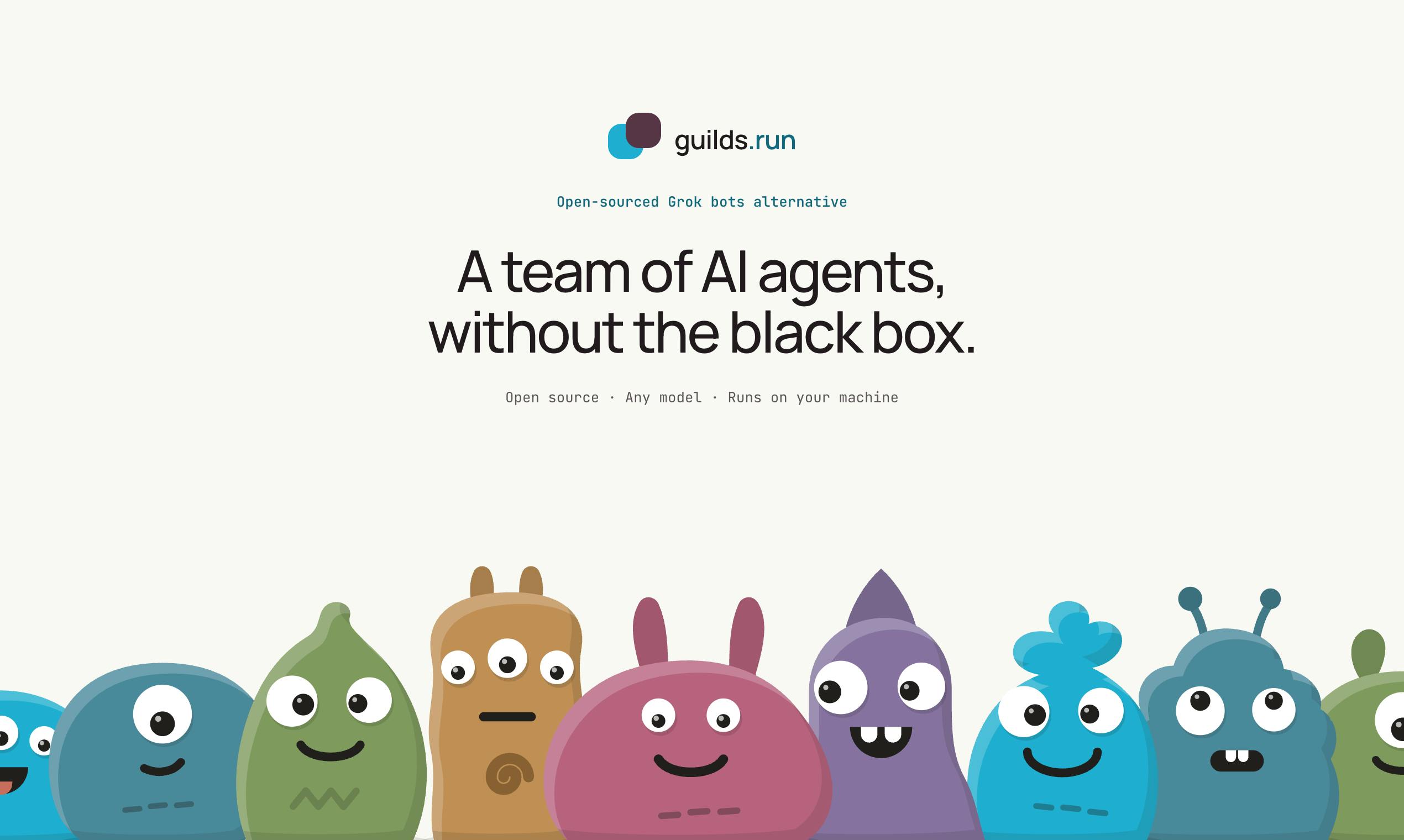
Open-source tool guilds.run brings inspectability to multi-agent systems, solving the agent black-box debugging challenge.
guilds.run is the open-source project ranked #8 on Product Hunt, targeting the "behavior black box" pain point of multi-agent systems. It offers four layers of observability: full-chain tracing of prompts, tool calls, memory changes, and inter-agent messages; per-agent permission settings with real-time context editing; individual model selection per agent; and free self-hosting. Positioned above orchestration frameworks like LangChain and AutoGen, it reflects AI engineering's shift from feature implementation toward observability and controllability.
Multi-agent collaboration is becoming a mainstream architecture for AI applications, but a core pain point continues to plague developers: when multiple agents call each other's tools, modify memory, and pass context back and forth, the behavior of the entire system is essentially a black box. guilds.run, the open-source project ranked #8 on Product Hunt, aims to solve this problem.
The Black Box Dilemma: The Trust Crisis in Multi-Agent Systems
Most current multi-agent frameworks focus on "getting agents to run" rather than "getting agents to run transparently." After building an agent pipeline, developers often face several thorny questions: Why did a particular agent choose this tool? At which step was memory tampered with? Did the interaction between two agents deviate from its original intent?
guilds.run's product description speaks directly to this pain point — "Stop guessing what your agents are doing." Its core proposition isn't stronger orchestration capability, but rather inspectability.
This approach reflects a directional shift in AI engineering: from pursuing feature implementation to pursuing observability and controllability. When agents move from demos to production environments, trust becomes a necessity.
What is Multi-Agent Collaboration
Multi-agent collaboration refers to systems composed of multiple autonomous AI agents, each with independent roles, goals, tool sets, and memory, working together through message passing, task allocation, or negotiation mechanisms to accomplish complex tasks that a single agent cannot handle. Compared to monolithic agents, multi-agent architectures have a natural division-of-labor advantage — for example, one agent handles retrieval, one handles reasoning, and one handles code execution. But the cost is that the system's behavior is no longer a single causal chain, but a complex network formed by interwoven decision points. This emergent behavior is the fundamental source of debugging difficulty: no single component's logs can fully reconstruct system-level behavior; cross-agent tracing mechanisms are essential.
Breaking Down Four Debugging Dimensions
guilds.run provides four layers of observability, covering the key operational aspects of multi-agent systems.
Full-Chain Tracing: Prompts, Tool Calls, and Memory Changes
Every step of every agent's operation can be recorded and reviewed — including the complete prompt sent to the model, the tools and parameters the agent selected, memory reads/writes and modifications, and message passing between agents. This level of tracing means developers no longer need to guess from logs; they can reproduce issues step by step.
For teams that need to debug complex agent pipelines, this capability directly determines troubleshooting efficiency.
Why "Memory" Is the Critical Variable in Multi-Agent Debugging
In agent systems, "memory" typically refers to context information that an agent persists beyond its short-term conversation window, including historical interaction summaries, factual knowledge, user preferences, etc., often implemented via vector databases or structured storage. Unlike prompts and tool calls, memory is state that accumulates across turns and across agents — an erroneous conclusion written by one agent may be read and treated as factual basis by another agent several turns later. This type of contamination is insidious and delayed, making it difficult for traditional logs to locate the source. Therefore, the ability to record memory read/write operations item by item, with writer and timestamp annotations, is a prerequisite for troubleshooting issues like "why did the agent suddenly make an absurd decision." This is also why guilds.run traces memory changes alongside prompts and tool calls.
Permission Control and Context Editing
The system allows permission boundaries to be set for each agent, while also supporting manual context editing. This means that when an agent deviates from expectations, developers can intervene in real time rather than only being able to restart the entire pipeline.
Permission control is especially important in multi-agent scenarios — an agent with unrestricted access to tools and memory can trigger cascading errors. guilds.run designs permission management as a first-class feature.
The Relationship Between Context Editing and Agent Governance
"Context editing" refers to manually or programmatically modifying an agent's currently visible context during runtime — for example, deleting a misleading historical message, correcting an erroneous tool return result, or injecting additional constraints. In multi-agent pipelines, the output quality of downstream agents depends heavily on the context passed in by upstream agents; once upstream deviates, errors amplify along the chain. Allowing real-time context editing essentially downgrades "rerunning the entire pipeline" to "local repair and continue," significantly shortening the experiment iteration cycle. Combined with permission control (restricting which tools an agent can call and which memory partitions it can read/write), this forms a runtime governance mechanism — precisely the core dividing line between production and demo environments.
Per-Agent Model Selection
Different tasks require different model capabilities. guilds.run allows individual model selection for each agent, meaning lightweight models can handle simple tasks while powerful models handle critical decisions, striking a balance between cost and effectiveness.
Self-Hosted Deployment
The project supports free self-hosting, a key selling point for data-sensitive teams. Agent run logs, memory contents, and prompts all involve core business information, and self-hosting eliminates concerns about data leaving the organization.
Why Self-Hosting Is Especially Important for Agent Debugging Tools
Self-hosting means users deploy software on their own servers or private clouds rather than using a vendor-hosted SaaS version. For agent observability tools, this choice carries significance beyond general data compliance considerations: debugging tools collect precisely the most sensitive operational data — complete system prompts, internal tool parameters and return values, business context passed between agents, and persisted memory contents. This data often contains business logic, customer information, and internal API structures. Once it flows to a third party, it represents both a compliance risk and an exposure of core AI assets. Free self-hosting also lowers the adoption barrier for small and medium-sized teams, making "get it working locally first, then consider scaling" a viable path.
Open Source Strategy and Community Response
guilds.run is released as open source, categorized under Open Source, Virtual Assistants, and Bots. It received 92 upvotes and 19 comments on Product Hunt, ranking #8 for the day.
This result is above average among open-source developer tools. Considering that multi-agent debugging is still a relatively niche need, this level of attention demonstrates that market demand for "inspectable agent systems" genuinely exists.
In terms of product positioning, guilds.run doesn't try to be another LangChain or AutoGen — it targets a layer above these frameworks: the observability and governance layer. If this positioning is executed thoroughly, it has the potential to become an essential component in the multi-agent tech stack.
The Next Competitive Battleground for Multi-Agent Systems
As orchestration frameworks mature, differentiation will increasingly come down to "can you let developers confidently deploy agents to production?" guilds.run represents one direction within this trend: building trust through transparency and control.
For teams currently building multi-agent systems, the core question worth considering is: when your system has problems, how quickly can you pinpoint the cause? If the answer is "it requires a lot of guessing," then tools like guilds.run deserve to be part of your evaluation.
One-line Summary
Open-source tool guilds.run brings inspectability to multi-agent systems, solving the agent black-box debugging challenge.
Paragraph Summary
guilds.run is the open-source project ranked #8 on Product Hunt, targeting the core pain point of multi-agent system "behavior black boxes." Rather than pursuing stronger orchestration, it offers four layers of observability: full-chain tracing of prompts, tool calls, memory changes, and inter-agent messages; per-agent permission settings with real-time context editing; individual model selection per agent to balance cost and effectiveness; and free self-hosting for data-sensitive teams. Positioned as a layer above orchestration frameworks like LangChain and AutoGen — the observability and governance layer — its 92 upvotes and 19 comments on Product Hunt demonstrate that the niche need for multi-agent debugging is real, reflecting AI engineering's shift from feature implementation toward observability and controllability.
Related articles

JobRunner MCP Server: AI Agents Can Now Fix Failed Java Jobs
JobRunner launches an open-source MCP server enabling AI agents to view cluster status, diagnose failures, and recover Java jobs—incident response from any cloud coding environment or existing agent.

MLAI Digital Launches 9 Security Agents: MCP Server Safeguards the Full Lifecycle of Agentic AI
MLAI Digital launches Security MCP Server with nine built-in specialized security agents covering vulnerability discovery, attack simulation, prompt injection detection, API and infrastructure assessment, and accelerated remediation—embedding security validation across the full Agentic AI lifecycle from development to production.

Running Isaac Lab on H100 GPUs: Exploring Better Approaches
Exploring optimization methods for running Isaac Lab on NVIDIA H100 GPUs, including MIG configuration, mixed precision, TensorRT acceleration, and community experience to improve robotics simulation and reinforcement learning efficiency.