Guitoro: A Virtual Guitar You 'Play' with Your Keyboard, an Open-Source Project Drawing Attention on Show HN

Guitoro simulates guitar playing with a keyboard, exploring the possibility of software redefining performance boundaries.
Guitoro is a virtual instrument project that appeared in the Show HN section of Hacker News. Its core idea is to turn a computer keyboard into the strings of a virtual guitar, letting users strike keys to play. The article points out that the real difficulty of such projects lies not in note mapping, but in simulating the continuous rhythm of strumming, the intuitive design of chord fingerings, and expressing timbre dynamics on a keyboard without velocity sensitivity. Choosing to launch on Show HN usually means the project is open source, playable, and the author hopes to get genuine feedback from the technical community. The article positions Guitoro as an "entry point for inspiration" rather than an "endpoint for performance," suitable for people with a keyboard but no guitar, developers interested in audio interaction, and music enthusiasts needing lightweight creation tools, while reminding that virtual instruments generally face the challenge of stunning demos but difficult retention.
When Your Keyboard Becomes Guitar Strings: What Is Guitoro
In the Show HN section of Hacker News, a project called Guitoro has sparked discussion in the developer community. Its core concept is straightforward: turn a computer keyboard into the "strings" of a virtual guitar, letting users "play" the guitar by striking keys.
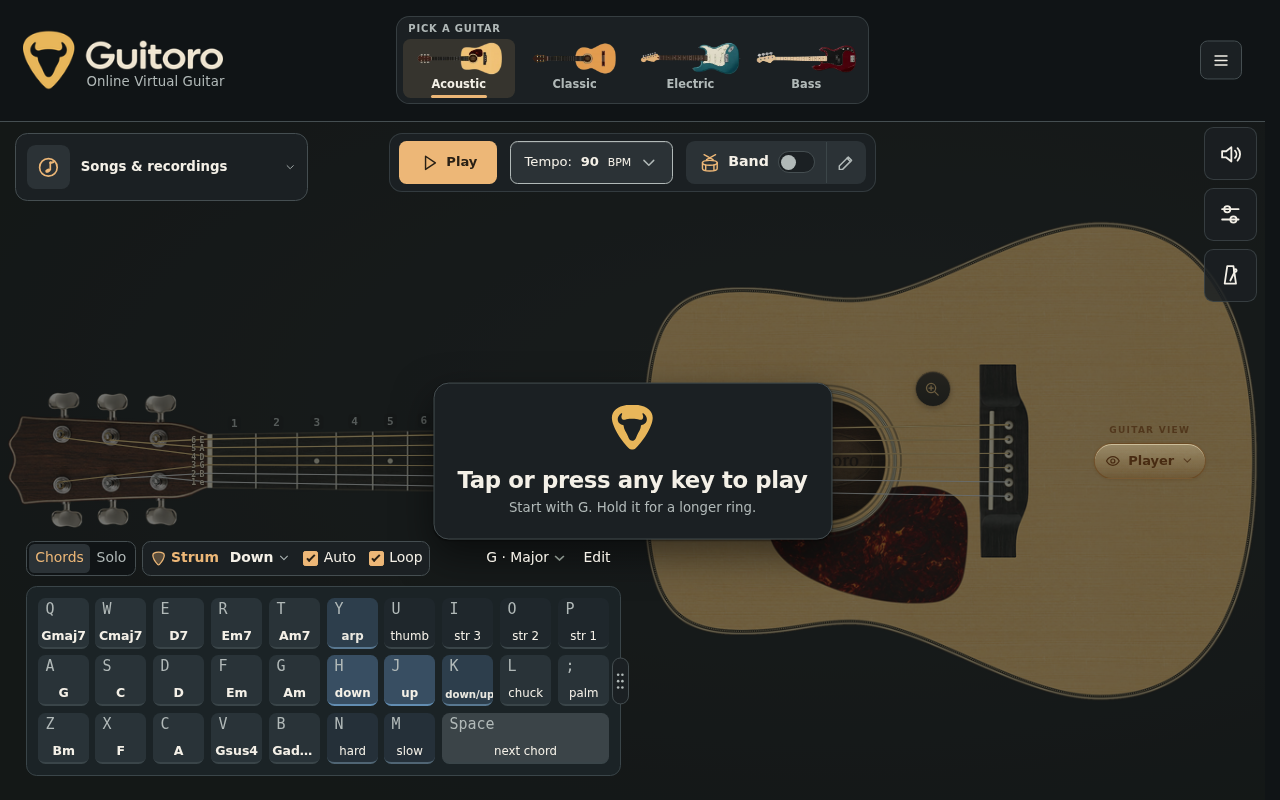
Unlike traditional music production software, Guitoro doesn't aim for complex arrangement features. Instead, it focuses on the interaction method itself. It tries to solve a specific problem: when you don't have a physical guitar on hand and don't want to learn a complicated MIDI controller, can you rely on the most familiar input device—the keyboard—to quickly get the experience of playing a guitar?
This idea isn't entirely new. For years, developers have been trying to lower the barrier to music creation, from browser-based virtual pianos to various online metronomes. But Guitoro chose the "guitar" category and launched on Show HN, suggesting it may have differentiated itself in certain experience details.
Playing Guitar with a Keyboard: Where's the Difficulty
If it were just mapping each key to a note, it would be yet another online scale tool. What truly makes "keyboard guitar playing" challenging are the actions in guitar performance that can't be simply replaced by key presses.
The rhythmic feel of strumming. One of the guitar's most recognizable sounds comes from strumming, and the essence of strumming is multiple strings sounding in rapid succession within an extremely short time. The keyboard is a discrete, individually-triggered input device. To simulate this "connected string" effect, you need to compress time and layer timbres at the software level.
Mapping chords and fingerings. On a real guitar, a chord corresponds to a set of finger placements on the strings. Moving this to the keyboard requires designing an intuitive mapping scheme so that when users press a certain combination of keys, they hear the corresponding chord rather than a bunch of isolated notes.
Timbre and dynamics. The same chord sounds completely different when strummed lightly versus heavily. Keyboards have no velocity sensitivity, so the software can only infer playing intent through key duration, combination patterns, or other auxiliary inputs.
These difficulties determine Guitoro's success or failure: whether it's just a toy or a tool that can actually be used to make some music depends on how it handles the above details.
The basic mechanics of MIDI and virtual instruments. To understand projects like Guitoro, you first need to understand MIDI (Musical Instrument Digital Interface). MIDI is not an audio file, but a protocol describing performance actions: it records "which note, at what velocity, when pressed, when released," not the sound itself. Virtual instruments (VST, AU, and other plugins) receive MIDI events and then synthesize specific timbres through sampling or physical modeling. This means "keyboard guitar playing" is technically a layer of mapping: translating key events into MIDI note events, then handing them to a guitar sound source for sound production. How the mapping layer is designed directly determines whether the performance feels natural—this is also the key to distinguishing a toy from a tool.
Two approaches to timbre: sampling and physical modeling. Guitar timbres are usually generated in two ways. The sampling method pre-records real guitar sounds at various pitches and velocities, calling them up as needed during playback. Its advantage is realism; its disadvantages are large file size and stiff dynamic transitions. Physical modeling uses algorithms to simulate string vibration, the resonance chamber, and plucking actions. Its advantages are continuously adjustable parameters and the ability to express subtle velocity changes; its disadvantages are high computational requirements and timbres that may not sound enough "like" a real guitar. Which approach Guitoro chooses will directly affect its competitiveness in "sound quality."
What Launching on Show HN Means
Choosing to launch on Show HN itself conveys certain signals. Hacker News's audience is primarily developers and tech professionals, and projects in this section usually have several characteristics: open source, immediately playable, and authors willing to directly face feedback from the technical community.
For Guitoro, this means it's very likely an open-source project (or at least has a publicly accessible demo), and the author hopes to get genuine opinions about technical implementation and interaction design, not just traffic.
From a broader perspective, Guitoro represents a persistent direction in the music tools field: redefining the physical boundaries of performance with software. Physical instruments are limited by physical form and manufacturing cost, while software instruments can boldly recombine input and output. Keyboard guitar, mouse as drumstick, touchscreen for slides—these attempts may not all succeed, but together they expand the meaning of the word "performance."
How Show HN works. Show HN is a section on Hacker News specifically for showcasing works by individuals or small teams, with launch posts typically starting with "Show HN:". Its difference from regular posts lies in community conventions: authors should provide accessible links and try to respond to technical questions in the comments. Since Hacker News's ranking algorithm is based on votes and time decay, a project that gains enough attention in the first few hours can reach the front page for massive exposure; otherwise, it quickly sinks. Therefore, a Show HN launch is more like a "technical roadshow," where success often depends on whether the first version is playable enough and whether the author honestly faces criticism. This environment is both advantageous and stressful for Guitoro: feedback is direct and professional, but also merciless.
Who Should Try Guitoro
If you belong to any of the following groups, Guitoro is worth checking out:
- People with a keyboard but no guitar: Those who want to casually play a few chords without investing money and space in an instrument.
- Programmers' music experiments: Those interested in technical topics like interaction design, audio synthesis, and key mapping, wanting to see how others have handled them.
- Lightweight music creation needs: Those who need to quickly record a chord progression or riff idea without demanding professional sound quality.
Conversely, if you're after authentic playing feel and timbre performance, no keyboard simulation scheme can fully replace a physical guitar. Guitoro is positioned more as an "entry point for inspiration" than an "endpoint for performance."
Common Challenges for Such Projects
Virtual instrument projects often can't escape a dilemma: stunning demo, difficult retention. On first experience, the novelty of producing sound with a keyboard is strong; but for sustained use, users will start comparing it with real instruments and mature DAW plugins.
For Guitoro to break out of this dilemma, it may need to provide answers in two directions. One is sound quality—whether it can offer guitar timbres people are willing to listen to repeatedly. The other is the learning curve—whether its key mapping allows people to get started within minutes, rather than requiring reading a manual first.
Show HN's comment section usually points out these issues bluntly. For a newly launched project, this is precisely the most valuable source of feedback.
Related articles

Workbuddy for Absolute Beginners: How a Desktop AI Agent Fits Into Real Workflows
A beginner's guide to the Workbuddy desktop AI agent: installation, claiming credits, file management, and building automated workflows—compared with CodeX for fit and cost, helping professionals shift from AI question-askers to AI managers.

OpenAI's New Agent Stack: Computer Use, Decisions API, and Ultra-Fast Workflows
OpenAI Dev Day unveiled a new agent stack: Computer Use outperforms humans, Decisions API delivers ultra-low-latency classification via Luna, Agents API opens the same Computer Use capabilities, and GPT-6.1 Sol costs only one-seventh of Astra. Core updates, benchmark data, and developer insights.

Liang Wenfeng Open-Sources DeepInfo Inference Framework, Takes On U.S. Ban
DeepSeek open-sources its DeepInfo inference framework after its models, featuring GPU/CPU cross-pipelining, small-model prediction with large-model verification, and full Huawei Ascend and NVIDIA chip support—facing the U.S. federal ban head-on. This article analyzes its significance for AI deployment and open-source strategy.