Gym-Anything: Building Robot Simulation Environments with Coding Agents

Hand robot simulation creation to coding agents so simulation capacity auto-scales with AI coding ability.
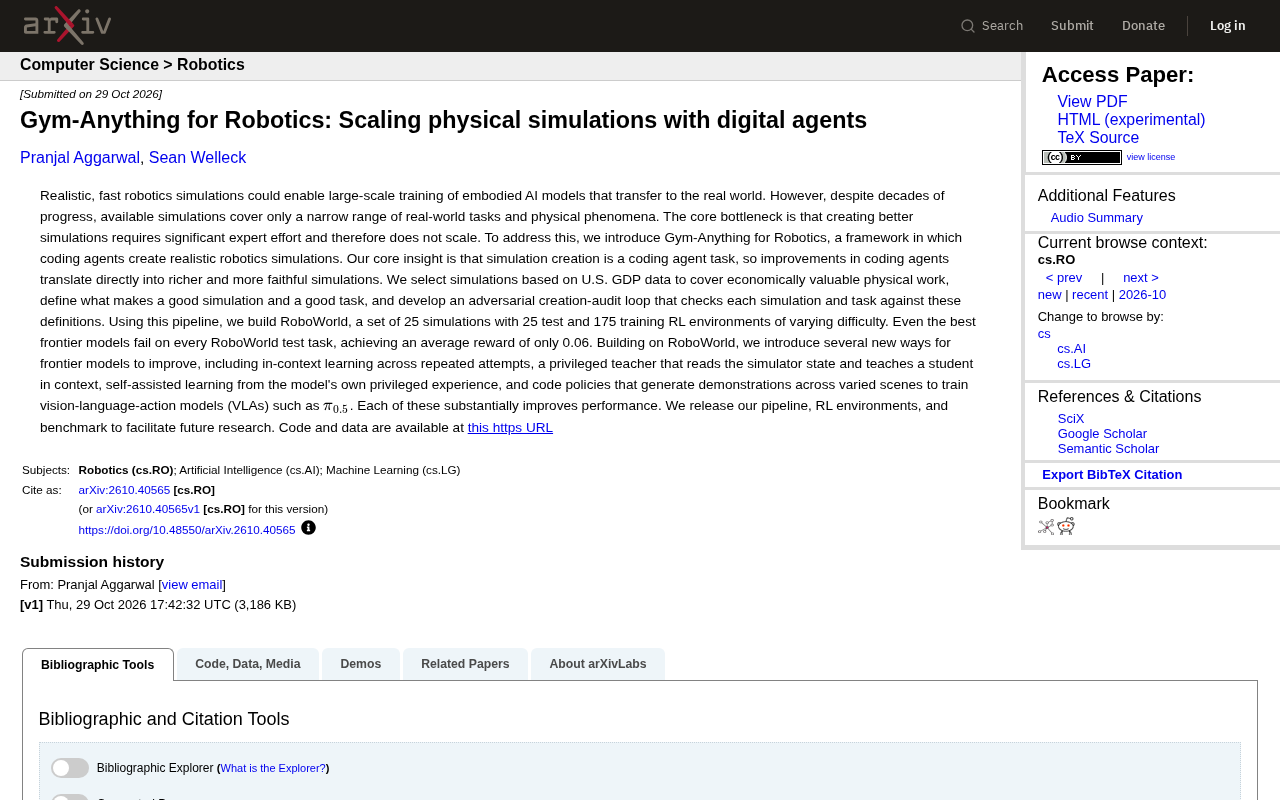
The core bottleneck of robot simulation isn't algorithms but that high-quality environments require expert manual construction, with cost rising linearly with task count—the supply side is capped by human capacity. Gym-Anything for Robotics models simulation creation as a coding-agent task, so coding advances translate into richer, more physically realistic simulations. It picks economically valuable physical labor based on U.S. GDP data and uses an adversarial creation–audit loop to keep a quality floor. The resulting RoboWorld has 25 simulations with 25 test and 175 training RL environments; the strongest frontier model fails every test task with an average reward of only 0.06, exposing structural weaknesses on long-horizon physical tasks. The paper also offers four improvement paths, and the pipeline and benchmark are fully open-sourced.
The pain point of robot simulation isn't the algorithms—it's that there are too few environments, and they're too narrow. Gym-Anything for Robotics, proposed by UC Berkeley and other institutions, attempts to hand off "building simulations" itself to coding agents, turning simulation creation into a scalable code task.
Why Robot Simulation Can't Scale
Training embodied AI models relies on large-scale, diverse simulation environments. But in reality, the available simulations cover only a very narrow class of tasks and physical phenomena—far removed from the richness of the real world.
The core bottleneck isn't hidden: building a high-quality simulation requires experts to invest substantial manual effort, and the cost rises linearly with the number of tasks, making it impossible to scale. In other words, the supply side of simulation is capped by human production capacity.
Gym-Anything's judgment is that if simulation creation can be framed as a coding-agent task, then improvements in coding-agent capability will translate directly into richer, more physically faithful simulations. This is an approach that ties "simulation capacity" to the progress curve of AI programming ability.
Embodied AI refers to the paradigm of learning intelligence through a perception–decision–action loop in a physical or simulated environment. Unlike models that only process text or images, its training signal comes from interaction outcomes with the environment. Reinforcement learning (RL) training in particular relies on large numbers of resettable, parallelizable environment instances, because policies need millions of trial-and-error attempts to converge. Simulators provide a low-cost, reproducible, and accelerable venue for interaction, but each simulation environment itself still requires humans to build scenes, write physics parameters, and define task rewards—this constitutes the supply-side bottleneck. The gap between simulated environments and the real world is called the "sim-to-real gap." The more uniform the environments, the greater the performance decay when a policy is transferred to real robots. Environment diversity is therefore itself one of the determining factors of a model's generalization ability.
Reverse-Engineering Which Simulations to Build from GDP Data
An easily overlooked design question is: which tasks should be simulated first? Gym-Anything's approach is to select them based on U.S. GDP data, so that simulations cover physical labor with economic value, rather than picking a few flashy scenarios on intuition.
This brings two benefits. First, the task distribution has a real-world basis, avoiding the skew common in benchmarks. Second, it provides a discussable external standard for "whether a simulation is worth building."
The framework also explicitly defines what counts as a good simulation and what counts as a good task, and designs an adversarial creation–audit loop accordingly: agents create simulations and tasks, and the audit stage checks each item against the definitions. This self-adversarial structure is meant to maintain a quality floor even without human review.
RoboWorld: 25 Simulations, 200 RL Environments
Following this pipeline, the team built RoboWorld, containing 25 simulations—25 test and 175 training reinforcement learning environments in total—with difficulty spread across multiple levels.
The benchmark results are quite blunt: even the strongest current frontier models fail on every test task in RoboWorld, with an average reward of only 0.06. This number doesn't show that models are "not good enough yet"—it shows that existing models have structural shortcomings on long-horizon robotic tasks with explicit physical constraints.
Reinforcement learning environments typically consist of three parts: the state space (the set of all observable quantities inside the simulator), the action space (the control commands the robot can execute), and the reward function (scalar feedback for each step's behavior). A "test RL environment" refers to one used only to evaluate policy performance and not for training; a "training environment" is one from which the agent repeatedly samples to update its policy. An average reward of 0.06 means that, on a score normalized to [0,1], the model can barely complete tasks—especially common in long-horizon tasks, which require consecutive correct decisions across many steps, where any single misstep causes the entire trajectory to fail, thus demanding far more planning and physical common sense than single-step manipulation tasks.
Four Paths to Improvement
RoboWorld isn't just an evaluation set—the paper also offers several concrete methods for making frontier models stronger.
In-context learning through repeated attempts lets the model accumulate signal across multiple trial-and-error runs on the same task. The privileged teacher approach reads the simulator's internal state and teaches that knowledge to the student model in context. Self-assisted learning uses the model's own privileged experience to feed back into itself. The code policy method generates cross-scene demonstration data used to train vision-language-action models (VLAs), such as π₀.₅.
Each path brings significant improvements. The "privileged teacher" design is particularly intriguing: the simulator's full state is usually unavailable on a real robot, but during training it's a free high-quality supervision signal—precisely one of simulation's core advantages over reality.
A vision-language-action model (VLA) is a class of model that maps visual observations and natural-language instructions to robot action sequences; π₀.₅ is a representative open-source work in this area. VLA training requires large amounts of "observation–instruction–action" triplet demonstration data, and collecting demonstrations on real robots is extremely costly—simulation can generate such data in bulk. A code policy refers to representing a policy with executable code rather than neural network weights; its advantage is that the same piece of code can be replayed under different scene parameters, thereby cheaply producing cross-scene demonstration variants. A privileged teacher is a variant of knowledge distillation: the teacher accesses extra information at training time that is invisible to the student at deployment (such as the simulator's precise object poses and velocities), compressing decision knowledge into a student model that can only see raw observations.
What This Really Means
Handing simulation creation to coding agents is essentially finding a data pipeline for robotics research that automatically expands with AI programming capability. As coding agents get stronger, simulations become richer and more realistic, and the ceiling on training data rises accordingly.
Risks exist as well. As the adversarial audit loop grows more complex, whether quality can be maintained depends on how rigorous the definitions are; and selecting tasks by economic value may steer the benchmark away from directions that are academically meaningful but of low commercial value.
The team has open-sourced the pipeline, RL environments, and benchmark; code and data are available at gym-anything.github.io/robotics. For teams working on embodied AI and VLA training, this is an environment-supply solution they can adopt directly.
One-line Summary
Hand robot simulation creation to coding agents, so simulation capacity automatically scales with AI programming capability.
Paragraph Summary
The core bottleneck of robot simulation isn't algorithms but that high-quality environments require expert manual construction, with cost rising linearly with the number of tasks—the supply side is capped by human capacity. Gym-Anything for Robotics, proposed by UC Berkeley and other institutions, models simulation creation as a coding-agent task, so that advances in coding capability translate directly into richer, more physically realistic simulations. The framework selects economically valuable physical labor as simulation targets based on U.S. GDP data, and uses an adversarial creation–audit loop to maintain a quality floor in the absence of human review. The resulting RoboWorld contains 25 simulations and 25 test plus 175 training RL environments; the strongest frontier model fails every test task with an average reward of just 0.06, exposing structural shortcomings on long-horizon physical tasks. The paper also offers four improvement paths—repeated in-context attempts, privileged teachers, self-assisted learning, and code policies for generating VLA demonstrations—with the pipeline and benchmark fully open-sourced.
Related articles

Vibe Coding Full-Stack in Practice: AI Programming from Beginner to Enterprise Deployment
From Cursor to Claude Code, this Bilibili AI programming course uses four progressive projects to cover full-stack development, open-source secondary development, and team collaboration. The article analyzes the shock to frontend roles, the efficiency shift from 50 people to 5, and the methodology required for enterprise-grade projects.

David Blaine's Global Quest for Real Magic: From South Africa to Japan and India
David Blaine travels to South Africa, Japan, and India in his Do Not Attempt special, documenting Spinning drivers, black mamba rescuers, iaijutsu masters, and ascetics—exploring the boundary between magic and real human极限 challenges.

Is a Touchscreen MacBook Coming? Vergecast Reveals Apple Executive's Response
Vergecast podcast reveals a conversation between a reporter and Apple executive John Ternus about a touchscreen MacBook and Apple Pencil support. Ternus says iPad is the best device for a stylus, while the reporter bets MacBook will eventually support Apple Pencil.