ha-mcp: Automate Home Assistant with Claude and ChatGPT

Open-source ha-mcp uses MCP protocol to let AI assistants configure and automate Home Assistant in natural language.
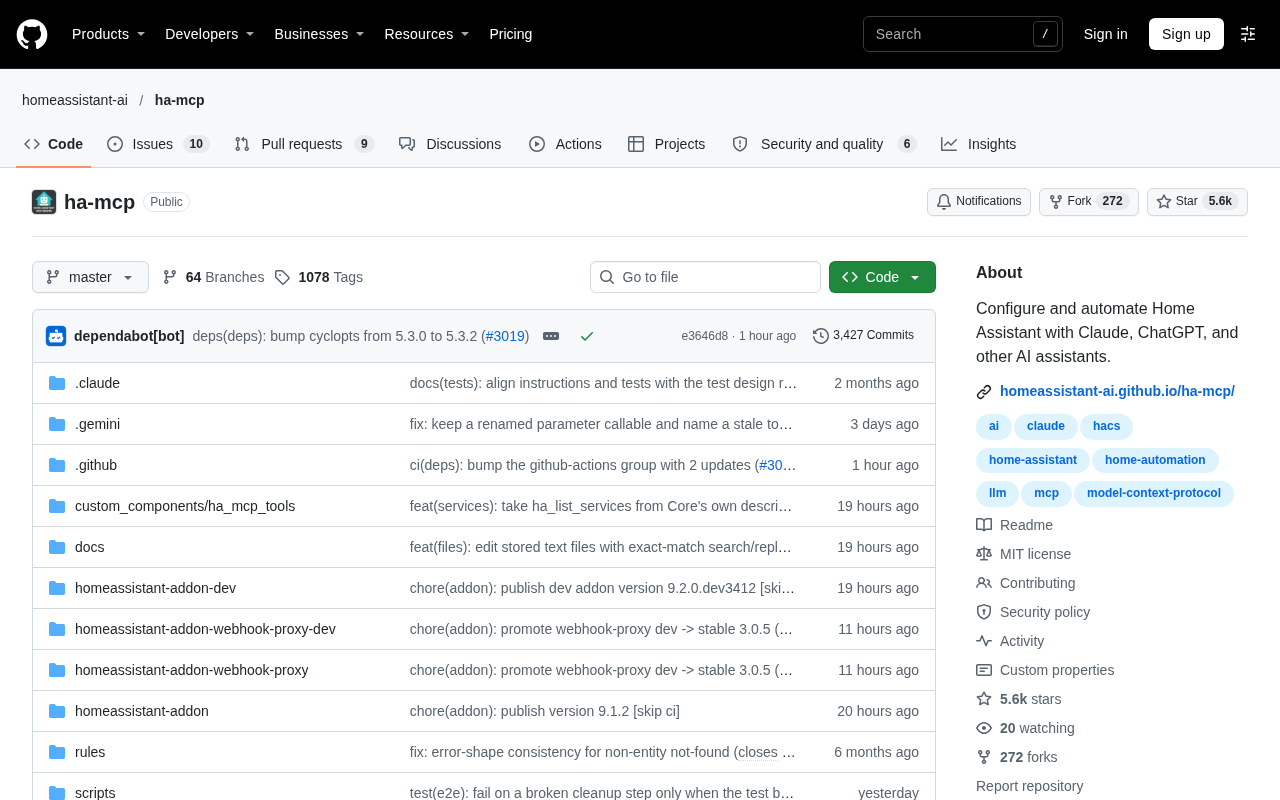
ha-mcp is an open-source project built on the Model Context Protocol (MCP) that lets AI assistants like Claude and ChatGPT control Home Assistant through natural language. Written in Python, it supports device control, automation creation, and configuration assistance. With 5,527 stars and 270 forks on GitHub and 31 new stars today, community interest is rising. MCP gives AI structured tool-calling capabilities, shifting smart home configuration from coding to conversation. Security, reliability, and deployment complexity remain challenges, making it best suited for existing Home Assistant users and developers exploring AI + IoT.
The barrier to entry for smart homes is quietly being lowered by AI. The open-source GitHub project homeassistant-ai/ha-mcp lets users configure and automate Home Assistant directly through natural language commands given to AI assistants like Claude and ChatGPT. The project has already earned 5,527 stars and 270 forks, with 31 new stars today alone—its popularity is hard to ignore.
Project Core: Where MCP Protocol Meets Smart Home
ha-mcp is built on the Model Context Protocol (MCP). MCP is a protocol that enables AI assistants to safely and structurally invoke external tools and services. Through it, AI assistants no longer just generate text—they can actually control devices in Home Assistant, read states, and execute automations.
The project's positioning is clear: make AI the "operator" of Home Assistant. Users no longer need to juggle between YAML and the UI. They simply describe their intent to Claude or ChatGPT, and the MCP server translates that intent into executable operations within Home Assistant. This means smart home configuration and automation shift from "writing code" to "stating requirements," dramatically lowering the barrier to entry.
Model Context Protocol (MCP) is an open protocol launched by Anthropic in late 2024, designed to provide a standardized communication method between AI assistants and external tools and data sources. Its core idea is "tools as a service": developers implement MCP servers that expose domain-specific capabilities (such as file operations, database queries, or smart home control) as a set of structured tools, and AI assistants act as clients that dynamically invoke these tools based on user intent. MCP uses JSON-RPC 2.0 as its message format, supports both local processes and remote HTTP transports, and includes built-in permission control mechanisms (e.g., tool calls require user confirmation). Compared to traditional function calling, MCP emphasizes cross-platform and cross-model interoperability, allowing the same MCP server to be reused by different AI assistants like Claude and ChatGPT, thereby reducing ecosystem fragmentation.
Language and Ecosystem: Powered by Python
The project uses Python as its implementation language, which aligns closely with Home Assistant's own tech stack. This choice lowers the cost of secondary development for developers and makes deployment easier for users—whether running locally or in containers, the Python ecosystem offers mature toolchain support.
On GitHub, the project has been forked by 270 repositories, indicating that many developers are already trying to build extensions or adaptations on top of it. The 5,527 stars reflect community recognition of the "AI + smart home" direction.
Home Assistant is an open-source smart home platform built on Python, featuring an event-driven architecture and modular integrations design that supports thousands of devices and services. Its core concepts include entities, states, services, and automations. Entities represent devices or sensors, states are the current values of entities, services are executable operations, and automations are rules composed of triggers, conditions, and actions. Home Assistant configuration is typically done through YAML files or the UI, which poses a barrier for non-technical users. As an MCP server, ha-mcp essentially wraps Home Assistant's REST API and WebSocket API into tools that AI can invoke, enabling AI assistants to query entity states, call services, create automations, and more. This architecture means AI assistants don't need to handle low-level YAML or API details directly—they only need to understand user intent and invoke the appropriate tools.
Practical Use: What Can It Do?
According to the project description, ha-mcp aims to "configure and automate" Home Assistant. In real-world scenarios, this covers:
- Device control: Use conversation to have AI turn on lights, adjust temperature, or query sensor states.
- Automation creation: Describe rules in natural language (e.g., "turn on the hallway light after sunset every day") and let AI generate the corresponding automation configuration.
- Configuration assistance: Have AI help review and adjust Home Assistant configuration items, reducing manual editing errors.
Although the original material doesn't disclose specific API details, based on the project's positioning and MCP protocol capabilities, its focus is on reducing operational friction, enabling non-expert users to efficiently manage their smart homes. For users already familiar with Home Assistant, it offers a faster way to interact.
The ambiguity of natural language commands is one of the main challenges when AI controls smart homes. For example, when a user says "turn on the hallway light," the AI needs to determine which specific light entity is meant, whether to adjust brightness or color temperature, and whether to consider current ambient light. MCP servers typically need well-designed tool descriptions and parameter schemas to guide AI in generating accurate calls. Additionally, AI models themselves may produce "hallucinations," calling non-existent services or passing incorrect parameters. Therefore, in actual deployment, it's recommended to enable MCP's permission confirmation mechanism or combine it with Home Assistant's automation conditions and scripts for secondary validation. For critical operations (such as door locks or security), human confirmation steps should be set up to avoid accidental actions.
Community Signals and Potential Challenges
With 31 new stars today, the project is clearly in its early growth phase. The scale of 5,527 stars and 270 forks puts it at a noteworthy level among open-source smart home projects on GitHub.
However, the MCP approach also raises some questions worth considering:
- Security: Once AI assistants gain device control permissions, how do we prevent accidental or malicious invocations?
- Reliability: The ambiguity of natural language commands may cause execution results to deviate from expectations, requiring users to develop verification habits.
- Configuration complexity: While the project lowers the barrier to using Home Assistant, deploying and authenticating the MCP service itself may still pose challenges for ordinary users.
The answers to these questions depend on the project's future documentation improvements and community practices.
Who Is It For?
ha-mcp currently suits two types of people: first, smart home enthusiasts who already run Home Assistant and want to use AI to boost efficiency; second, developers interested in the MCP protocol who want to explore the intersection of AI and IoT. If you're still on the fence about getting into Home Assistant, this project could be a good "catalyst"—it brings smart home automation closer to natural conversation rather than code.
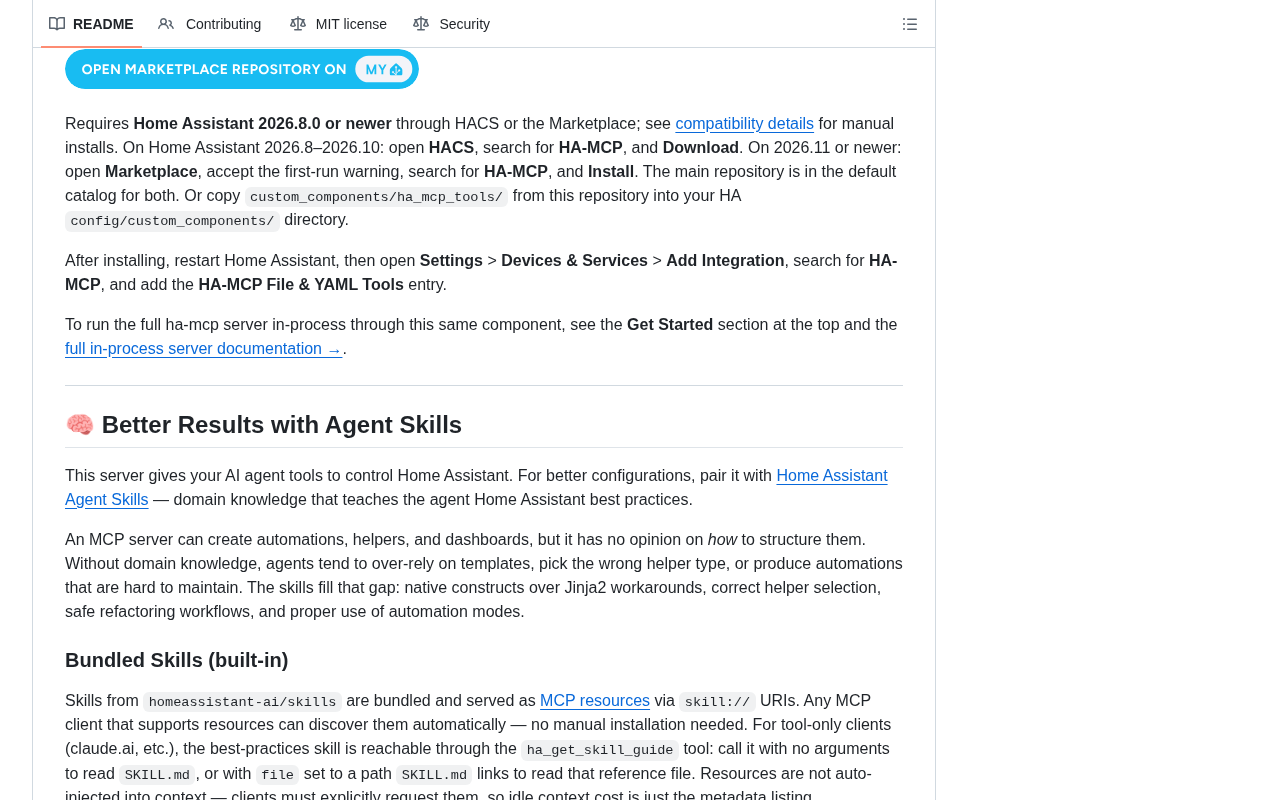
The project is written in Python and open-sourced on GitHub. Interested users can directly review the source code and documentation to assess whether it meets their needs.
One-line Summary
Open-source project ha-mcp uses the MCP protocol to let AI assistants configure and automate Home Assistant through natural language, lowering the barrier to smart homes.
Paragraph Summary
ha-mcp is an open-source project based on the Model Context Protocol (MCP) that enables AI assistants like Claude and ChatGPT to directly control Home Assistant through natural language. Written in Python and aligned with Home Assistant's tech stack, it supports device control, automation creation, and configuration assistance. It has earned 5,527 stars and 270 forks on GitHub, with 31 new stars today, showing growing community interest. The MCP protocol gives AI the ability to structurally invoke external tools, transforming smart home configuration from writing code to stating requirements. However, security, reliability, and deployment complexity remain potential challenges, making the project better suited for Home Assistant users and developers interested in exploring the intersection of AI and IoT.
Related articles

Loop Engineering Primer: Agent Loop and Intelligent Agent Loop Design in Practice
Starting from Agent Loop, this article breaks down Loop Engineering: how agents differ from LLMs in tool calling and memory, while-loop implementations, termination conditions, tool boundaries, and context management.

The Ultimate Bilibili Guide to Codex: From Installation to Hands-On Practice, Let AI Operate Your Computer
A full breakdown of the Bilibili step-by-step Codex tutorial: installing from the app store, configuring Everyday Work mode, project folder management, organizing messy files, generating Excel summary tables, and building a visual dashboard with Plan Mode, plus practical tips for beginners.

Decoding the Underlying Logic of Large Models: A Practical Introduction from Prompts to Agents
From the Transformer dividing line to the large-model training pipeline and applications in education, healthcare, and office work, this systematically explains the underlying logic and practical use of large models.