Hacking a $27 Smart Watch with Claude: A Practical Guide to AI-Assisted Reverse Engineering

Using Claude AI to reverse-engineer a $27 smart watch, demonstrating how AI lowers hardware hacking barriers.
A developer used Anthropic's Claude to reverse-engineer a cheap $27 smart watch, leveraging AI for BLE protocol analysis, code generation, and rapid iteration. This case demonstrates how LLMs are lowering the barrier to hardware hacking, enabling hobbyists to tackle tasks that once required deep embedded systems expertise, while also highlighting the importance of verifying AI outputs against real hardware.
When Cheap Hardware Meets an AI Assistant
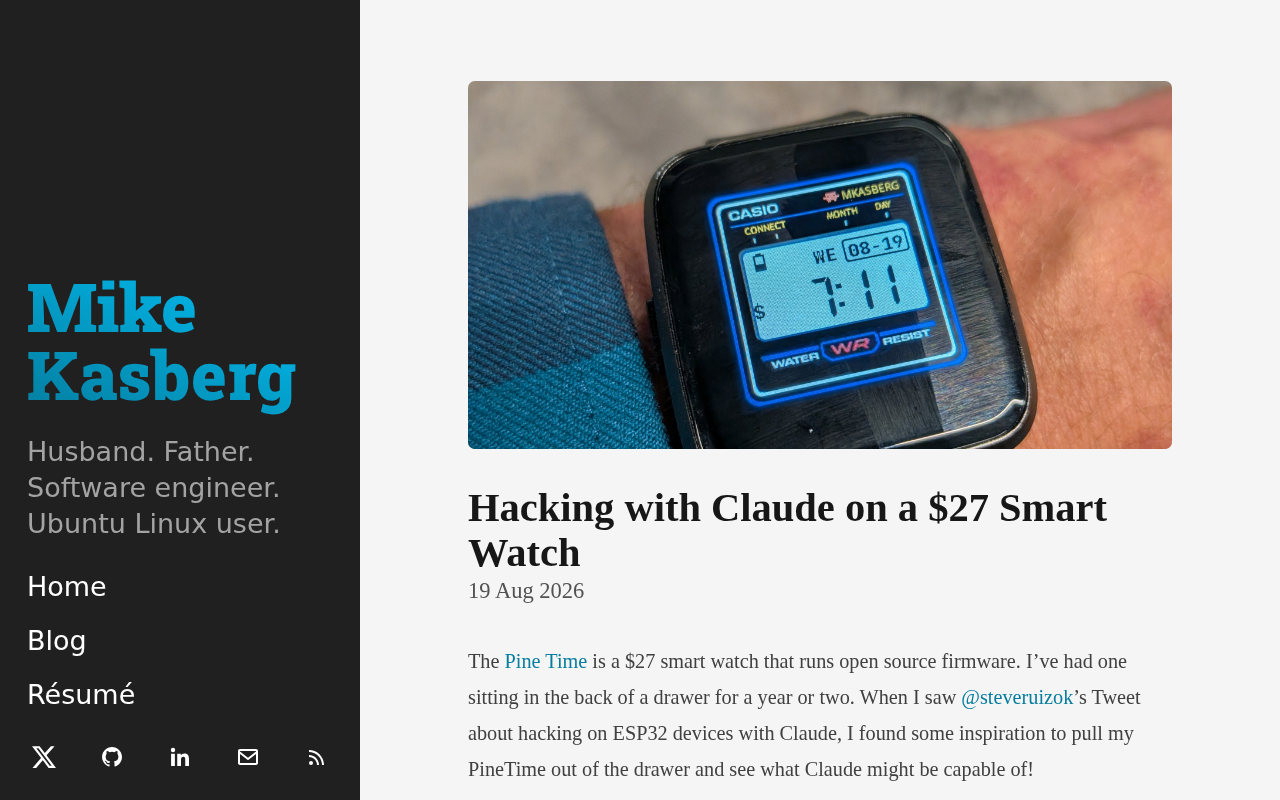
Recently, a technical write-up titled Hacking with Claude on a $27 Smart Watch caught attention on Hacker News. The author used Anthropic's Claude as an intelligent assistant to reverse-engineer and customize a cheap $27 smart watch. This case vividly demonstrates an emerging trend: AI large language models are increasingly becoming powerful tools for hardware hackers and reverse engineering enthusiasts.
For many hardware hobbyists, cheap white-label smart watches have long been ideal experimental subjects. They're inexpensive, typically built around generic Bluetooth chips and display modules, and the loss from a failed experiment is entirely acceptable. These white-label smart watches are usually designed by solution providers in Shenzhen and similar regions, using Bluetooth SoC chips from manufacturers like JL (JieLi Technology), Realtek, BES (Bestechnic), or Nordic. These chips integrate ARM Cortex-M processor cores, Bluetooth Low Energy (BLE) radio modules, and basic sensor interfaces. Solution providers offer complete reference designs and firmware templates, so brand owners only need to swap the casing and watch face UI for rapid production. This industry model means that many different-looking watches actually share the same hardware platform and communication protocol stack, which is a boon for reverse engineering — once you crack the protocol of one device, it often applies to dozens of products based on the same solution.
Historically, the biggest barrier to reverse engineering these devices has been the need for solid embedded systems knowledge, the ability to read obscure datasheets, and the patience to analyze undocumented communication protocols. Now, AI assistants like Claude are significantly lowering that barrier.
How AI Accelerates Smart Watch Reverse Engineering
From Datasheets to Bluetooth Protocol Analysis
In the traditional hardware reverse engineering workflow, developers spend enormous amounts of time reading chip datasheets, capturing Bluetooth communication packets, and guessing the meaning of proprietary protocol fields. This work is often tedious and highly experience-dependent.
Specifically, the Bluetooth Low Energy protocol is based on the GATT (Generic Attribute Profile) architecture, where devices organize data through Services and Characteristics. Reverse engineers typically use tools like nRF Connect, Wireshark paired with an Ubertooth or Nordic nRF52840 Dongle to capture BLE communication packets. Proprietary protocols are often encapsulated within specific Characteristic UUIDs, with data transmitted in custom binary formats whose field meanings have no public documentation. The traditional approach requires comparing packet differences produced by different operations to infer the meaning of each byte — a task demanding significant experience and patience.
With Claude, the author could feed raw captured data, register configurations, or code snippets directly to the model, letting the AI help interpret protocol structures, infer field purposes, and even generate usable control code. The introduction of AI models makes pattern recognition far more efficient — when given multiple sets of data packets, it can quickly identify common protocol structures like frame headers, length fields, command codes, and checksums.
This interactive analysis approach dramatically shortens the path from "staring at a pile of hexadecimal data" to "understanding how the device works." The AI not only provides possible explanations but also continuously refines its inferences based on the developer's feedback from actual test results, forming an efficient exploration loop.
AI Code Generation and Rapid Iterative Development
Beyond protocol analysis, AI assistants also excel at writing driver code and communication scripts. For a cheap smart watch, a developer might want to customize watch faces, read sensor data, or make it perform functions beyond the stock firmware. Claude can quickly generate Python or C code prototypes based on known hardware information, and the developer only needs to verify and fine-tune on real hardware — dramatically improving iteration speed.
This workflow is especially suitable for embedded development beginners — you don't need to write every line of code from scratch. Instead, let the AI generate the initial framework, then gradually refine it based on the hardware's actual responses.
The Broader Significance of Combining Cheap Hardware with AI
Lowering the Barrier to Hardware Exploration and Embedded Development
The reason this $27 watch case deserves attention isn't because the project itself is particularly complex, but because it reveals a new possibility: reverse engineering tasks that previously required seasoned engineers can now be attempted by ordinary hobbyists with AI assistance. This "lowering of the barrier" has profound implications for the entire maker and open-source hardware community.
When a cheap device can be easily modified and reprogrammed, it transforms from a closed consumer product into an open platform for learning and creation. Students, independent developers, and hobbyists can all gain hands-on experience with embedded development and wireless communication at minimal cost.
Community Discussion: Limitations of AI Assistance and IoT Security Concerns
In the Hacker News comments section, the discussion also reflected some practical considerations. On one hand, people acknowledged the value of AI in accelerating exploration; on the other, voices reminded that AI-generated protocol inferences and code are not always reliable — it can "confidently" provide wrong answers (the so-called hallucination problem).
The hallucination problem of large language models is particularly dangerous in hardware development scenarios. In pure software, incorrect code typically only causes program crashes or abnormal output; but in embedded development, wrong register configurations can cause chip overheating, incorrect GPIO levels can burn peripherals, and faulty power management code can even cause physical damage like battery swelling. Additionally, AI might fabricate non-existent register addresses or invent chip capabilities. Therefore, real verification still requires actual testing on hardware — AI is more like an efficient "copilot" rather than a fully trustworthy autopilot. Developers must use datasheets as the ultimate reference and treat AI output as hypotheses to be verified, not instructions to be directly executed.
Furthermore, reverse engineering cheap white-label devices also touches on security and privacy topics. The security issues of cheap IoT devices have been a long-standing focus in the cybersecurity field. Research shows that a large number of low-cost Bluetooth devices have vulnerabilities including plaintext transmission, fixed pairing keys, and lack of firmware signature verification. The BLURtooth vulnerability discovered in 2020 affected devices using Bluetooth 4.0 through 5.0, while the SweynTooth vulnerabilities impacted multiple mainstream BLE chip manufacturers. For white-label smart watches, the health data they collect (heart rate, sleep, activity tracking, etc.) is often transmitted through unencrypted BLE channels to phone apps and then uploaded to cloud servers — any security gap along this chain could lead to user privacy leaks. While reverse engineering exposes these security issues, it also provides the community with opportunities to improve security. This is both the joy of hacker exploration and a reminder for consumers to be aware of potential security risks in cheap IoT devices.
Practical Takeaways for Hardware Enthusiasts
For readers who want to try similar projects, this case offers several practical tips:
Choose an appropriate target device: Prioritize cheap devices with common chip solutions as your starting point. This reduces the cost of failure while increasing the likelihood of finding community resources and technical support.
Use AI wisely but maintain critical thinking: Let AI assistants like Claude handle tedious data analysis and code prototyping, but always validate against real hardware test results. Never blindly trust model output.
Document and share your exploration process: As the original author did, recording the reverse engineering process in detail and sharing it publicly accumulates valuable knowledge and experience for the entire community.
As large model capabilities continue to improve, "AI-assisted hardware hacking" will likely become an increasingly common practice. The combination of cheap hardware and powerful AI is putting the ability to create with one's hands into the reach of more people than ever before.
Key Takeaways
Related articles

JobRunner MCP Server: AI Agents Can Now Fix Failed Java Jobs
JobRunner launches an open-source MCP server enabling AI agents to view cluster status, diagnose failures, and recover Java jobs—incident response from any cloud coding environment or existing agent.

MLAI Digital Launches 9 Security Agents: MCP Server Safeguards the Full Lifecycle of Agentic AI
MLAI Digital launches Security MCP Server with nine built-in specialized security agents covering vulnerability discovery, attack simulation, prompt injection detection, API and infrastructure assessment, and accelerated remediation—embedding security validation across the full Agentic AI lifecycle from development to production.

Running Isaac Lab on H100 GPUs: Exploring Better Approaches
Exploring optimization methods for running Isaac Lab on NVIDIA H100 GPUs, including MIG configuration, mixed precision, TensorRT acceleration, and community experience to improve robotics simulation and reinforcement learning efficiency.