Hacking Group ShinyHunters Claims to Have Breached the FBI, Stealing Agent and Applicant Data

ShinyHunters claims to have breached the FBI and stolen agent data; the FBI has not confirmed the incident.
Hacking group ShinyHunters claims to have breached FBI systems and stolen personal data belonging to agents and job applicants. The FBI has yet to issue official confirmation. Unlike ordinary data breaches, exposed law enforcement personnel data could be used by foreign actors to coerce agents or their families into espionage — constituting a major counterintelligence threat. ShinyHunters is a well-known dark web hacking group with a history of high-profile breaches, though it has also been known to exaggerate its claims, so this remains an unverified allegation.
Overview
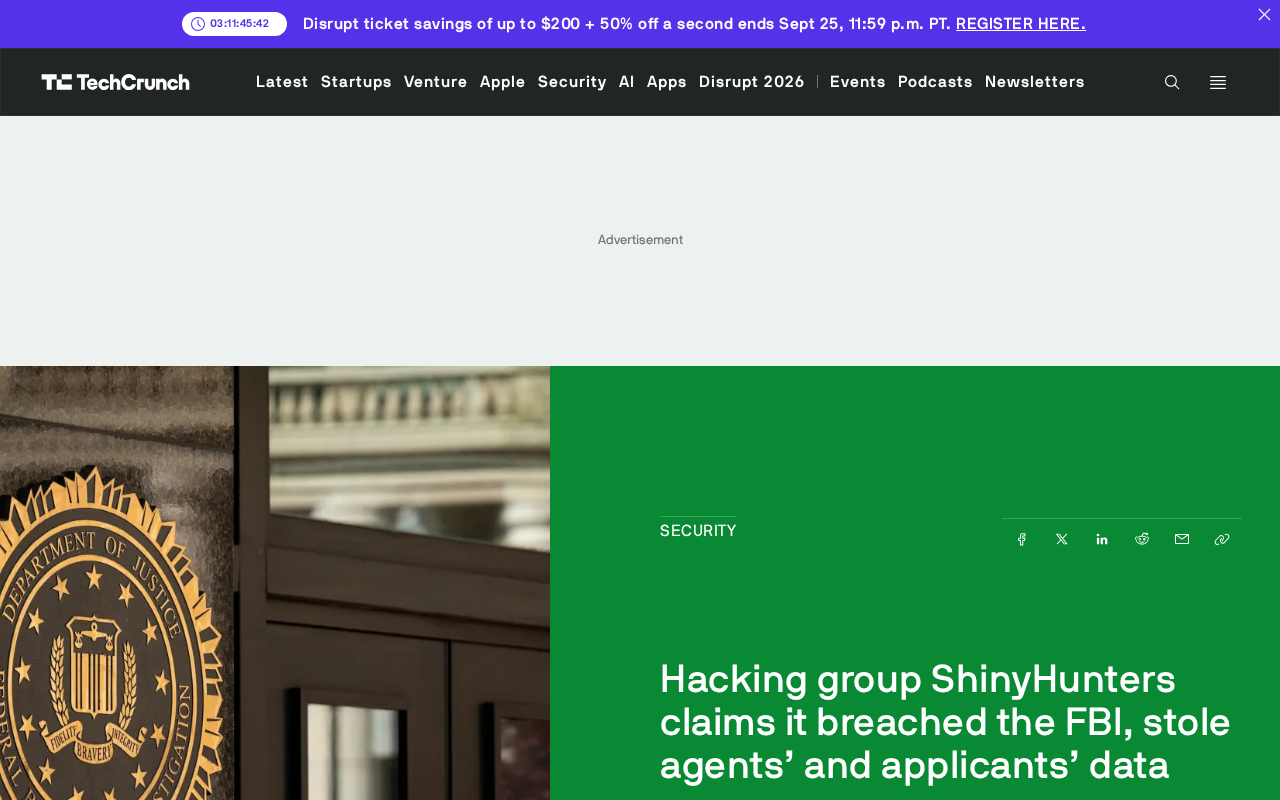
Hacking group ShinyHunters has publicly claimed to have successfully breached systems belonging to the Federal Bureau of Investigation (FBI), stealing a large volume of personal data belonging to FBI agents and job applicants. If the claim proves accurate, this would represent a serious data security incident targeting one of the United States' core law enforcement institutions.
The FBI has not yet issued an official confirmation, and the authenticity and scope of the incident remain pending official verification. However, given ShinyHunters' track record of activity, the security community is treating this claim with considerable caution.
Why Leaking Agent Data Is Especially Dangerous
Unlike typical corporate data breaches, the exposure of law enforcement agents' personal information carries potential harm far beyond financial loss. According to the original report, this data theft may constitute a "significant counterintelligence threat."
The core risk lies in the coercion chain: foreign governments or hostile actors who obtain sensitive information — such as the identities and home addresses of agents and their families — could use it to blackmail those individuals into cooperating with espionage operations or leaking classified material. This "hostage-for-intelligence" model is one of the most feared attack vectors in national security circles.
For applicants still in the hiring process, the background investigation materials they submit often contain highly detailed personal histories. Exposure of this data could equally be leveraged for precisely targeted social engineering attacks.
Who Is ShinyHunters?
ShinyHunters is a hacking collective that has been highly active on dark web forums and underground markets in recent years, known for breaching large corporations and institutions and then selling or publicly releasing the stolen data. The group typically claims high-profile targets to boost its reputation within hacking circles — and to pressure victims into paying ransoms.
It is worth noting that public claims from groups like this often contain exaggerations. There is a long history of hacking groups inflating their achievements or repackaging old data as the result of a new breach. For this reason, until the FBI provides official confirmation, this claim should be treated as an unverified allegation.
ShinyHunters first attracted widespread attention around 2020, when the group began releasing data from dozens of platforms — including Tokopedia, Wishbone, and Microsoft's private GitHub repositories — on the dark web forum RaidForums, affecting a total of hundreds of millions of user records. After RaidForums was shut down by law enforcement in 2022, ShinyHunters migrated to BreachForums to continue operations. In 2023, French judicial authorities issued an international arrest warrant for one of its members, and some members have been indicted by U.S. federal prosecutors, though the group's core operations have continued. Notably, ShinyHunters' preferred attack methods include exploiting misconfigured cloud storage (such as open AWS S3 bucket permissions), third-party supply chain vulnerabilities, and credential stuffing attacks — rather than relying solely on zero-day exploits. This makes even security-conscious organizations difficult to fully immunize. If their claim of attacking the FBI is accurate, it would be the group's most politically sensitive operation to date.
Security Lessons for Institutions
Regardless of whether this particular claim is ultimately substantiated, the incident once again highlights the serious data protection challenges facing sensitive organizations. Law enforcement and intelligence agencies hold high-value target information, making them natural prime targets for both advanced persistent threat (APT) actors and ransomware groups.
For organizations of this nature, strengthening access controls, implementing the principle of least privilege, encrypting and isolating core databases containing personnel identity information, and establishing rapid breach detection and response mechanisms are all necessary measures to reduce these risks. Additionally, once a breach is confirmed, promptly alerting affected agents and their families and activating identity protection measures are critical steps in limiting damage.
Advanced Persistent Threat (APT) refers to high-level attacks funded by nation-states or state-backed organizations, aimed at long-term infiltration and targeted intelligence theft — distinct from ordinary ransomware groups motivated by short-term financial gain. APT actors typically lurk within target networks for months or even years, gradually moving laterally and escalating privileges before exfiltrating data in bulk when the time is right. The reason agencies like the FBI are prime APT targets is precisely because their internal databases store highly valuable classified material, including informant identities, active investigation files, and foreign intelligence-sharing agreements.
The Principle of Least Privilege is a foundational architectural strategy for defending against both internal and external threats: every system user or process is granted only the minimum level of access required to perform their function, thereby minimizing the potential "blast radius" if a single account is compromised.
Conclusion
At this point, the incident remains in a stage where the hacker has made a unilateral claim that has not been officially confirmed. How it unfolds depends on the results of the FBI's investigation and its official response. We will continue to monitor developments regarding verification of this incident and its potential implications.
For readers who follow cybersecurity, this case offers a notable observation: even government agencies with the highest levels of security cannot afford to be complacent in the ongoing battle over data security.
Related articles

Workbuddy for Absolute Beginners: How a Desktop AI Agent Fits Into Real Workflows
A beginner's guide to the Workbuddy desktop AI agent: installation, claiming credits, file management, and building automated workflows—compared with CodeX for fit and cost, helping professionals shift from AI question-askers to AI managers.

OpenAI's New Agent Stack: Computer Use, Decisions API, and Ultra-Fast Workflows
OpenAI Dev Day unveiled a new agent stack: Computer Use outperforms humans, Decisions API delivers ultra-low-latency classification via Luna, Agents API opens the same Computer Use capabilities, and GPT-6.1 Sol costs only one-seventh of Astra. Core updates, benchmark data, and developer insights.

Liang Wenfeng Open-Sources DeepInfo Inference Framework, Takes On U.S. Ban
DeepSeek open-sources its DeepInfo inference framework after its models, featuring GPU/CPU cross-pipelining, small-model prediction with large-model verification, and full Huawei Ascend and NVIDIA chip support—facing the U.S. federal ban head-on. This article analyzes its significance for AI deployment and open-source strategy.