Hacking the 7: Replit's Extreme Building Experiment on the NYC Subway

Replit turned a NYC subway ride into a live demo of idea-to-shipped-app speed.
Replit's "Hacking the 7" event invited 35 makers onto New York's 7 Train and challenged them to go from zero to a deployed app before reaching the last stop. Using the train journey itself as a countdown timer, the event made Replit's low-barrier, cloud-based development tangible and shareable. At its core, it's a polished brand activation designed to showcase Replit's AI-assisted generation and one-click deployment — and signal to potential users that building an app is now within anyone's reach. It also reflects a broader industry shift: AI coding tool competition has moved from feature comparisons to experiential storytelling.
A Coding Challenge Inside a Subway Car
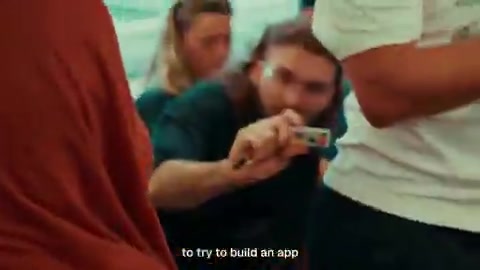
35 makers. One subway line. Ride it from start to finish. That's the premise of Replit's "Hacking the 7" event. They "took over" New York's 7 Train and gave every participant a deceptively simple yet genuinely demanding challenge: build a fully shippable app — from idea to deployed product — before the train reached the last stop.
What makes this setup so clever is how it makes the time constraint tangible. It's not an abstract "30 minutes on the clock" — it's a real journey with a clear beginning and an unmovable end. The city scrolling past the windows becomes a source of inspiration, and the moment the train pulls into the terminal station is the non-negotiable delivery deadline.


Why a "Moving Cityscape" Becomes Creative Fuel
Replit's event description specifically highlighted that the "moving cityscape inspired them to make." Transplanting the act of coding from a quiet office into a noisy, bumpy, ever-changing subway car is itself a challenge to conventional ideas about what a "development environment" should look like.
This setup sends a clear product message: modern AI-assisted coding tools are now lightweight and powerful enough that building a usable app no longer requires complex local environment setup. All you need is a device, a browser, and an internet connection — creation can happen anywhere, even on a subway hurtling through the city at speed. That's exactly what Replit set out to prove: the distance between an idea and a live app is being compressed to its absolute minimum.
The Logic Behind Replit's Product Narrative
"Hacking the 7" is less a competition and more a carefully orchestrated product demo. It packages Replit's core value propositions — rapid prototyping, cloud-based development, one-click deployment — inside a highly shareable urban story.
For the AI coding tools space, events like this matter because they lower the psychological barrier to "building an app." When audiences watch everyday makers go from zero to deployed within a single commute, the tool's ease of use and efficiency are demonstrated in the most visceral way possible. Compared to a feature checklist, this kind of real-world challenge is far more persuasive to potential users: you can do this too.
Replit is a browser-based cloud integrated development environment (Cloud IDE). Users don't need to install any compiler, runtime, or dependency library locally — just open a webpage and start writing, running, and deploying code. Its core differentiator is integrating "editor + runtime + hosted deployment" into a single seamless experience: once the code is written, one button press makes the app live at a public URL. In recent years, Replit has heavily integrated AI-assisted features through Replit Agent, allowing users to describe what they want in plain language and have AI automatically generate a project scaffold or even a complete, runnable application — further compressing the time from idea to prototype. This product design is what makes "finishing an app on the subway" technically feasible: participants don't need to configure an environment or worry about local machine performance, because all the computation happens on cloud servers.
An Industry Signal Worth Watching
Behind this kind of marketing activation lies a broader shift: competition among AI-assisted development tools has entered a "proof-by-experience" phase. Vendors are no longer content to list technical specs — they're using real-world scenarios, time pressure, and creative output to demonstrate what their products can actually do.
Making the act of building public, gamified, and urban also redefines who gets to be a creator. When the barrier to building something is low enough, subway riders and non-professional developers can all become participants. That may be the deeper message "Hacking the 7" is really trying to send.
In the AI coding tools space, Replit's main competitors include GitHub Copilot (Microsoft, focused on code completion), Cursor (an AI-native editor built on VS Code), Lovable, and bolt.new (both centered on generating full-stack apps from natural language). These tools have collectively driven the rise of "vibe coding" — a paradigm where users take on more of a product manager role, describing their intent in plain language while AI handles most of the actual code writing. Events like "Hacking the 7" are a direct response to the commoditization of this space: when technical capabilities start to converge, whoever can tell the more compelling "what's possible" story is the one that wins mindshare.
Wrapping Up
Due to the limited source material available, we can't yet report on exactly what apps those 35 makers built or how polished the results were. But as an expression of brand identity and product philosophy, the event itself lands well: it used a single subway line to make the promise of "idea to shipped app" feel real and immediate. If you're curious about what the makers actually created, Replit has shared links to their work for you to explore.
Related articles

Chain of Thought Isn't Just for AI: How Humans Can Use CoT to Improve Thinking Quality
Chain of Thought isn't just a prompt trick for large models. Starting from a Hacker News discussion, this article analyzes why CoT works for human thinking too, breaks down actionable ways to transfer it, and highlights the key differences between human CoT and machine CoT.
Cloudflare Teams Up with OpenAI: Closi…
Cloudflare Teams Up with OpenAI: Closing the Loop from Vulnerability Discovery to Defense with AI
Cloudflare uses OpenAI Daybreak to investigate security vulnerabilities and generate reviewable remediation plans, while developers use Codex to boost coding efficiency and quality.

Orca Multi-Agent Orchestration in Practice: A Guide to Parallel Collaboration with Claude and Codex
Orca is Stable AI's free open-source agent workbench supporting 34 agents like Claude Code and Codex in parallel. Learn its Git worktree isolation, multi-model orchestration, and mobile management.