Haiku 5.5 Benchmarked Against DeepSeek V4.1 Flash and GPT-6 Luna

Haiku 5.5, DeepSeek V4.1 Flash, and GPT-6 Luna tested head-to-head: no all-around winner, but clear trade-offs.
This article benchmarks Haiku 5.5, DeepSeek V4.1 Flash, and GPT-6 Luna across Chinese creative writing, visual receipt recognition, and 3D agentic coding. Haiku 5.5 wins on writing but has a hidden 5x pricing spike past 100K tokens. Both Haiku and DeepSeek aced all 15 damaged receipts while Luna missed three. On the 3D coding task, DeepSeek produced the best visuals but took nearly an hour; Luna was the only model to include inscriptions but got the orientation wrong; Haiku had the weakest visual output. Each model has clear trade-offs — match the tool to your task.
Right after the National Day holiday, Anthropic launched Haiku 5.5, positioning it as their "fastest and most affordable" model. With small, medium, and large tiers all dropping within half a month, the rapid pace has many reading it as a pre-IPO sprint. Official benchmarks show Haiku 5.5 leading GPT-6 Luna across every listed metric. But paper numbers and real-world experience often diverge. Drawing on hands-on testing from a Bilibili creator, this article evaluates three "fast and cheap" lightweight models — Haiku 5.5, DeepSeek V4.1 Flash, and GPT-6 Luna — across three dimensions: Chinese writing, visual reasoning, and agentic coding, to find out which one actually delivers at this price point.
Tiered Pricing: Targeting Luna, but With a Hidden Cost
Haiku 5.5's pricing strategy takes direct aim at GPT-6 Luna. Within the first 100K tokens, it matches Luna's price and comes in slightly below DeepSeekAd's off-peak rate — highly competitive on the surface. The catch comes later: once input exceeds 100K tokens, Haiku's pricing across all four tiers jumps by 5x, making it even more expensive than DeepSeek's peak rates for large-scale tasks.
This tiered structure means users need to be very careful when handling long documents or long-context tasks, or they'll quietly drift into the expensive tier. The tester bluntly called this model "restrictive to work with," which undermines the "cheapest option" pitch. For developers actually running large workloads, this is a hidden cost that needs to be calculated upfront.
Tiered token pricing is a common strategy in today's LLM API market — essentially a price discrimination model designed to attract users with a low entry point while covering costs at higher volumes. A token is the basic unit of text a model processes; in Chinese, roughly 1 character maps to 1.5–2 tokens, so 100K tokens equals about 50,000–60,000 Chinese characters — equivalent to a mid-length industry report or dozens of rounds of extended conversation. For everyday lightweight queries, this threshold is rarely hit. But in RAG (Retrieval-Augmented Generation), long-document analysis, and multi-step agentic tasks, a single call can easily blow past it. Developers evaluating these models shouldn't just look at the starting price — they need to calculate a weighted per-token cost based on their actual average context length and call frequency to make a truly informed decision.
Chinese Writing: Haiku 5.5 Wins This Round, but Falls Short of Top-Tier Models
The first test reused a prompt from a previous flagship model evaluation: writing Chapter 1 of a full-length novel titled Cultivation Bubble Tea Shop (修真奶茶铺). All three lightweight models were given the same prompt and scored against the same rubric.
On a unified 5-point scale, Haiku 5.5 turned in the best Chinese writing performance of the three. That said, compared to GPT-6 Astra from the previous evaluation, the tester still felt it "fell a bit short" — suggesting lightweight models still have a visible gap behind flagship models when it comes to narrative coherence and literary quality in long-form fiction.
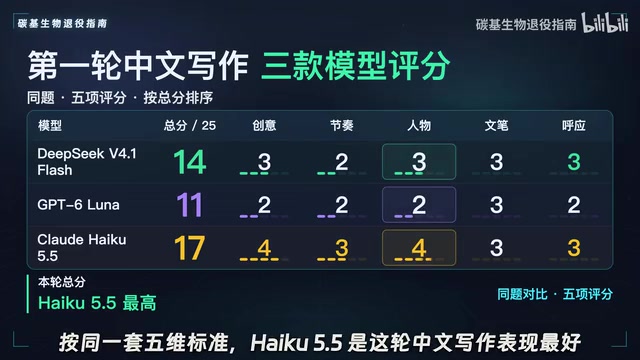
Worth noting: the tester compiled all three models' raw fiction outputs, the full prompt, and the scoring rubric into a shared document, inviting readers to score them using the same standard. This reproducible approach is far more useful than simply reporting a number.
Visual Reasoning: A Hard Test with 15 Receipts
The second round used a task close to real office pain points: identifying 15 receipts from different regions, years, and formats — some faded or damaged, with fields partially obscured or missing entirely. The model needed to recognize the information on the receipt, use context to infer missing content, and avoid "over-imagining" details that introduce hallucinations. The tester estimated a human would need at least 15 minutes to complete this manually.
The results were striking: GPT-6 Luna got three wrong, while Haiku 5.5 and DeepSeek V4.1 Flash (nicknamed "Little Whale" in the video) got all 15 correct. On speed, DeepSeek was twice as fast as Haiku.
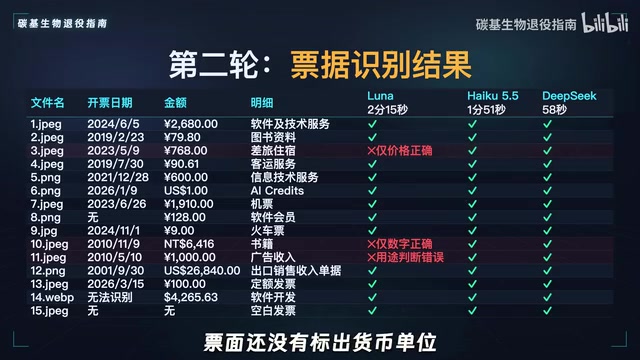
The hardest receipt was number 10 — both the amount and item description were handwritten, and no currency unit was printed anywhere on the form. The model had to first determine which region the receipt was from and then infer the corresponding currency. Luna could barely read anything beyond the numbers, while Haiku and DeepSeek performed "surprisingly well."
The real-world value of this kind of task is clear: faced with yellowed, damaged, or incomplete paper documents, you can photograph or scan them, let a model extract key information and categorize it, flag unclear points for manual review, and compress what might have been a week of work into a single day — if you choose the right method and tool.
Receipt recognition falls under Document Visual Understanding, which requires a model to simultaneously handle OCR (optical character recognition), layout analysis, and cross-field semantic reasoning. Unlike reading clean printed text, damaged receipts also involve image denoising, incomplete information reconstruction, and region-specific common sense inference — for example, using stamps, paper style, or place names to determine the currency system. This type of task demands exceptional hallucination control: too conservative and the model misses information; too speculative and it fabricates details. Most modern multimodal LLMs jointly train a visual encoder with a language model so the model can call on world knowledge from the language side while "seeing" the image — which is exactly why Haiku 5.5 and DeepSeek were able to infer the currency unit on receipt number 10.
Agentic Coding: A 3D Monument Tests Engineering Depth
The third round moved into agentic coding, with the task of building a 3D model of the Monument to the People's Heroes: the camera must orbit 360 degrees continuously, and the lighting must simulate 24 hours of daylight changes. This is a demanding challenge combining 3D modeling, rendering, and software engineering.
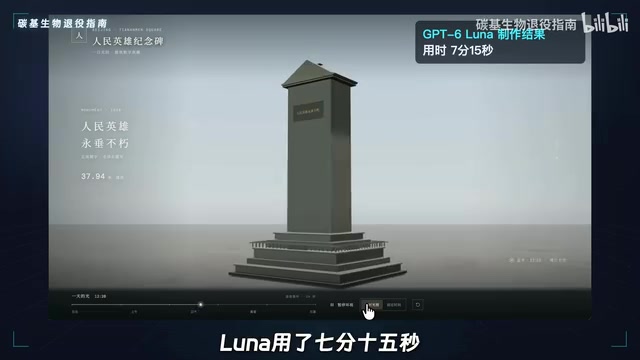
GPT-6 Luna completed the task in 7 minutes 15 seconds and was the only model to include the inscriptions on the monument — but got the orientation wrong, rendering the vertically aligned text horizontally. The rest of the monument lacked detail, and the sunrise/sunset lighting was unconvincing. On the plus side, the code was well-structured and easier to test and maintain.
Haiku 5.5 finished in 8 minutes 23 seconds with the weakest visual output — aside from sunrise/sunset lighting that was relatively realistic, the monument itself was described as "barely watchable." Its code centralizes parameters, which makes tweaking easier.
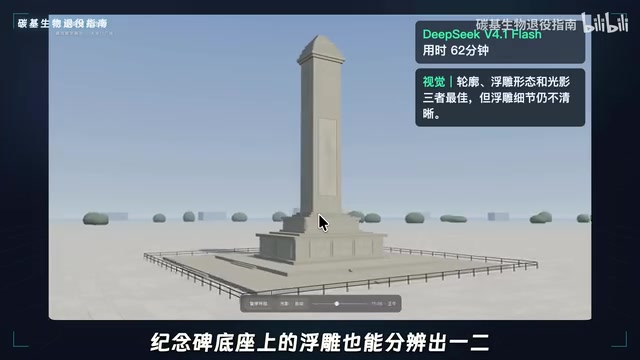
DeepSeek V4.1 Flash produced by far the best result — the bas-relief carvings on the base were actually distinguishable — and the code featured proper functional encapsulation and performance optimization. But it "took a full hour" to complete, and finished during a low-traffic window after 9 PM. The tester joked this speed was "not exactly living up to China's reputation for pace." It also showed some weaknesses in code modularization and testing.
Agentic coding differs fundamentally from standard code completion: the model must autonomously break down the task, decide the order of tool calls, handle error feedback at intermediate steps, and deliver a working end-to-end project — not just fill in a single function body. 3D rendering scenarios are especially complex. Models typically reach for browser-side libraries like Three.js or WebGL and must simultaneously manage geometry construction, material texturing, dynamic lighting, and camera animation. A mistake in any one parameter will affect the final visual output. DeepSeek's ability to render bas-relief detail and encapsulate functionality shows greater maturity in code abstraction and modularity — but the nearly one-hour generation time also exposes a throughput bottleneck that would be a significant constraint in latency-sensitive production environments.
Three-Round Summary: The Trade-Off Between Speed and Quality
After three rounds, the picture is fairly clear: GPT-6 Luna lost badly on task outcomes; DeepSeek V4.1 Flash delivered consistently strong results in both visual and coding tasks, but the cumulative runtime exceeded an hour — speed is its Achilles' heel; Haiku 5.5 led on Chinese writing and held its own on visual reasoning, but fell noticeably short on the 3D coding task.
In other words, none of these three models is an all-around champion. If output quality is your priority, look to DeepSeek — but be prepared to wait. If speed and writing matter more, Haiku 5.5 is worth considering, though watch out for that 5x price jump past 100K tokens. The tester also called on the DeepSeek team to invest more in hardware and bring inference speed up to where it should be.
For everyday users and developers, rather than chasing the "strongest" model in the abstract, the smarter move is to match the model to the task — writing, document extraction, or 3D modeling — and choose accordingly. Picking the right method and tool is what actually drives efficiency.
Related articles

Is the Agent Harness Dead? Cursor's Early Engineer Breaks Down the Real Architecture of AI Coding Agents
Cursor early engineer Jediah breaks down the real architecture of the agent harness: why "the harness is dead" is only half right, how the data flywheel lets the harness obsolete itself, and how Grokbot, software factories, and primitive design open new frontiers for agents.
Python Visitor Pattern and Better Alternatives Explained
A deep dive into Python's visitor pattern and four alternatives: method pattern, pattern matching, dictionary mapping, and functools.singledispatch. Choose the best decoupling design by change frequency.

357 Days of Deep Experience: Why Omarchy Made Me Stop Distro-Hopping
A 357-day deep dive into Omarchy: 59-second install, out-of-the-box audio and GPU support, the Quattro QuickShell rewrite migration pains, and why Arch users should try it.