Half a Brain Built from Human Cells: The Science Behind Chimeric Mice
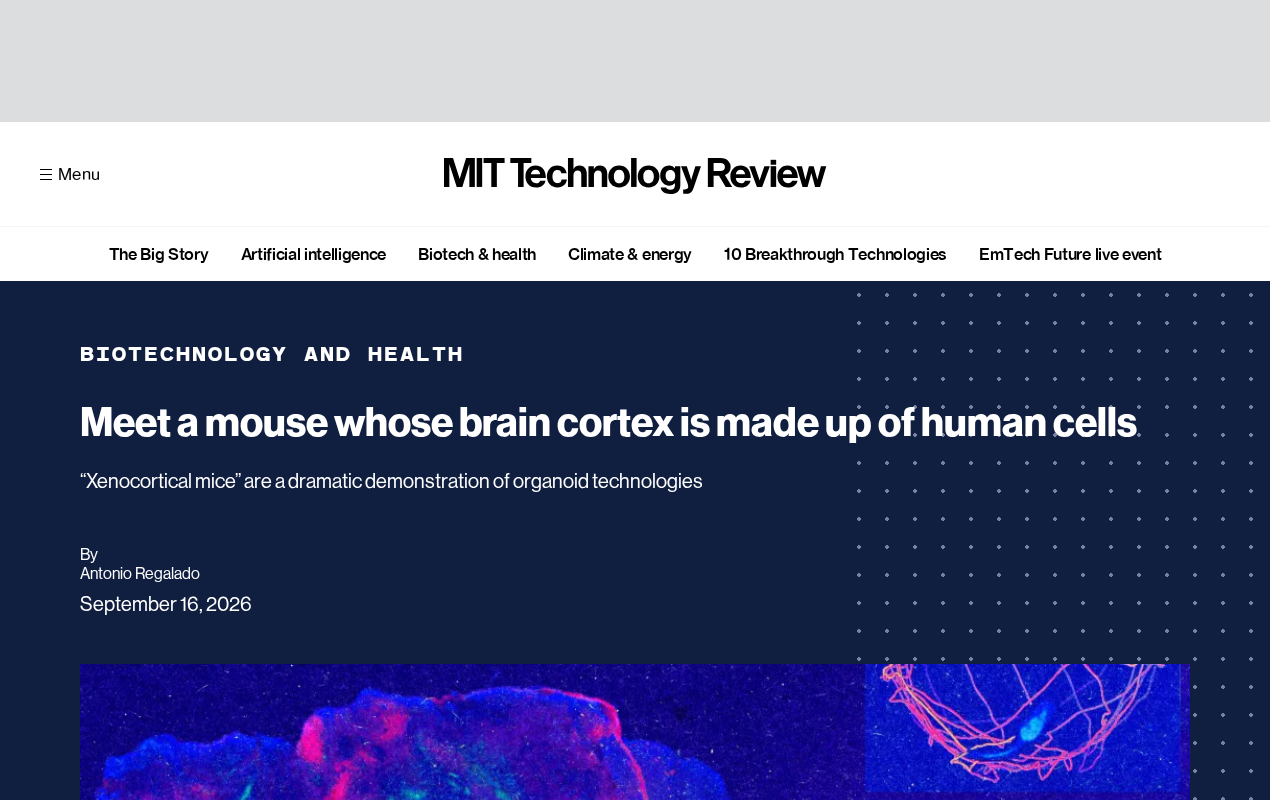
Scientists built a mouse with nearly half its brain made of human cells to study human neurons in a living environment.
Researchers transplanted human neural cells into a mouse cerebral cortex, replacing nearly half its brain volume to create the highest-ratio human-mouse brain chimera to date. By tracking the mouse's behavior with multiple cameras in real time, they confirmed that the foreign cells can integrate into the host's neural circuits and participate in sensory and motor control. The approach aims to overcome the inherent limitations of in vitro organoids — which lack blood supply, immune environment, and complete neural connectivity — providing a new platform for studying human neuron development and disease mechanisms under real physiological conditions. The high proportion of human cells has also sparked ethical debate about the boundaries of animal consciousness and prompted calls to revisit existing regulatory frameworks. Long-term, the model could be applied to pathological research on neurodegenerative diseases like Alzheimer's and to testing novel therapies.
A Closely Watched Mouse
Inside a small experimental enclosure, multiple cameras simultaneously track a mouse's every move. A computer plots its position and speed in real time, tracing movement patterns across the screen not unlike the classic game Pong. It looks like a routine behavioral experiment — but there's an extraordinary fact hidden beneath the surface: nearly half of this rodent's brain volume has been replaced by human cells.
The reason researchers are monitoring this mouse so meticulously is to determine whether these transplanted human neurons have genuinely integrated into the mouse's nervous system and are actively participating in sensory processing, motor control, and behavior. Behavioral performance serves as a critical window into whether the transplanted cells are functioning as intended.
Why Cross-Species Brain Tissue Fusion Matters
Mixing brain tissue from two distantly related species falls under the neuroscience field of "chimera" research. The central goal of these experiments is to create a platform for studying human neural cells within a living biological environment.
The complexity of the human brain presents both ethical and technical barriers to direct study, while organoids grown in vitro cannot fully replicate the blood supply, immune environment, and neural connectivity of a real brain. Transplanting human cells into a mouse cortex allows those cells to grow, mature, and form connections inside a living organism with genuine blood perfusion — opening new possibilities for studying human brain development, disease mechanisms, and drug testing.
Why the Cerebral Cortex?
The cortex is the brain region responsible for higher cognitive functions and a critical site in many neurological diseases. Building a mouse cortex from human cells lets researchers observe how human neurons differentiate, migrate, and integrate into existing neural circuits within a foreign-species environment — offering direct insight into what makes the human brain unique.
Background: Organoids and Their Limitations
Organoids are miniature tissue structures that self-assemble from stem cells under three-dimensional in vitro culture conditions, partially reproducing the cellular composition and spatial organization of real organs. Since their first report in 2013, brain organoids have become important tools for studying human brain development and neurological disease. However, they have several fundamental limitations: the absence of a vascular system causes cells in the interior to die from insufficient oxygen and nutrients; there are no immune cells to participate in regulation; and they cannot form complete sensory input or motor output circuits. These constraints mean organoids more closely resemble early embryonic brain tissue than a mature, functional brain. Chimeric animal models were developed as a complementary strategy to overcome these bottlenecks — using the host animal's circulatory system and neural framework to provide transplanted human cells with a genuine physiological environment.
Background: The Cerebral Cortex
The cerebral cortex is the outermost layer of neural tissue in the mammalian brain, and in humans it is highly folded to accommodate approximately 16 billion neurons. It handles sensory processing, voluntary movement, language, memory, and higher-order reasoning, and is subdivided by region into the frontal, parietal, occipital, and temporal cortices. Human cortex differs significantly from mouse cortex in neuron types, developmental timeline, and laminar structure — human cortical development takes years, while a mouse's takes only weeks, and the human cortex contains a greater diversity of interneuron subtypes. This difference is itself the core entry point for research: by observing how human cortical cells behave inside a mouse brain, scientists can identify which developmental characteristics are intrinsic properties of human neurons and which are shaped by the surrounding environment.
The Ethical Questions That Follow
When nearly half of a mouse's brain volume is made up of human cells, a natural question arises: could this endow the animal with some form of human-like consciousness or cognition? This is the enduring ethical focal point of chimera research.
The current scientific consensus leans toward the view that cellular origin does not equate to the origin of consciousness — the species identity of neural cells, combined with the overall brain architecture, volume, and connectivity, collectively determine functional outcomes. The mouse's skull, body structure, and overall nervous system framework remain firmly in the rodent domain. Nevertheless, as replacement ratios increase and technology advances, this research still demands ongoing ethical oversight and open public discussion to ensure a balance between scientific exploration and moral boundaries.
Background: The Regulatory Landscape
Ethical oversight frameworks for human-animal chimera research vary across countries. The U.S. National Institutes of Health (NIH) paused funding in 2015 for research introducing human pluripotent stem cells into non-human primate embryos, and in 2016 proposed revised oversight rules requiring case-by-case review by a specialized committee. Guidelines from the International Society for Stem Cell Research (ISSCR) classify chimera research as a category requiring enhanced oversight, with particular attention to the extent of human cell integration into the host's germline and brain. The core metrics typically used to assess ethical boundaries include: the proportion of human cells in the host nervous system, the degree of functional integration, and whether the host animal's cognition or perception could be affected. The current research, which pushes the replacement ratio to nearly 50%, has prompted discussion in the scientific community about whether existing regulatory frameworks need corresponding updates.
Looking Ahead: From Model to Application
The value of the chimeric mouse model ultimately depends on whether it can drive real medical progress. If human neural cells can stably perform their functions inside a mouse, researchers could use the model to replicate the pathological processes of neurodegenerative diseases such as Alzheimer's and Parkinson's, or to test novel therapies targeting human neurons.
This kind of platform may also accelerate regenerative medicine, helping scientists understand how to repair or replace damaged brain tissue. Of course, the path from laboratory model to clinical application remains long, encompassing questions of safety, efficacy, and long-term stability. The mouse leaving its movement trails across a small experimental arena represents yet another exploratory step science has taken on the road to understanding the human brain.
Related articles

AI Agent Developer Job Hunt Guide: Four Hard Standards to Clear Before You Apply
A practical guide for landing AI Agent developer roles: four measurable standards — project runs, problems debuggable, solution explainable, interviews survivable.

Multi-Agent Development Guide: From Monolithic AI to Team Collaboration in Practice
A beginner's guide to multi-agent development covering core advantages, common learning pain points, enterprise tech stacks, and engineering methodology for AI developers.
Agent Skill Routing: Retrieval vs. LLM vs. Two-Stage Architecture Compared
Retrieval or LLM for Agent skill routing? Compare coarse-filter vs. fine-select architectures on latency, accuracy, and cost — with 4 key production considerations.