Halide Update: Full Variable Aperture Control Unlocked for iPhone 18 Pro

Halide update brings full manual variable aperture control to iPhone 18 Pro, reinforcing its pro camera alternative positioning.
Halide has released an update adding full manual variable aperture control for the iPhone 18 Pro's main camera, alongside two new photography looks. True to its anti-algorithm philosophy, Halide hands photographers direct control over aperture, exposure, and focus rather than deferring to automation. While not the first third-party app to support the feature, Halide emphasizes finer control granularity. Variable aperture represents a rare optical hardware leap for iPhone, reopening differentiation opportunities for pro camera apps and reflecting mobile photography's shift toward serving both casual and advanced users.
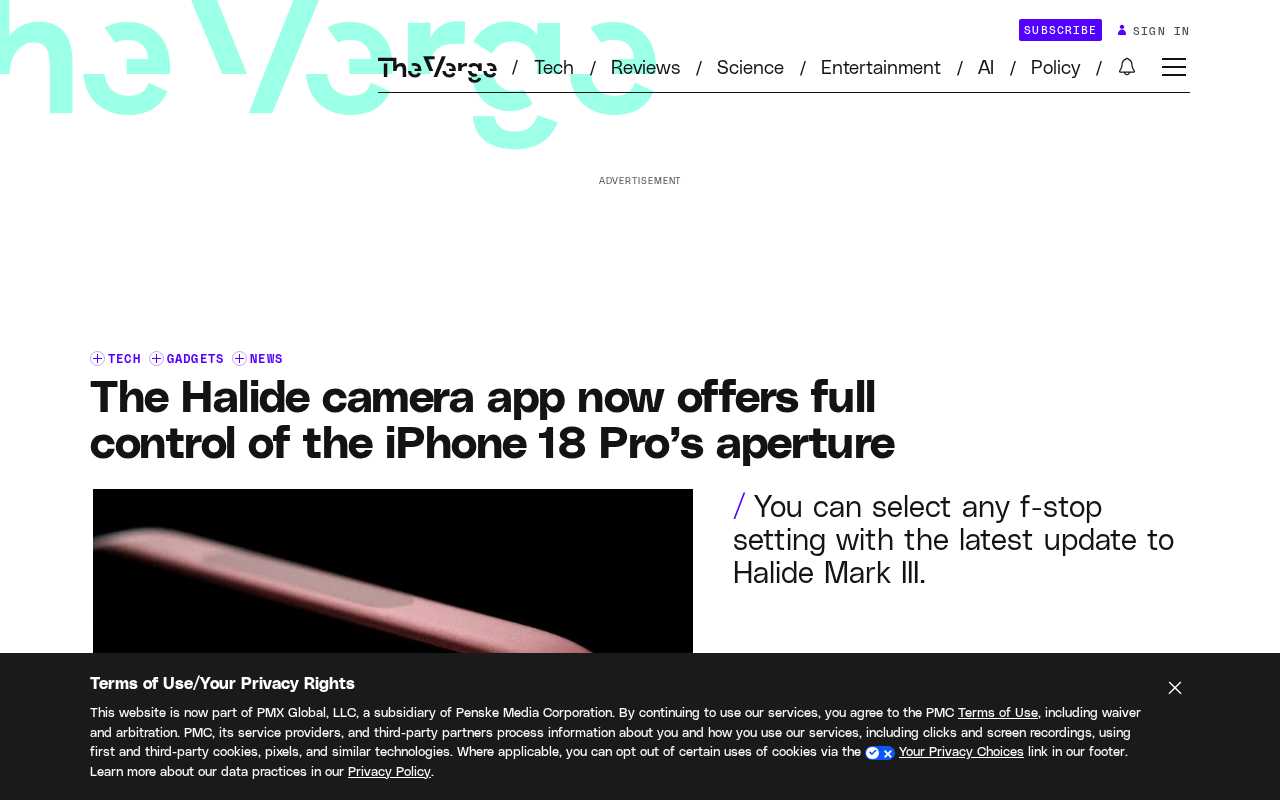
Lux Optics' Halide camera app — known for its "anti-algorithm" philosophy — has shipped a new update bringing two noteworthy changes for iPhone and iPad users: two new photography looks, and full support for variable aperture control on the iPhone 18 Pro's main camera.
Variable Aperture Enters the Core of Mobile Photography
The iPhone 18 Pro introduces a variable aperture mechanism on its main camera, meaning users are no longer locked into a fixed exposure level — they can adjust the aperture value just like on a traditional camera. Aperture changes directly affect two things: the amount of light entering the sensor and depth of field. A wider aperture (lower f-number) produces shallower depth of field and stronger background blur, while a narrower aperture (higher f-number) keeps a greater range of the scene in sharp focus.
The value of this hardware capability depends entirely on whether software is willing to hand control over to the user. The native iOS Camera app tends to favor automated decision-making, while Halide's product philosophy is the opposite — it puts professional-grade manual control front and center. This update allows users to directly and precisely adjust the aperture on the iPhone 18 Pro's main camera, rather than relying on the system's automatic judgment.
From a technical standpoint, the iPhone 18 Pro's variable aperture is not a continuously variable system in the traditional sense — it switches between a limited number of discrete stops (currently known to support f/1.78 and f/2.2, possibly more). This differs from how DSLRs and mirrorless cameras achieve continuous adjustment through physical aperture blade movement, but it's still a significant leap compared to previous iPhones being locked to a single fixed aperture. It's also worth noting the diffraction trade-off: at very small apertures, light wave diffraction can cause slight softening of fine detail, so smaller isn't always better — the optimal stop depends on the scene. For mobile sensor sizes, the diffraction threshold arrives sooner than it does on full-frame cameras, which is precisely why fine software control matters more than simply defaulting to the smallest aperture.
Halide's "Anti-Algorithm" Positioning
Halide's long-standing differentiator has been positioning itself against the "over-algorithmized" nature of the system camera. Apple's native camera makes massive investments in computational photography — HDR fusion, Smart HDR, Night mode, and more are all handled automatically by algorithms, and the final images are typically the result of heavy processing. For photographers who value authentic texture and hands-on control, that "algorithmic look" isn't always welcome.
Halide emphasizes preserving imaging results closer to the optical source, returning control over exposure, focus, aperture, and other parameters to the photographer. Support for variable aperture is a natural extension of this philosophy: if the hardware offers a new physical control dimension, Halide exposes it fully to the user rather than reducing it to a simple toggle.
At a technical level, Halide's "anti-algorithm" stance manifests as deep support for Apple ProRAW and standard RAW formats, along with the ability to bypass or disable iOS's computational photography pipeline. Apple's computational photography process — including Smart HDR and Deep Fusion — intervenes at the exposure capture stage, fusing multi-frame data into a finished image in an irreversible way. By calling lower-level camera APIs directly, Halide can output minimally processed raw data, leaving far more room for post-processing. For users who want to do professional color grading in Lightroom, Capture One, or similar desktop software, these "lightly processed" output files offer far more flexibility than deeply computed HEIC images — and that's one of the most valued traits among Halide's core user base: photographers migrating from traditional cameras.
Not the First, But Emphasizing "Complete Control"
It's worth noting that Halide is not the first third-party camera app to support variable aperture on the iPhone 18 Pro. After Apple opened up the relevant capabilities, other alternatives had already moved to support this feature. Halide's differentiator lies in its claim of offering more granular control, rather than simply toggling between a few preset stops.
For users who frequently switch between low-light, portrait, landscape, and other scenarios, continuous or multi-stop adjustable aperture means significantly greater creative freedom. Combined with the two new photography looks, Halide is working to reinforce its identity as a professional tool on two fronts simultaneously: image style and parameter control.
What This Means for the iPhone Photography Ecosystem
Variable aperture is one of the few genuine physical-layer breakthroughs in iPhone imaging hardware in recent years. Camera upgrades across the past several iPhone generations have relied more heavily on computational photography and sensor spec improvements, while traditional optical parameters like aperture remained fixed. This hardware-level change reopens the door for third-party professional camera apps to differentiate themselves.
Looking further ahead, this also reflects a broader trend in mobile photography: evolving from "fully automatic, great results for everyone" toward a dual-track model of "both point-and-shoot simplicity and professional-grade control." The native camera continues to serve the mass market, while apps like Halide cater to the advanced photography crowd migrating from DSLRs and mirrorless systems. Whoever can translate new hardware capabilities into usable creative tools the fastest and most thoroughly will hold the advantage in this niche market.
Conclusion
This Halide update may look like a simple feature addition on the surface, but it's really a reinforcement of the app's core product identity. Through full support for the iPhone 18 Pro's variable aperture — along with two new photography looks — it further cements its role as a "professional manual camera alternative." For iPhone photographers who value being in control, this is an update worth paying attention to.
Related articles

Chain of Thought Isn't Just for AI: How Humans Can Use CoT to Improve Thinking Quality
Chain of Thought isn't just a prompt trick for large models. Starting from a Hacker News discussion, this article analyzes why CoT works for human thinking too, breaks down actionable ways to transfer it, and highlights the key differences between human CoT and machine CoT.
Cloudflare Teams Up with OpenAI: Closi…
Cloudflare Teams Up with OpenAI: Closing the Loop from Vulnerability Discovery to Defense with AI
Cloudflare uses OpenAI Daybreak to investigate security vulnerabilities and generate reviewable remediation plans, while developers use Codex to boost coding efficiency and quality.

Orca Multi-Agent Orchestration in Practice: A Guide to Parallel Collaboration with Claude and Codex
Orca is Stable AI's free open-source agent workbench supporting 34 agents like Claude Code and Codex in parallel. Learn its Git worktree isolation, multi-model orchestration, and mobile management.