Halloween Night, My Robotic Hand Tries to Escape? A Fun Soft Robotics Demo

A Halloween skit playfully showcases soft robotics with a "candy-seeking runaway robotic hand," highlighting the communication value of anthropomorphic narratives.
Using a Reddit Halloween-themed demo of a soft robotic hand "escaping for candy" as an entry point, the article explains how soft robots use flexible materials like silicone and pneumatic or hydraulic actuation for muscle-like bending and grasping, with lively movements often mistaken for "having a mind of its own." It notes that such demos lower the public's understanding barrier through anthropomorphic mini-dramas; packaging hardcore tech into festive scenes with both topical and professional hashtags is a lightweight yet effective communication strategy.
Halloween eve, the lab is brightly lit. You're working overtime debugging equipment when you suddenly notice that soft robotic hand quietly "crawling" toward the door—it wants to escape? This vivid scene comes from a Reddit post where the creator used a lighthearted, humorous demo to showcase the lively side of soft robotics.
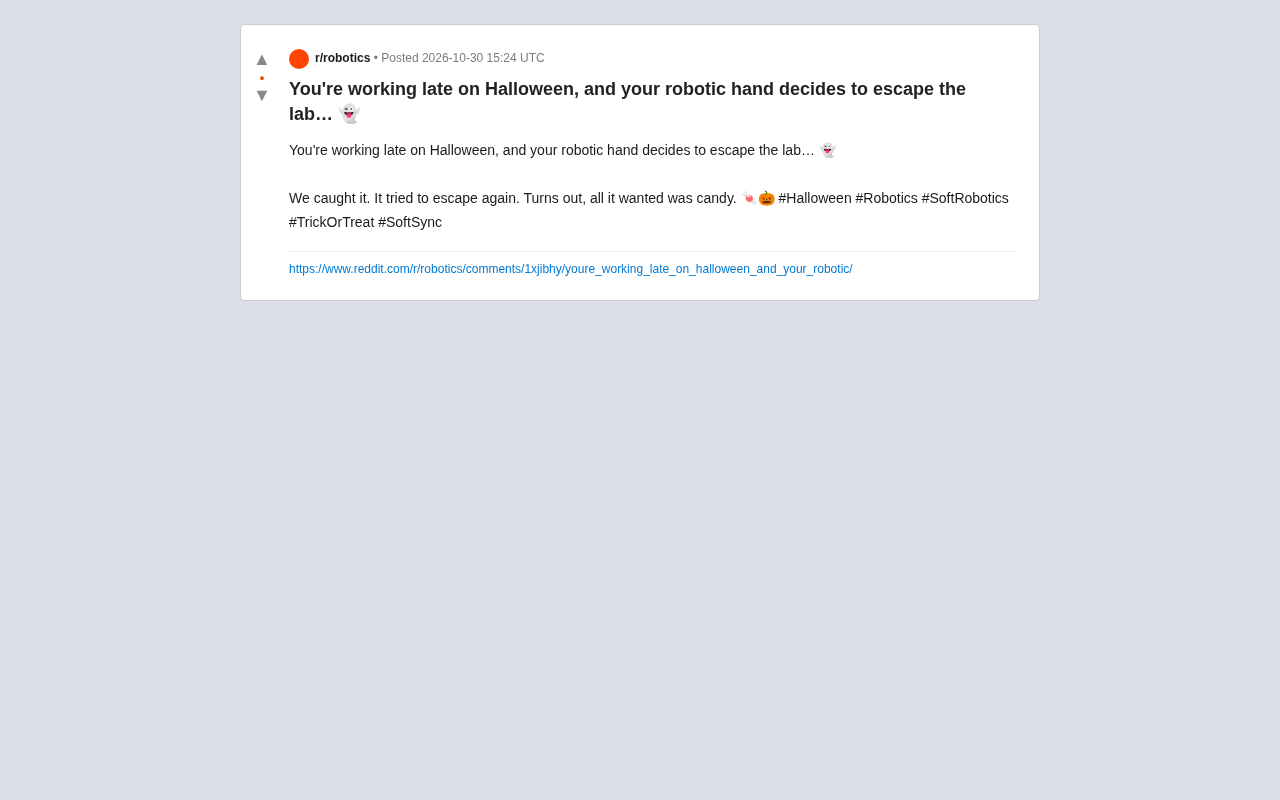
A Halloween-themed robot "jailbreak" show
The post caption reads: "You're working overtime on Halloween, and your robotic hand decides to escape the lab... We caught it. It tried to run again. Turns out it just wanted candy." In just a few sentences, a little anthropomorphic drama unfolds, with the soft robotic hand given a "candy-craving" personality.
This expression isn't just for laughs. Soft robotics has gained attention in recent years for its compliant materials and strong adaptability, but the public is still relatively unfamiliar with its forms and locomotion. Wrapping it in a Halloween "trick-or-treat" meme lowers the barrier to understanding and gives the tech demo传播 power.
Reddit is a large community-based social platform in the US, organizing content into user-created subreddits, where tech, maker, and DIY enthusiasts often share project demos. Compared to academic conferences or papers, Reddit has a low posting barrier and direct feedback—a short video or GIF can get hundreds of thousands of views. For robotics researchers and makers, it's both a channel to showcase work and gather feedback, and an important entry point for tech to "break out" into the public eye, often used as the first stop for science communication.
Why soft robotic hands seem "alive"
Traditional rigid robotic hands rely on motors and joints—precise but stiff. Soft robotic hands are typically made from silicone, elastomers, and other materials, driven pneumatically or hydraulically, able to bend and grasp like biological muscles. That's why its crawling and probing movements in the video create the illusion that "it has a mind of its own."
This post doesn't disclose specific technical parameters, but from the demo style, the focus is on showcasing the flexibility and playfulness of soft structures rather than engineering metrics. For robotics outreach, this kind of "anthropomorphic narrative" often sparks more interest among ordinary people than spec sheets.
Pneumatic and hydraulic actuation are the two most mainstream driving methods for soft robots. Pneumatic actuation works by inflating or deflating sealed flexible chambers, causing the material to expand or contract and thus bend as a whole; hydraulic actuation uses incompressible liquid instead of gas, providing greater output force and faster response but requiring more complex sealing and tubing. Another common approach is fiber-reinforced actuators: fibers wound at specific angles around a silicone chamber allow it to expand only in predetermined directions when inflated, enabling controlled bending or twisting. These actuation methods eliminate rigid joints and motors, making the robot entirely soft and able to conform to irregular surfaces, but they also bring challenges like low control precision and difficult force-feedback modeling.
Tech communication needs a bit of "festive spirit"
When research teams and makers share results on social platforms, they often face the dilemma of "professional content nobody watches." Putting a soft robotic hand into a Halloween scene, wrapped in a "escape" and "want candy" plot, is essentially a content strategy: grab attention first, then make people remember the keyword "soft robotics."
The post includes tags like #Halloween, #Robotics, #SoftRobotics, #TrickOrTreat, balancing topicality and technical tags. This lightweight approach to communication may not explain technical details clearly, but it can plant seeds of curiosity in a broader audience.
Conclusion
Behind a robotic hand trying to beg for candy is a playful showcase of soft robotics technology. It reminds us that hardcore tech can also have a soft, even slightly mischievous, way of expressing itself.
One-line Summary
A Halloween skit uses a "candy-seeking runaway robotic hand" to playfully showcase soft robotics, revealing the communication value of anthropomorphic narratives.
Paragraph Summary
The article uses a Reddit Halloween-themed demo of a soft robotic hand "escaping for candy" as an entry point, introducing how soft robots rely on flexible materials like silicone and pneumatic or hydraulic actuation to achieve muscle-like bending and grasping, with lively movements often mistaken for "having a mind of its own." The author notes that such demos don't pursue technical parameters but use anthropomorphic mini-dramas to lower the public's understanding barrier; when research teams and makers share results on social platforms, packaging hardcore tech into festive scenes while balancing hashtags like #Halloween with professional tags like #SoftRobotics can plant curiosity in a wider audience—a lightweight yet effective tech communication strategy.
Related articles

Type-Safe Keep Rules in R8 and DEX Optimization in Practice
Google Play requires over 25% DEX optimization. This article explains the R8 configuration analyzer, Jetpack Keep type-safe annotations, and the Android CLI validation tool to help Android developers narrow keep rules, improve shrinking/optimization/obfuscation, and reduce ANRs.

Why Are Old Buildings More Beautiful Than New Ones? Pulitzer Prize-Winning Author Reveals an Overlooked Economic Truth
Pulitzer Prize-winning author Robert Caro found that poorer countries built more beautiful buildings. He reveals how cheap skilled craftsmen created the intricate details of old New York architecture, and how rising labor costs changed architectural aesthetics.

The Truth About AI Coding: Code Output Soars, So Why Is Delivery Still Hard to Speed Up?
Engineering leaders from Databricks, Uber, and Google Maps discuss AI coding's real impact: code output soars but delivery bottlenecks shift, code review faces rethinking, and enterprises begin fine-grained token governance.