Hamilton: A Fully Offline Android Health Dashboard App

Hamilton is an offline-only Android health dashboard that keeps all your health data strictly on-device.
Hamilton is an Android health dashboard app built by an indie developer, notable for being entirely offline — all health data is stored locally and never sent to any remote server. As concerns around health data privacy grow, its local-first design hands full data sovereignty back to users while also enabling use in low-connectivity environments. The project is in early stages, maintained as a side project, and was introduced publicly via Hacker News's Show HN section. The article argues that "no internet" is evolving from a perceived limitation into a compelling differentiator, and that Hamilton represents a viable path for protecting user privacy through simple, unpretentious technical choices.
A Privacy-First Offline Health App
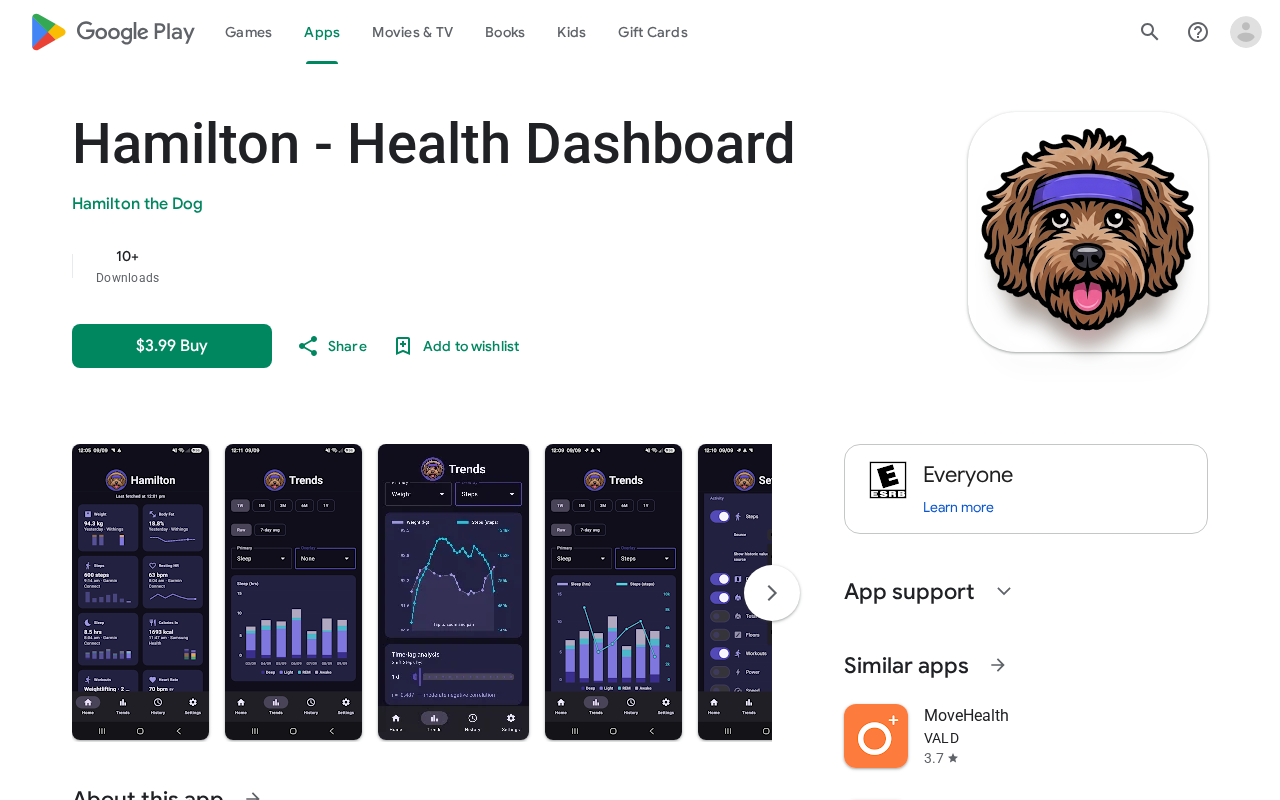
At a time when health data is routinely uploaded to the cloud and analyzed by third parties, one developer chose to go in the opposite direction. He posted an Android health dashboard app called Hamilton on Hacker News — a health data management tool that requires no internet connection whatsoever. The project is named after the developer's own dog, a personal touch that hints at the small, indie-driven nature of the project.
Unlike mainstream health apps, Hamilton's core selling point is being "no-internet." It never transmits user health data to any remote server — all storage and display happens locally on the device. For a growing segment of users who care deeply about data privacy, this design philosophy is itself a meaningful point of differentiation.
Why "Offline-First" Deserves Attention
Health data is among the most sensitive categories of personal information — heart rate, sleep patterns, activity logs — and the consequences of a breach or misuse go far beyond those of ordinary data leaks. Many commercial health platforms rely on cloud sync to deliver cross-device experiences, but the tradeoff is that users must trust how the company handles their data.
Offline-first (also called local-first) design is a direct response to this tension. It returns data sovereignty to the user: if data never leaves the device, there's no risk of it being uploaded, analyzed, or sold. Hamilton treats this principle as the core of the product rather than an optional feature, reflecting the developer's unambiguous stance on privacy.
There's another understated advantage to this kind of app: reliability. Not depending on a network connection means users can still view and record health data in areas with no signal — a genuine convenience for anyone who frequently finds themselves in low-connectivity environments.
What is Local-First Software? Local-first software is a software design philosophy that has gained traction in the tech community in recent years, systematically articulated by the Ink & Switch research team in their 2019 paper of the same name. Its central argument is that user data should be stored primarily on local devices, that software should be fully functional without a network connection, and that cloud sync — if it exists at all — should be a bonus rather than a prerequisite. This stands in direct contrast to the mainstream SaaS architecture, where the cloud is primary and local storage is secondary. The local-first philosophy also emphasizes long-term data accessibility: even if a developer shuts down their service, users' data remains fully intact on their own devices and doesn't disappear when servers go dark. This matters especially for health data — years of sleep records or activity logs tend to grow in value over time, and users deserve permanent control over them.
The Reality of an Indie Developer Project
Based on feedback on Hacker News, the project is still in its early stages, having received relatively few upvotes and comments. This is typical of most Show HN indie projects: a tool built by one person in their spare time, floated to the tech community to gather early user feedback.
For projects like this, maturity and long-term maintenance are the biggest unknowns. A truly useful health dashboard requires sustained investment in data visualization, sensor integration, and user experience. But the "offline" positioning also lowers the operational burden — no server costs, no ongoing backend maintenance pressure — which actually makes it more sustainable for an indie developer to iterate on over time with minimal overhead.
What is Show HN? Show HN (Show Hacker News) is a dedicated section on the Hacker News community where developers showcase projects, tools, or products they're building in order to gather early user feedback and technical discussion. Unlike regular news posts, Show HN submissions are typically made by the authors themselves, and the comments that follow often directly shape how the product evolves. Since a large number of Show HN projects are posted every day, most receive limited attention — posts that spark substantial discussion are the exception, not the rule. As a result, upvote counts and comment numbers in this context are not a reliable proxy for project quality; they reflect topic relevance and timing more than anything else. Many open-source tools that later became widely influential had similarly quiet debuts on Show HN.
What This Means for the Health App Space
Hamilton's existence is a signal: as data privacy awareness grows, "no internet connection" is shifting from a perceived weakness to a genuine selling point. We used to assume health apps should offer cloud sync, intelligent analysis, and social sharing as defaults — but a segment of users is starting to question the cost of those features.
For developers, privacy can be a clear and coherent product positioning rather than an afterthought. For users, having one more option that keeps data local is simply a good thing. Hamilton is still small, but the path it represents — using straightforward technical means to protect user privacy — is worth watching.
(Note: This article is based on limited public information available on Hacker News. The app's feature details and real-world performance remain to be further verified.)
Related articles

Chain of Thought Isn't Just for AI: How Humans Can Use CoT to Improve Thinking Quality
Chain of Thought isn't just a prompt trick for large models. Starting from a Hacker News discussion, this article analyzes why CoT works for human thinking too, breaks down actionable ways to transfer it, and highlights the key differences between human CoT and machine CoT.
Cloudflare Teams Up with OpenAI: Closi…
Cloudflare Teams Up with OpenAI: Closing the Loop from Vulnerability Discovery to Defense with AI
Cloudflare uses OpenAI Daybreak to investigate security vulnerabilities and generate reviewable remediation plans, while developers use Codex to boost coding efficiency and quality.

Orca Multi-Agent Orchestration in Practice: A Guide to Parallel Collaboration with Claude and Codex
Orca is Stable AI's free open-source agent workbench supporting 34 agents like Claude Code and Codex in parallel. Learn its Git worktree isolation, multi-model orchestration, and mobile management.