Handling Low-Quality Audio in AI Agent Pipelines: Architecture Strategies and Practical Guide

Build resilient voice AI pipelines that fail honestly on bad audio rather than hallucinating confidently.
This article systematically covers end-to-end architectural strategies for handling low-quality audio in voice-driven AI Agent pipelines — from upfront preprocessing to multi-engine arbitration. STT models in low-SNR environments don't admit uncertainty; they hallucinate plausible-sounding text. Preprocessing (VAD segmentation, noise reduction, dereverberation) can salvage recoverable audio, but physically lost information can't be restored algorithmically. Guardrail design should combine confidence threshold interception, hallucination detection heuristics, and graceful degradation to ensure honest failure over convincing errors. For critical use cases, multi-engine cross-validation and LLM post-processing Agents can further boost reliability — with strict prompt constraints to prevent LLM hallucination.
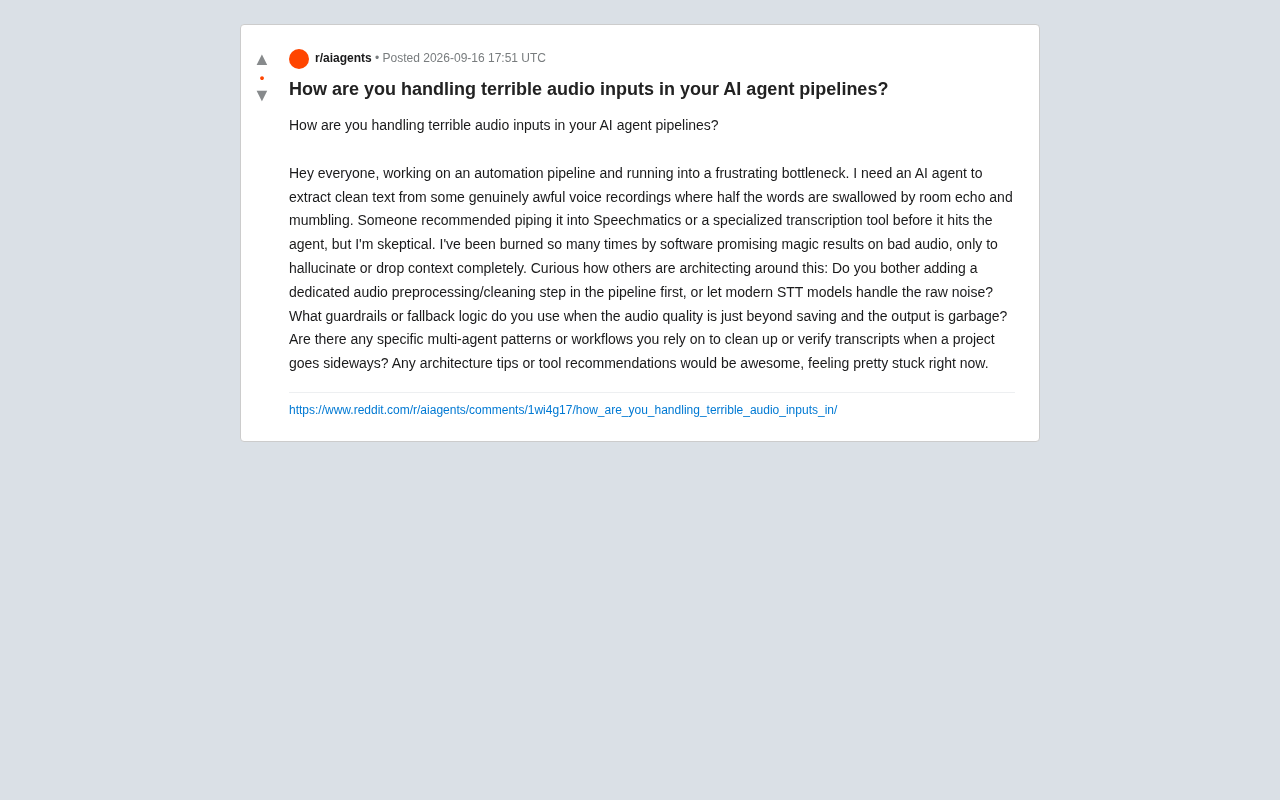
When building voice-driven AI Agent automation pipelines, the most frustrating bottleneck is rarely the model itself — it's the audio quality at the input stage. A Reddit user recently raised a highly representative question: when dealing with recordings plagued by room echo, mumbled speech, and "half the words swallowed," how should you design a pipeline to extract clean, usable text?
This question cuts to the core tension in production speech AI engineering — should you invest resources in upfront audio cleaning, or trust modern STT (speech-to-text) models to handle noise directly? Drawing from the pain points surfaced in that discussion, this article lays out an architectural approach for dealing with low-quality audio.
The Core Problem: Garbage In, Garbage Out
The original poster's dilemma is very real: someone recommended feeding audio into a specialized transcription tool like Speechmatics before passing it to the Agent, but he was skeptical. His reason: he had "been burned so many times" — software promises to work magic on bad audio, only for the model to hallucinate or completely lose context.
This is an unavoidable reality in all voice pipelines: STT models operating in low signal-to-noise environments don't honestly "admit they can't hear clearly" — they tend to fabricate plausible but incorrect words and phrases. Models like Whisper are especially prone to this, frequently generating hallucinated text out of thin air during silent or noisy segments. Simply relying on "a stronger model" doesn't solve the fundamental problem — protection at the architecture level is what actually matters.
Do You Need a Dedicated Audio Preprocessing Step?
On the core debate of "should you add an independent audio cleaning stage," the answer is generally yes, but with realistic expectations.
What Preprocessing Can Do
Adding a preprocessing layer before audio reaches your STT engine can significantly improve downstream transcription quality. Common approaches include:
- Noise reduction and dereverberation: For room echo (reverb), dedicated dereverberation algorithms or deep learning-based noise reduction models (such as RNNoise or DeepFilterNet) can strip away some environmental interference.
- Volume normalization and gain control: Brings low-volume speech that's been "swallowed" up to a recognizable level.
- Voice Activity Detection (VAD): Pre-segments audio to isolate actual speech, filtering out pure noise segments and reducing opportunities for hallucination at the source.
RNNoise is Mozilla's lightweight recurrent neural network-based noise suppression library, designed for real-time voice communication with minimal computational overhead — it excels at suppressing stationary noise (e.g., fans, air conditioning). DeepFilterNet is a newer generation deep filter network using a two-stage architecture to separately process speech envelope features and fine details, with solid performance against non-stationary noise (e.g., keyboard clicks, footsteps). Dereverberation and noise reduction are two distinct subproblems: noise reduction targets additive noise, while dereverberation addresses multipath reflection buildup in enclosed spaces — room echo falls into the latter category. Common tools include implementations of the WPE (Weighted Prediction Error) algorithm and neural network approaches like MetricGAN+. For VAD, Silero VAD is a widely used lightweight pretrained model in production pipelines — more robust to complex environments than WebRTC VAD, and easily integrated into Python pipelines, making it an ideal first-pass gate for segmenting noisy sections.
The Limits of Cleaning
It's important to be clear-eyed: preprocessing is not a magic bullet. If information in the original recording has been lost at the physical level (speech so mumbled that even a human ear can't make it out), no algorithm can conjure it from nothing. Overly aggressive noise reduction can even damage valid speech, actually lowering recognition rates. The goal of preprocessing should be "improving audio that can be salvaged" — not "rescuing audio that's already dead."
Guardrail Design for Truly Unsalvageable Audio
The second key question in the original post: when audio quality is so poor that output is pure garbage, what guardrails and fallback logic should catch it? This is precisely the part most often overlooked in engineering, yet most revealing of a system's robustness.
Confidence Scoring and Threshold Interception
Most STT engines (including Speechmatics) output word-level or segment-level confidence scores. Setting a threshold in your pipeline — flagging an entire transcription segment as "low quality" when its average confidence falls below a certain level — prevents it from entering downstream Agent processing and polluting subsequent decisions with erroneous information.
Confidence scores from different STT engines vary significantly in meaning and calibration quality and cannot be compared directly across engines. Whisper doesn't natively expose word-level confidence in its standard API, but underlying logits can be accessed indirectly via parameters like
--word_timestampsto retrieve log probabilities, which require additional conversion. Deepgram and Speechmatics both provide aconfidencefield per word directly in their JSON responses, making engineering integration more straightforward. In practice, calibrate confidence thresholds against your specific business scenario using labeled data: plot a PR curve on a sample of "known correct transcriptions" versus "known incorrect transcriptions," then select the final threshold based on your business's precision/recall preferences — don't just use rule-of-thumb values like 0.7 or 0.8, since different speech rates and accent distributions significantly affect threshold validity.
Hallucination Detection Heuristics
Simple heuristic rules can help identify suspicious output: abnormally high frequency of repeated phrases, strings that deviate severely from a known vocabulary, timestamp-to-text-length mismatches — these are all classic hallucination signals. When these rules fire, trigger a human review or retry logic.
Graceful Degradation
Rather than outputting confidently wrong text, have your system explicitly return "this audio segment could not be reliably transcribed." For an automated pipeline, an honest failure marker is far more valuable than a convincing hallucination.
Multi-Agent Validation Patterns
The original post also asked whether there are specific multi-Agent workflows for cleaning or validating transcription results. This is a promising direction.
Multi-engine cross-validation is the most direct pattern: send the same audio in parallel to two or three different STT engines (e.g., Speechmatics, Whisper, Deepgram), then have an "arbitration Agent" compare results. Segments where all three agree carry high confidence; segments with significant disagreement are flagged for human review. This redundant design is more expensive, but extremely valuable for mission-critical use cases.
Another approach is introducing an LLM post-processing Agent: after obtaining the raw transcription, use a large language model to perform context-aware semantic correction and completion. It's important to strictly constrain the prompt here to prevent the LLM from independently "filling in" content that doesn't exist — the goal of this step is repair, not re-creation.
Multi-engine cross-validation typically uses character- or word-based alignment algorithms (such as longest common subsequence or CER/WER calculation) to quantify the degree of divergence between engines. Arbitration logic can be as simple as "majority voting" — taking segments where two or more of three engines agree as the final output — or it can use weighted confidence, giving engines with higher historical accuracy more influence. Prompt constraints in LLM post-processing are a practical challenge: you need to explicitly instruct the model to "only make spelling and grammar corrections within the given transcription text, and not complete information you consider plausible but which does not appear in the original," and provide metadata like original audio duration and speaker count as constraints to reduce the model's room to improvise. Some teams also introduce domain-specific vocabulary lists (e.g., industry terminology glossaries) in the LLM post-processing stage, using few-shot examples to guide the model toward preferred domain terms and further reducing hallucination substitutions.
Practical Advice for Stuck Developers
Drawing from this discussion, here's how to build a pipeline for low-quality audio by priority:
- Start with preprocessing: VAD segmentation + noise reduction and dereverberation to improve what's salvageable.
- Choose an STT engine that outputs confidence scores: Essential for setting interception gates downstream.
- Build hallucination guardrails: Threshold interception + heuristic detection + graceful degradation.
- Add multi-engine arbitration for critical scenarios: Trade cost for reliability.
- Accept physical limits: Design a "cannot transcribe" branch into your workflow, rather than forcing 100% coverage.
The maturity of speech AI engineering is rarely demonstrated in how accurate a system is on clean audio — it shows in whether the system can fail honestly and controllably when faced with garbage input. Rather than chasing single-model magic, build resilience into every layer of the pipeline.
Related articles
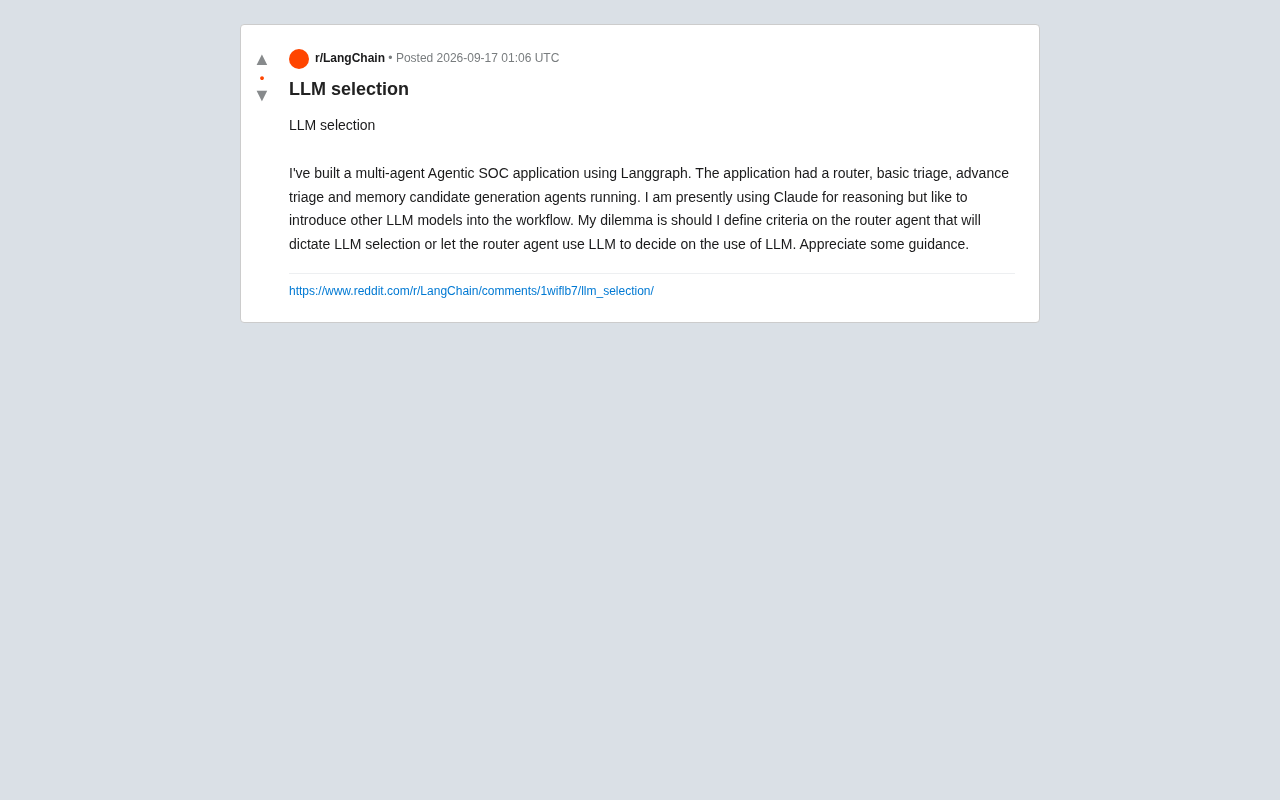
LLM Selection Strategy for Multi-Agent SOC Applications: Rule-Based Routing vs. LLM-Driven Decisions
Should multi-agent SOC apps on LangGraph use rule-based routing or LLM-driven model selection? This article analyzes both approaches and recommends a hybrid strategy for security operations.

Snap Pushes Its $2,200 Smart Glasses Again — Can It Convince the Market?
Snap launched new features for its $2,200 smart glasses, doubling down on AR. We break down the pricing dilemma, its rivalry with Meta Ray-Ban, and what it means for the AR glasses race.
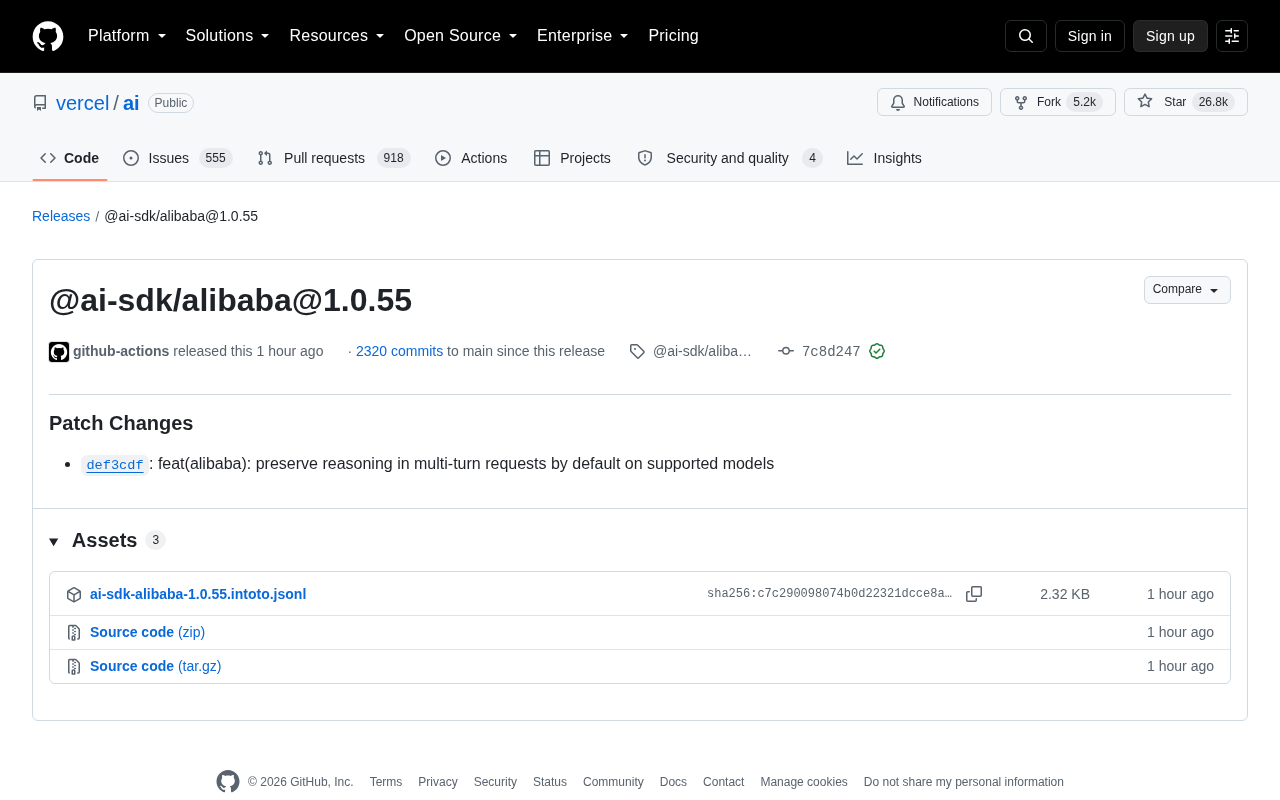
Vercel AI SDK Update: Multi-Turn Reasoning Preservation for Alibaba Models
Vercel AI SDK releases @ai-sdk/alibaba@1.0.55, enabling reasoning preservation by default in multi-turn requests for supported Alibaba models like Qwen.