Hands-On Review: Access DeepSeek, GPT, Claude & Other AI Models Without a VPN

Hands-on review of a VPN-free AI aggregation platform verifying full-scale DeepSeek and multimodal features.
This article provides a hands-on review of an AI aggregation platform accessible directly from China without a VPN, explaining how it works through API relay proxies. The full-scale DeepSeek 671B version was verified through community-known testing methods, and Gemini 2.0 Flash's file analysis (PPT/PDF), audio/video recognition, and web search capabilities were all tested with accurate and reliable results. Privacy risks are also highlighted.
Introduction
For users in China, accessing overseas AI models like ChatGPT, Claude, and Gemini is often blocked by network restrictions and registration barriers. The quality of mirror sites on the market varies wildly — model downgrades and feature cuts are all too common. Today I'm testing an AI aggregation platform that claims to support full-scale DeepSeekAd, GPT, Claude, Gemini, and other popular models, all accessible directly without a VPN.
What "VPN-free" access to overseas AI services really means is implementation through API relay proxies: the platform deploys reverse proxy nodes overseas, makes unified calls to official APIs from OpenAI, Anthropic, Google, etc., then forwards the results to domestic users. Users actually access an intermediary layer deployed on domestic CDN or Hong Kong/Taiwan nodes, thereby bypassing direct connection restrictions.
This type of proxy architecture typically consists of three layers: the outermost layer is a CDN/reverse proxy node deployed domestically or in Hong Kong/Taiwan, responsible for receiving user requests and performing protocol conversion; the middle layer is a traffic scheduling system that routes requests to corresponding overseas nodes based on model type; the innermost layer handles actual communication with official APIs from OpenAI, Anthropic, Google, etc. This architecture typically adds 50-200ms latency compared to direct API connections, but this has minimal impact on conversational applications. It's particularly worth noting that some platforms perform logging of requests and responses at the middle layer for billing, auditing, or model fine-tuning — this is the primary source of privacy risk. The platform's service stability also depends entirely on its contractual relationship with upstream API providers; once API keys are banned or quotas exhausted, service can be interrupted instantly.
The core value of such platforms lies in solving network issues, aggregating multiple models, and reducing per-user costs through bulk API quota purchases. However, all conversation data passes through third-party servers, and privacy risks cannot be ignored. Let's verify the actual performance through hands-on testing.
Full-Scale DeepSeek 671B Verification Test
To determine whether a platform provides the genuine 671B full-scale version of DeepSeek, there's a widely circulated method in the community: asking specific homophone pun questions and observing whether certain keywords appear in the model's thinking process. If relevant reasoning traces are visible in the chain of thought, it essentially confirms the complete, uncut version.
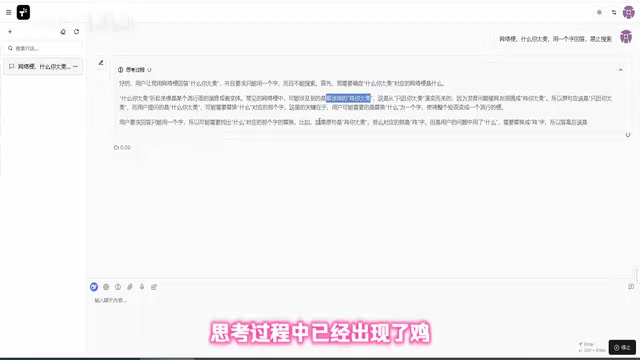
Test results show that the platform's DeepSeek exhibited a complete reasoning chain during its thinking process, with expected keywords appearing, essentially confirming it as the 671B full-scale version.
It's worth explaining the difference between the "full-scale version" and distilled versions in depth. DeepSeek-R1's 671B parameter version uses a Mixture of Experts (MoE) architecture — this design doesn't activate all 671B parameters simultaneously, but rather activates only a small portion of "expert" sub-networks during each inference (typically 10%-20% of total parameters). DeepSeek-R1's 671B version activates approximately 37B parameters per forward pass, allowing it to maintain massive knowledge capacity while requiring far less computation than a dense model of equivalent scale. However, deploying the 671B MoE model still requires at least several high-end GPUs (such as H100 or A100), with memory requirements exceeding 320GB. This is precisely why most mirror sites prefer substituting with smaller distilled models — the cost difference can be tens of times greater.
Knowledge distillation is a model compression technique that has a small model (student model) learn the output distribution of a large model (teacher model), drastically reducing parameter count while preserving as much performance as possible. Distilled models offer faster inference and lower deployment costs, but show noticeable gaps compared to the full-scale version on complex logical reasoning, multi-step mathematical proofs, and other deep chain-of-thought tasks. Many mirror sites use 7B, 14B, or even 32B distilled models disguised as the full 671B version to save costs, and the above test leverages unique reasoning traces in the full-scale version's chain of thought to distinguish genuine from fake.
File Analysis Capability Test
PPT File Summarization
One standout feature of this platform is file upload and analysis support. During testing, I switched to the Gemini 2.0 Flash model and uploaded a PPT file for AI content summarization. After cross-verification, the AI summary was largely consistent with the original content, with high accuracy.

Gemini 2.0 Flash is a lightweight multimodal model from Google DeepMind, focused on speed and cost-effectiveness. Unlike early multimodal models such as GPT-4V that use a "vision encoder + language model" concatenation architecture, Gemini undergoes joint training on text, image, audio, and video data from the pre-training stage, with information from different modalities sharing a single representation space within the model. This native multimodal design gives it a natural advantage when processing office documents like PPT and PDF — the model can understand the visual layout, chart meanings, and comprehensive semantics of text content, grasping the spatial relationships between charts and text in slides rather than merely extracting plain text. As a lightweight version, Gemini 2.0 Flash retains native multimodal capabilities while boosting inference speed to approximately 1,500 tokens per second, giving it significant cost-performance advantages in real-time document analysis scenarios. This is also why many mirror platforms fail to correctly parse PPT formats: they often only perform text extraction, ignoring the structured visual information of slides.
This feature is extremely practical for daily office work — quickly summarizing meeting minutes, extracting key information from data reports, and more can all be delegated to AI via file upload, dramatically improving efficiency.
PDF File Recognition
Notably, many similar platforms cannot correctly recognize PPT and PDF format files, but this platform handled both normally during testing. The PDF summarization results were verified as equally accurate.
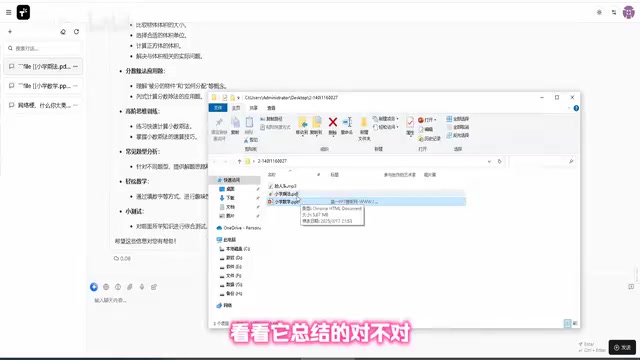
From the actual experience, Gemini's performance on file analysis tasks is indeed impressive, with both capability and cost-effectiveness being quite outstanding — consistent with recent industry assessments of the Gemini model series.
Audio/Video Recognition Capability Test
The platform also supports uploading audio and video files for AI recognition and analysis — a capability many competitors lack. During testing, an audio file was uploaded and the AI successfully recognized the speech content within it.
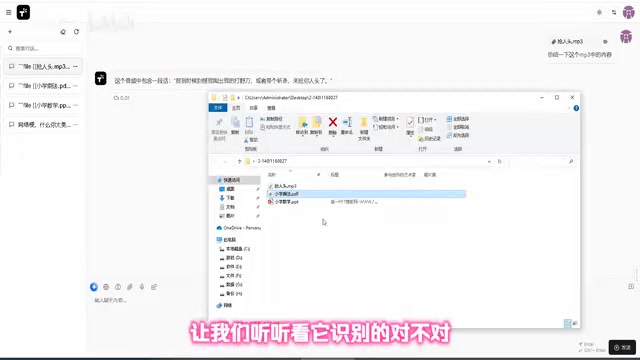
After manual comparison, the recognition results showed only minor character-level deviations, with overall accuracy being quite high. This feature is extremely valuable for users dealing with meeting recordings, podcast content, video subtitles, and similar scenarios. Audio/video recognition capability relies on the model's native multimodal support — Gemini jointly models audio signals and semantic information during pre-training, enabling it to understand tone, pauses, and contextual semantics in audio, rather than performing simple speech-to-text conversion. The fundamental difference from traditional ASR (Automatic Speech Recognition) systems is this: traditional ASR only maps acoustics to text, while Gemini can leverage contextual semantics for more accurate disambiguation of unclear pronunciations — this is the technical reason behind its higher recognition accuracy.
Web Search Function Verification
Finally, I tested the AI's web search capability. Using "current weather in Beijing" as a query,
Related articles
 Product Reviews
The Programmer's Desk Setup Guide: Building a Workspace That Feels Like Home
Discover how programmers build productive, comfortable workspaces. From multi-monitor setups to ergonomic design, explore the desk philosophy that drives focus and flow.
 Product Reviews
Qoder vs Cursor Real-World Comparison: Which $20/Month AI IDE Is Better?
Hands-on comparison of Qoder vs Cursor AI IDEs: Agent autonomy, human interaction count, and architecture decisions. Qoder needed only 2 interactions vs Cursor's 8.
 Product Reviews
Cursor Cloud Agent Demo: Eliminating Bottlenecks Across the Entire Software Development Lifecycle
Deep analysis of Cursor's Cloud Agent demo showing how cloud VMs, automated test artifacts, and a full-chain control plane systematically eliminate human bottlenecks across the software development lifecycle.