Hands-On Review: GLM5 Free Access via Trae — How Good Is It for Backend Programming?

Real-world test of GLM5's coding ability building a full-stack student management system in Trae
The author used Zhipu AI's GLM5 model, freely available in Trae IDE, to build a complete student management system with a Django backend, DRF API, and SQLite database. The test covered a data dashboard, CRUD operations, pagination, search, and data filtering. Key prompt engineering tips are shared, including having the AI generate a task list first (a Chain-of-Thought technique variant) to improve code completeness and development organization.
Introduction
Trae recently added free access to Zhipu AI's GLM5 model, and many developers are asking: how good is GLM5 at coding? I put it through a real-world test by building a complete student management system covering full-stack development. Here's what I found.
About GLM5 and Trae
Zhipu AI's GLM (General Language Model) series is a large language model jointly developed by Tsinghua University and Zhipu AI. It's built on an Autoregressive Blank Infilling training objective — distinct from both GPT's unidirectional autoregressive approach and BERT's bidirectional masked prediction — giving it unique advantages in understanding context and generating coherent long-form text. GLM5 is the fifth generation of this series, with significant improvements in code generation, logical reasoning, and multi-turn dialogue compared to its predecessors.
Trae is an AI-native Integrated Development Environment (IDE) launched by ByteDance. Compared to similar products like GitHub Copilot and Cursor, its differentiating strategy is integrating domestic Chinese LLMs and offering free usage quotas, lowering the barrier to entry for developers in China. Trae supports multi-model switching, making it an ideal platform for testing and comparing different AI coding capabilities.
Test Task: Building a Student Management System with GLM5
This test wasn't about writing a simple frontend page — it was a complete system with both frontend and backend. Here's the required tech stack:
- Backend Language: Python 3.13
- Web Framework: Django 5/6
- API Framework: Django REST Framework (DRF)
- Database: SQLite
Technical Background: Django REST Framework (DRF) is a powerful Web API toolkit built on top of Django and one of the most mature RESTful API solutions in the Python ecosystem. DRF provides core components like Serializers, ViewSets, and Routers that can quickly transform Django ORM models into standardized JSON API endpoints. Its built-in browsable API interface, permission control system, and pagination mechanisms significantly reduce the effort required to build a production-grade API from scratch. Thanks to its convention-over-configuration design philosophy, DRF code is highly structured, making it particularly well-suited for AI models to learn from and generate.
Why SQLite? SQLite is an embedded relational database that stores data as a single file without requiring a separate database server process. Django uses SQLite as its default development database precisely because its zero-configuration, easily portable characteristics are ideal for prototyping and learning scenarios. When a project needs to move to production, Django's ORM abstraction layer allows developers to switch almost seamlessly to PostgreSQL or MySQL by simply modifying the database configuration in
settings.py.
Detailed Feature Requirements
The system needed to implement the following core features:
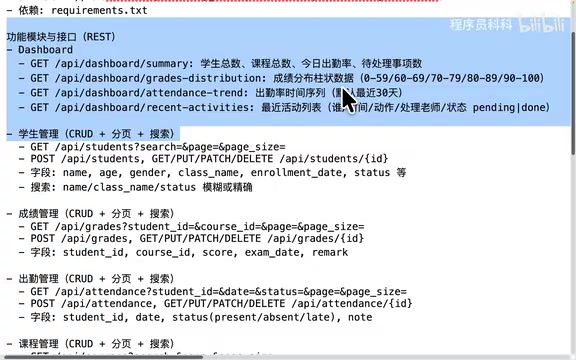
- Data Dashboard: Display statistics including total students, total courses, attendance rate, and pending tasks
- CRUD Operations: Complete Create, Read, Update, and Delete functionality
- Pagination & Search: Support paginated browsing, fuzzy search, and exact search
- Data Filtering: Filter by fields like student name, gender, etc.
The prompt also specified detailed API endpoint design, data field definitions, and search strategies.
Key Prompt Engineering Techniques
During my experience with Trae + GLM5, I discovered several prompt optimization tips worth sharing:
Prompt Engineering refers to the technical methodology of carefully designing input instructions to guide large language models toward more accurate, expected outputs. In code generation scenarios, prompt engineering is particularly critical because the model's understanding of task boundaries directly determines the completeness and usability of the generated code. The following techniques proved highly effective in practice:
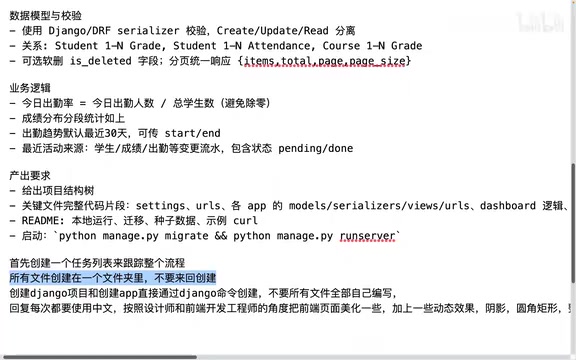
Have the AI Generate a Task List First
By requiring GLM5 to generate a Task List first in the prompt, it plans the execution order of each step on its own. This significantly improves development organization and reduces omissions and redundancy.
This is essentially a variant of Chain-of-Thought (CoT) prompting — having the model plan before executing effectively reduces issues like losing context midway or skipping critical steps. Research shows that asking models to "think before acting"
Related articles
 Product Reviews
The Programmer's Desk Setup Guide: Building a Workspace That Feels Like Home
Discover how programmers build productive, comfortable workspaces. From multi-monitor setups to ergonomic design, explore the desk philosophy that drives focus and flow.
 Product Reviews
Qoder vs Cursor Real-World Comparison: Which $20/Month AI IDE Is Better?
Hands-on comparison of Qoder vs Cursor AI IDEs: Agent autonomy, human interaction count, and architecture decisions. Qoder needed only 2 interactions vs Cursor's 8.
 Product Reviews
Cursor Cloud Agent Demo: Eliminating Bottlenecks Across the Entire Software Development Lifecycle
Deep analysis of Cursor's Cloud Agent demo showing how cloud VMs, automated test artifacts, and a full-chain control plane systematically eliminate human bottlenecks across the software development lifecycle.