Hands-On Test: Kimi K2.5 Multi-Agent One-Click Website Building — How Good Is Chinese AI's Product Delivery?

Kimi K2.5 delivers a working website from a single sentence via multi-agent collaboration.
Kimi K2.5 leverages its Do Agent multi-agent collaboration mechanism to demonstrate end-to-end productization capability from requirements to delivery. In testing, the user input just one sentence, and the system automatically spun up multiple Agents for requirements research, competitive analysis, technical planning, and UI design — ultimately producing a working website. The test also revealed a critical tip: providing AI with design reference images yields far better results than letting it improvise freely. Chinese large models have achieved substantial breakthroughs in product delivery capability, though human creative insight and oversight remain essential.
From Writing Code to Delivering Products: Kimi K2.5 Takes a Critical Step
The capability boundaries of Chinese-made large language models are rapidly expanding. The recently released Kimi K2.5 model has attracted significant attention — not because it "can write code" (that's old news) — but because it demonstrates end-to-end productization capability from requirements to delivery.
In simple terms, you only need to describe your requirements in one sentence, and it automatically breaks down tasks, assigns roles, progresses step by step, and ultimately outputs a working website. Behind this is Kimi K2.5's Do Agent multi-agent collaboration mechanism, which elevates the large model from a "tool" to a "team."
Multi-Agent Systems (MAS) represent an important research direction in AI. The core concept is decomposing complex tasks among multiple specialized agents working collaboratively — similar to division of labor in an enterprise. Early multi-agent research focused primarily on robot collaboration and game AI, but with the rise of large language models, this concept has been revitalized with new forms. Since 2023, frameworks like AutoGPT, MetaGPT, and CrewAI have emerged, attempting to have LLMs play different roles to complete complex workflows. Kimi K2.5's Do Agent mechanism is precisely the productized implementation of this trend — the key difference being that it internalizes the multi-agent orchestration logic within the model itself, rather than relying on hard-coded arrangements from external frameworks. This makes the entire collaboration process virtually seamless from the user's perspective.
Hands-On Test: The Full Journey from One Sentence to a Complete Website
Extremely Simple Input Requirements
The tester gave Kimi K2.5 just one sentence: "Help me build a PNG-to-SVG conversion website." No detailed PRD document, no tech stack specifications, no UI design mockups — just the most straightforward requirement description.
It's worth noting that PNG-to-SVG conversion is technically quite representative as a use case. PNG (bitmap format) and SVG (Scalable Vector Graphics) represent two fundamentally different image storage paradigms: PNG stores image information as a pixel matrix and becomes blurry when enlarged; SVG stores images as mathematical paths and geometric descriptions, maintaining clarity regardless of zoom level. PNG-to-SVG conversion is essentially an "image vectorization" problem that requires identifying contours, color blocks, and shapes in an image, then converting them into vector elements like Bézier curves. This use case is ideal for testing AI productization capability precisely because it simultaneously involves frontend interaction, file processing, algorithm integration, and other technical dimensions — thoroughly testing the depth of multi-Agent collaboration.
However, Kimi K2.5 didn't jump straight into writing code. Instead, like a real product team, it first initiated a complete preliminary research workflow.

Multi-Agent Automatic Collaboration with Clear Role Division
This is K2.5's most impressive capability. The system automatically spun up multiple Agents, each with distinct responsibilities:
- Requirements Research Agent: Analyzes the core scenarios and functional boundaries of user requirements
- Competitive Analysis Agent: Studies existing PNG-to-SVG tools on the market, identifying strengths and weaknesses
- Technical Solution Agent: Outputs complete technology selection and implementation paths
- Differentiation Strategist: Formulates product positioning and considers how to differentiate from competitors
- UI Designer: Plans interface style and interaction logic

Each Agent's output isn't fragmented bits and pieces, but structurally complete analytical reports. This means Kimi K2.5 isn't just executing tasks — it's simulating the collaborative workflow of a product team. From research and design to development, it achieves near-complete pipeline coverage.
Frontend Delivery: Functional but Visually Needs Guidance
After the preliminary research and design phases, K2.5 automatically entered the frontend development stage, generating runnable page code.
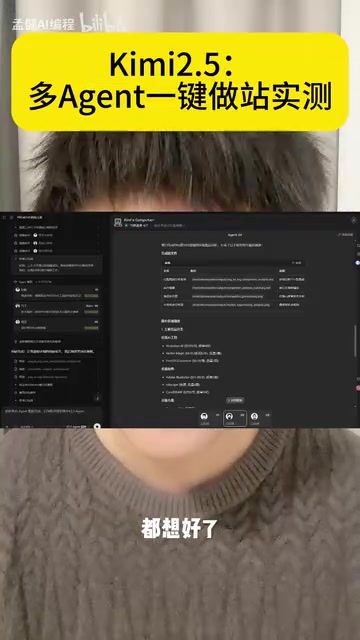
However, the tester also admitted that the initial version's design quality felt like "opening a mystery box" — the functional logic was fine, but the visual presentation wasn't ideal. This is actually a common issue across all AI coding tools today: without clear design references, AI's interpretation of "good-looking" tends to be rather random.
But the key turning point came in the next step: when the tester provided a reference design image, K2.5's output quality "took off immediately." It demonstrated extremely strong visual reference learning ability, quickly understanding the design style and applying it to the actual page. The final design quality improved dramatically.
Core Finding: Giving AI References Is More Important Than Giving It Freedom

This test revealed a highly practical AI collaboration technique: Rather than letting AI improvise freely, give it clear references. This principle applies not only to Kimi K2.5 but to virtually all AI-assisted creative scenarios.
There's deep technical logic behind this phenomenon. AI's "reference learning" ability in visual design fundamentally relies on multimodal large models' capacity to understand image semantics. When the model receives a reference design image, it parses design language elements such as color systems, spacing patterns, typography hierarchy, and component styles, then transfers these characteristics into the code generation process. This is conceptually similar to "style transfer" in the design field, but with a more direct implementation path — the model directly converts visual understanding into CSS styles and HTML structure. In the field of Prompt Engineering, this phenomenon is called the "anchoring effect": clear reference anchors significantly narrow the model's output distribution, allowing it to break free from the "statistical average" of training data and converge toward specific high-quality targets.
Specifically:
- Without references: AI generates based on the "average level" in its training data, producing results that are mediocre or even unsatisfying
- With references: AI precisely captures design language, layout logic, and visual style, significantly improving output quality
This also means the best practice for building products with AI isn't being a "hands-off boss" but rather being a good "client" — providing clear direction, explicit references, and specific constraints, letting AI maximize its effectiveness within a framework.
Where Does Chinese AI's Productization Capability Stand?
Based on this hands-on test, the productization capability represented by Kimi K2.5 shows that Chinese large models have achieved substantial breakthroughs in product delivery:
First, multi-Agent collaboration is no longer just a concept demo. In the past, discussions about multi-agent systems mostly remained at the technical demo level, but K2.5 demonstrates a truly usable workflow — from research to delivery, each stage has a dedicated Agent responsible for it, with automatic handoffs between stages.
Second, the barrier to product development has been dramatically lowered. A person who doesn't know how to code can potentially obtain a working website, as long as they can clearly describe requirements and provide design references. This was almost unimaginable two years ago.
Third, human oversight remains indispensable. What AI currently excels at is execution and imitation, while a product's core competitive advantages — innovative requirement insights, unique user experience design — still need humans to define. AI is a powerful executor, but not yet a qualified product manager.
Final Thoughts
"An ordinary person using AI to build a product
Related articles
 Product Reviews
The Programmer's Desk Setup Guide: Building a Workspace That Feels Like Home
Discover how programmers build productive, comfortable workspaces. From multi-monitor setups to ergonomic design, explore the desk philosophy that drives focus and flow.
 Product Reviews
Qoder vs Cursor Real-World Comparison: Which $20/Month AI IDE Is Better?
Hands-on comparison of Qoder vs Cursor AI IDEs: Agent autonomy, human interaction count, and architecture decisions. Qoder needed only 2 interactions vs Cursor's 8.
 Product Reviews
Cursor Cloud Agent Demo: Eliminating Bottlenecks Across the Entire Software Development Lifecycle
Deep analysis of Cursor's Cloud Agent demo showing how cloud VMs, automated test artifacts, and a full-chain control plane systematically eliminate human bottlenecks across the software development lifecycle.