Hands-On Tutorial: Building a Godot Game AI Agent with DeepSeek + Harness

Building a Godot game engine AI agent plugin using DeepSeek and Harness framework for automated code repair.
This tutorial demonstrates how a developer used the DeepSeek LLM and Harness middleware framework to create a deeply integrated AI agent plugin for the Godot game engine. The plugin leverages Godot's native APIs for real-time editor updates, built-in static analysis for error detection, and patch-style code modifications to save tokens — delivering a far superior experience compared to generic AI coding tools.
How a Beginner Built a Game Development AI Agent with AI
As large language model capabilities rapidly become mainstream, more and more developers are experimenting with deeply embedding AI agents into their workflows. This practical case study comes from a Chinese content creator who used DeepSeekAd model + Harness framework to develop a dedicated AI agent plugin for the open-source game engine Godot.
DeepSeek is a series of large language models developed by the Chinese AI company DeepSeek, known for its exceptional cost-effectiveness — its API pricing is far lower than competitors like GPT-4, yet it excels at code generation, mathematical reasoning, and similar tasks. Godot is a completely free and open-source 2D/3D game engine released under the MIT license, with no licensing fees or revenue sharing, making it popular among indie game developers and in educational settings.
What's interesting is that the entire development process was essentially "done by AI" — the creator self-identifies as a "beginner," and the core approach was: let AI understand what Harness is, download and install dependencies, then write the plugin that interfaces with Godot based on requirements. This "beginner using AI to master AI tools" approach is a perfect microcosm of how AI programming is lowering barriers to entry.
The author also made an observation: people online have already started selling overpriced courses on Harness-related tools, much like the crayfish farming hype of years past. In reality, this workflow is much simpler than imagined and can be done entirely on your own.
Harness Framework Explained: The "Routing Hub" for AI Agents
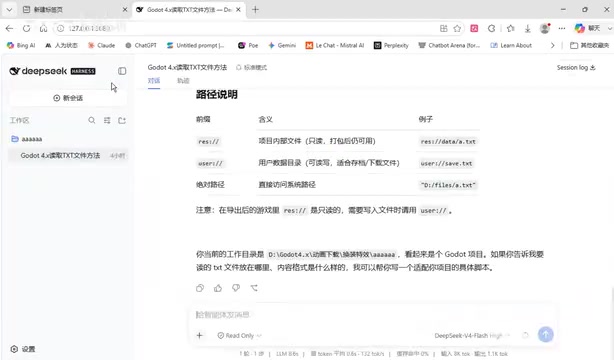
To understand this project, the key is first grasping Harness's role. It's essentially a middleware framework for AI agents — the frontend can be various plugins or UIs (colloquially called "wrappers"), while the backend handles communication with the large model (in this case, DeepSeek).
In the technical architecture of AI agents, there are typically three layers: the base layer is the large language model (LLM), the middle layer is the orchestration/scheduling framework (such as LangChain, AutoGPT, Harness, etc.), and the top layer is the user-facing frontend interface. Harness's core value lies in its implementation of the MCP (Model Context Protocol) specification — a standardized protocol that enables AI models to call external tools. Through MCP, AI is no longer limited to generating text; it can "take action": read/write files, execute commands, call APIs, and more. This architectural design completely decouples the frontend UI from the backend model, allowing developers to freely swap model providers or change frontend interfaces.
The author vividly compares it to online game communication mechanics:
"It's just like an online game — you need to click some function and connect to the server, isn't that just sending messages? Harness also connects by sending messages."
The specific call chain is: User message → Harness → DeepSeek model → Return results. Harness plays the role of routing and scheduling — it listens on a specific port, and the frontend UI establishes a connection with the backend through this port. Once the backend shuts down, the frontend becomes "an empty shell with nothing," which confirms its core status as a "hub."
You might not have noticed that Harness may pre-inject system prompts during the routing process. During testing, the author found that even without writing any prompts, the AI still "knew what it was" — precisely because Harness had already injected preset system prompts at the middleware layer. In the conversation architecture of large language models, messages are typically divided into three roles: system, user, and assistant. The System Prompt is a developer-preset instruction that defines the AI's behavioral boundaries, personality traits, and working methods — it's invisible to users but profoundly affects the model's output style and capability performance. Harness's approach of injecting system prompts at the middleware layer essentially manages AI behavioral strategies uniformly without modifying frontend code.
Permission Control and Model Settings
Harness provides a comprehensive permission management mechanism, including:
- Read-only mode: AI can only read files, not modify them
- Workspace write: Allows file modifications within the project workspace
- Full access: Can modify files anywhere on the computer
This tiered permission design is crucial for security — you can limit the AI's file operation scope based on your level of trust. This is also one of the core principles in AI agent security: the "Principle of Least Privilege" — only granting the AI the minimum permissions needed to complete a task, preventing accidental or malicious operations from causing system damage. Additionally, the UI allows setting the model (this case uses DeepSeek's deep reasoning model, which performs "chain-of-thought" reasoning before generating answers, first showing the reasoning process then presenting conclusions), reasoning intensity, custom prompts, and API verification.
Why Develop a Dedicated Godot Plugin Instead of Using Generic Tools
The most valuable part of this project is that the author didn't simply use Harness's built-in generic file read/write tools, but instead had AI write a plugin deeply integrated with the Godot engine.
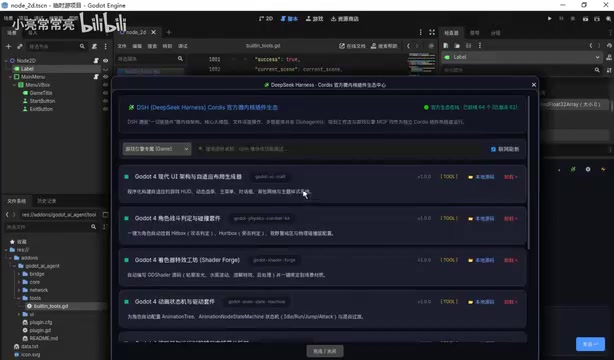
Why do this? The author gave several key reasons:
Real-time Editor UI Updates
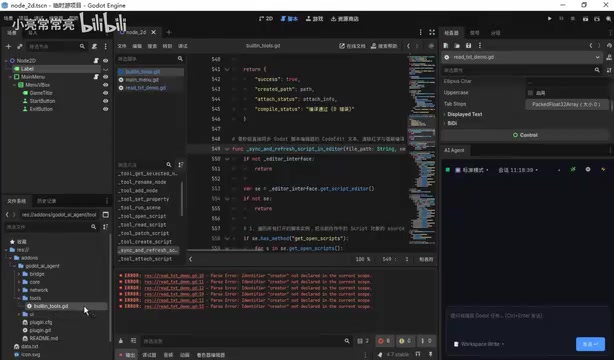
The problem with generic file read/write is: after AI modifies a file on disk, the editor interface doesn't automatically refresh — you need to manually reload the script. But when using Godot's native file read/write commands, modifications immediately refresh the editor interface, achieving true WYSIWYG. This involves an important software architecture concept — the synchronization between file system monitoring and the editor's internal state. Most IDEs and game engine editors maintain an in-memory cache of file contents; directly modifying disk files doesn't trigger a cache update. Only modifications made through the editor's own API can guarantee consistency between memory state and disk files.
Leveraging the Engine's Static Analysis Capabilities
Many AI agents need to analyze code syntax on their own, but the Godot editor already has built-in error detection capabilities. Godot uses its proprietary GDScript scripting language (with Python-like syntax), and its built-in static analyzer can detect syntax errors, type mismatches, undefined variables, and other issues before code execution. The author's plugin only needs to read the engine's existing error messages — no need to reinvent the wheel. It's both fast and accurate.
"The Godot editor already has this capability — if there's an error somewhere, it reports it automatically. The plugin we wrote just reads these errors, which is fast, convenient, and accurate."
Precise Patch-Style Code Modifications
Generic tools often rewrite entire files, while deeply integrated plugins can perform line-specific modifications — reading and fixing only the problematic sections without touching the rest. This is not only more precise but also significantly reduces token consumption. A token is the basic unit of text processing for large language models — roughly 1.5-2 tokens per Chinese character, and 1-3 tokens per English word, with API calls billed by token count. When AI needs to rewrite an entire 500-line script, it might consume thousands of tokens; patch-style modification only needs to transmit the few problematic lines and their fixes, potentially reducing token consumption by over 90%. For development workflows that frequently call AI, this optimization means significant cost savings and faster response times.
Live Demo: AI Autonomously Fixing Godot Code Errors End-to-End
The author demonstrated a typical scenario: deliberately introducing an error in a script, then letting AI fix it. The entire process was completed autonomously through a series of tool calls:
- Query error logs — Call tool to read "Line 10, XXX error"
- Read corresponding code — Precisely locate the problematic script segment
- Execute fix — Call patch tool to modify code, return "compilation successful"
This "think-act-observe" loop is known as the ReAct pattern (Reasoning + Acting) in the AI agent field. Its working principle is: developers pre-define a set of available tools (such as read_file, write_patch, get_errors, etc.), each containing a name, description, and parameter format. When the model determines it needs to perform an operation, instead of directly outputting a text response, it generates a structured tool call request. The framework receives the request, executes the actual operation, feeds the result back to the model, and the model continues reasoning based on the result — cycling until the task is complete.
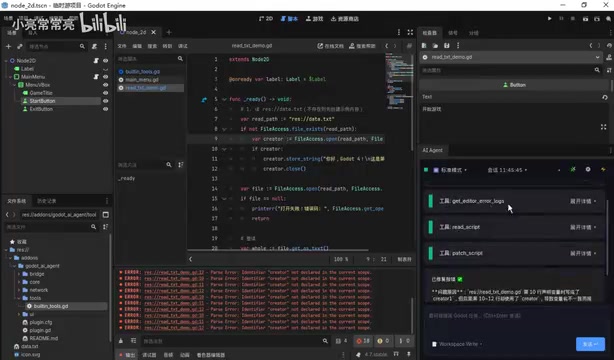
The entire workflow is very intuitive — after modifications are complete, the error indicators in the editor disappear immediately and the interface refreshes in real-time. The author emphasizes that this deeply integrated experience is far superior to the disconnected approach of "external AI editor + screenshot conversations" — the latter often requires opening an additional window, and the AI can't see the editor's real-time state.
However, testing also revealed some issues: the DeepSeek model occasionally takes too long to think, or even fails to properly display tool calls. The author suspects this is due to occasional model "hallucinations" or the plugin itself not being polished enough. "Hallucination" is a common problem with large language models, referring to the model generating content that seems reasonable but is actually incorrect or non-existent. In tool-calling scenarios, hallucinations might manifest as calling non-existent function names or passing parameters in wrong formats. This reminds us that AI agent stability still has room for optimization, and production environments typically need retry mechanisms and result validation layers.
Extensibility: From Godot to Unity and Beyond
This solution's potential extends well beyond Godot. The author points out that Harness, as a general-purpose middleware framework, can theoretically interface with Unity and other software, giving them AI agent capabilities. As one of the world's most widely used game engines, Unity has a comprehensive C# API and Editor extension mechanism (such as EditorWindow, CustomEditor, etc.), providing a solid technical foundation for AI agent plugin development.
Developers only need to write corresponding plugin functions for their target software, for example:
- Adding nodes, running scenes
- Opening/reading scripts
- Patch-style file read/write
- In-game screenshots, playthrough script testing, and other complex features
For complex features, they can be split into multiple independent files for separate management, maintaining project clarity. Additionally, combined with carefully designed system prompts (explaining under what circumstances to call each tool), AI behavior can be made more controllable. This "tool description + calling conditions" design pattern essentially builds an "operation manual" for the AI, helping it choose the most appropriate tool combinations for different tasks.
Conclusion: AI Programming Is Reshaping Game Development Workflows
The biggest takeaway from this case is: The value of AI agents lies not in replacing generic tools, but in deep integration with specific work environments. By calling the engine's native capabilities, AI can achieve faster, more accurate, and more token-efficient operational experiences.
For game developers and the broader software development community, frameworks like Harness provide a viable path — embedding large model capabilities into familiar tools with a relatively low barrier to entry. Behind the so-called "beginner mastery" is actually an inevitable trend following the democratization of AI programming capabilities: tedious work like writing plugins and setting up environments can all be handed off to AI, while humans only need to clearly express their requirements.
From a broader perspective, this represents an important paradigm shift in software development — from "humans writing code to control machines" to "humans using natural language to direct AI to write code to control machines." When AI can understand engine APIs, read error logs, and autonomously fix code, the developer's role is shifting from "implementer" to "architect" and "reviewer." This transformation won't eliminate the value of programming skills, but it will dramatically lower the barrier to entry, enabling more people with creativity but lacking programming experience to participate in game and software development.
Key Takeaways
Related articles

Chain of Thought Isn't Just for AI: How Humans Can Use CoT to Improve Thinking Quality
Chain of Thought isn't just a prompt trick for large models. Starting from a Hacker News discussion, this article analyzes why CoT works for human thinking too, breaks down actionable ways to transfer it, and highlights the key differences between human CoT and machine CoT.
Cloudflare Teams Up with OpenAI: Closi…
Cloudflare Teams Up with OpenAI: Closing the Loop from Vulnerability Discovery to Defense with AI
Cloudflare uses OpenAI Daybreak to investigate security vulnerabilities and generate reviewable remediation plans, while developers use Codex to boost coding efficiency and quality.

Orca Multi-Agent Orchestration in Practice: A Guide to Parallel Collaboration with Claude and Codex
Orca is Stable AI's free open-source agent workbench supporting 34 agents like Claude Code and Codex in parallel. Learn its Git worktree isolation, multi-model orchestration, and mobile management.