Hands-On with Apple Siri Recaps: A Useful but Unsettling AI Summary

Siri Recaps shows AI summary utility within a day, but privacy unease and room for improvement remain.
Based on a day of hands-on use, this article analyzes Apple Siri Recaps' practical value and potential concerns. Siri Recaps intelligently organizes notifications and long content, winning quick approval, yet privacy worries persist since the feature accesses user data, with the user calling it "a little unsettling." The article also notes room for improvement in accuracy, content adaptability, and privacy transparency, and positions Siri Recaps as an important step in Apple's AI strategy — its system-level integration an advantage, but facing third-party competition. Long-term acceptance hinges on balancing efficiency and privacy.
Title
Hands-On with Apple Siri Recaps: A Useful but Unsettling AI Summary
Meta Description
Hands-on test of Apple Siri Recaps: won user approval within a day, highly practical but raises privacy concerns. This article analyzes its strengths, privacy controversy, and room for improvement, exploring the convenience and unease of AI summaries.
Article Content
Apple's AI features have always drawn attention, and Siri Recaps, its latest smart summary feature, has sparked new discussion around the trade-off between privacy and convenience. After a day of real-world use, one user gave the verdict: "surprisingly useful — and a little unsettling." Based on that experience and multiple sources, this article takes a deep dive into the practical value and potential concerns of Siri Recaps.
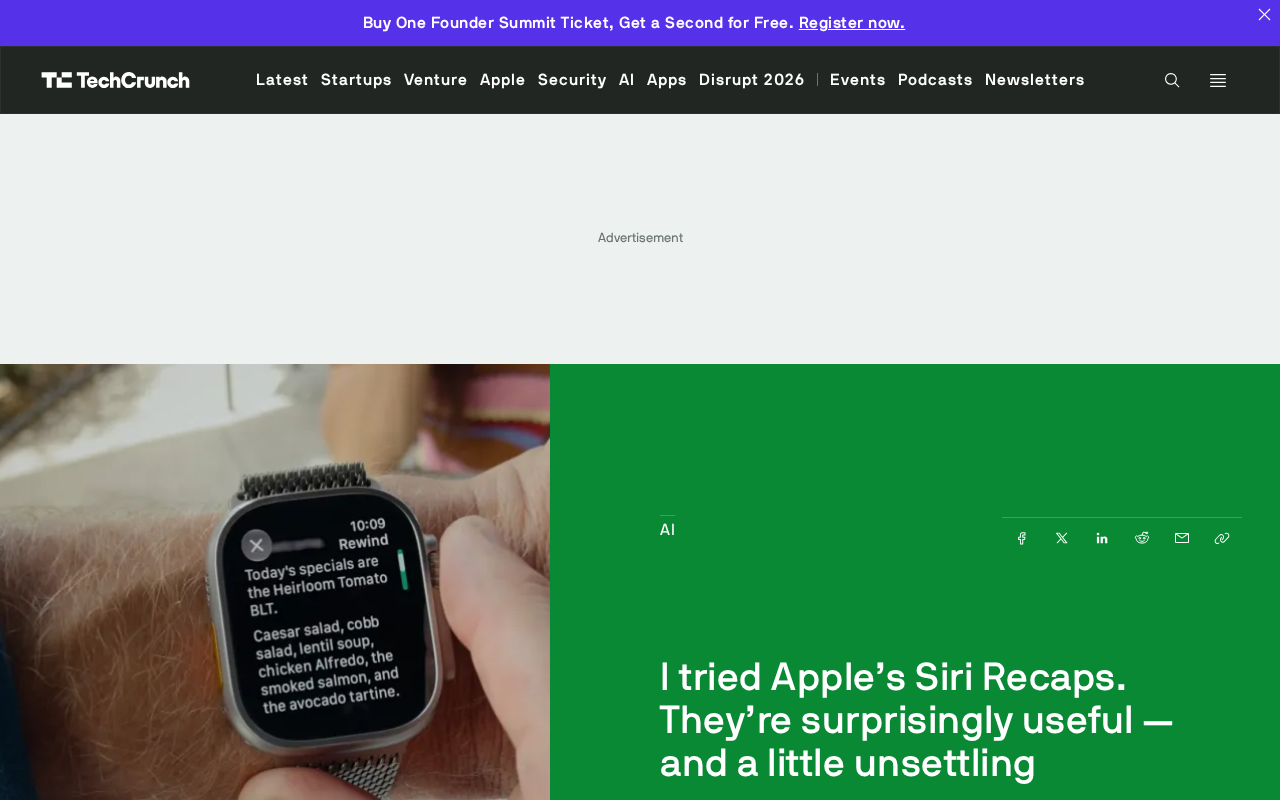
Surprisingly Useful: Winning Users Over in a Day
According to user feedback, Siri Recaps won him over in just one day. The feature intelligently organizes and summarizes information, helping users quickly grasp the key points, and performs especially well when handling large volumes of notifications or long content. Although the user initially had privacy concerns, practicality ultimately won out. This instant effectiveness suggests Apple has done considerable optimization on summary accuracy and scenario adaptation.
The Tug of War Between Privacy and Convenience
Behind the convenience of Siri Recaps lies users' natural concern about privacy. The feature needs access to user data to generate summaries, which inevitably involves sensitive information. The user's admission that it felt "a little unsettling" reflects the unease about how data is used and stored while enjoying the efficiency gains AI brings. Apple has always marketed privacy protection as a selling point, but whether the deep involvement of AI summaries changes that balance is worth watching.
The privacy difference between on-device and cloud processing is key background for understanding the privacy controversy around Siri Recaps. Apple's "privacy computing" strategy in recent years emphasizes completing as much AI inference as possible locally on the device (on-device) — for example, notification summaries and photo recognition can run on the iPhone's neural engine without raw data leaving the device. But limited by on-device compute, summaries of complex or long texts often need Apple's Private Cloud Compute — an architecture that claims "servers do not retain data and are used only for computation." The user's "a little unsettling" feeling stems precisely from the difficulty of intuitively judging which end a given summary was generated on and which nodes the data passed through. Compared with purely local processing, cloud involvement means the object of trust expands from "one's own device" to "Apple's servers and compliance commitments." Although this transfer of trust is supported by the technical architecture, it is not transparent to ordinary users.
Still Room for Improvement
Although Siri Recaps performs satisfactorily overall, the user explicitly noted that "there's still room for improvement." Possible directions include summary accuracy, adaptability to different content types, and more transparent privacy controls. The current feature may only be the starting point of Apple's AI strategy, and future iterations are worth anticipating.
Siri Recaps from Multiple Perspectives
Taking discussions from multiple sources together, the launch of Siri Recaps is seen as an important step for Apple in the AI assistant space. Some analyses point out that its deep integration with system-level apps is an advantage, but it also faces competition from third-party AI summary tools. In user communities, privacy concerns coexist with appreciation for convenience — a contradictory mindset that is quite representative.
Understanding Siri Recaps' positioning requires distinguishing between two technical approaches: system-level summarization and generative summarization. System-level summarization is mostly based on extractive methods, selecting key sentences from original notifications, emails, or web pages and reassembling them; its advantages are high factual fidelity and low risk of "hallucination," but limited linguistic flexibility. Generative (abstractive) summarization has large language models reorganize the language, offering stronger readability but carrying the risk of distorting the original meaning. Siri Recaps is closer to a hybrid of the former and lightweight generation, which explains why it performs relatively solidly on "accuracy" yet is still noted by users as having "room for improvement." Compared with third-party AI summary tools (such as browser extensions and standalone apps), the advantage of system-level integration is that it can call data across apps without users manually copying and pasting; the disadvantage is low configurability, making it hard for users to audit the source of summaries. This trade-off — "deep integration for convenience at the expense of some transparency" — is precisely the focus of multi-party discussion.
Conclusion: The Art of Balance
Siri Recaps demonstrates the practical potential of AI summaries, but it also reminds us that while pursuing efficiency, issues of privacy and control cannot be ignored. How Apple continues to optimize this balance will determine the feature's long-term acceptance.
One-line Summary
Siri Recaps shows the practicality of AI summaries within a day, but privacy unease and room for improvement coexist.
Paragraph Summary
Based on one user's day of real-world experience with Apple Siri Recaps, this article analyzes the practical value and potential concerns of the AI summary feature. The experience shows that Siri Recaps can intelligently organize notifications and long content, helping users quickly grasp key points, and won approval in a short time — indicating Apple has optimized summary accuracy and scenario adaptation. Yet behind the convenience are privacy concerns: the feature needs access to user data to generate summaries, and the user admitted the experience felt "a little unsettling," reflecting unease about data usage and storage. The article also notes room for improvement in summary accuracy, adaptability to content types, and transparency of privacy controls. Drawing on multi-source discussion, Siri Recaps is seen as an important step in Apple's AI strategy, with system-level integration as an advantage but facing competition from third-party tools. The conclusion emphasizes that whether Apple can maintain a balance between efficiency and privacy will determine the feature's long-term acceptance.
Related articles
 Tech Frontiers
Gemini Omni 1.2 Flash: AI Video Moves Toward Draft-Style Editing
Google's Gemini Omni 1.2 Flash update enables conversational, draft-style editing of the same video—swap scenes while keeping products, adjust lighting while keeping characters. Clips up to 15s, 720p costs 30% less than the previous Flash—ideal for e-commerce ads, previs, and short-asset production.

Codex Tutorial: One-Command Install and Run Your First Task
Codex tutorial: one-command install and run your first task. Covers the four Codex forms, sandbox and approval guardrails, AGENTS.md and MCP configs, cloud network policy, and the iron rule of human review—everything you need to get started with this autonomous coding agent.
 Tech Frontiers
Localix: An Open-Source Agentic Development Environment with Multi-Model and Local AI Integration
Localix is an MIT open-source Agentic Development Environment (ADE) supporting seamless Claude Code plugin loading, multi-model cloud and local execution, Mini Apps extensions, and agent context management—an open AI collaboration workbench for developers.