Hands-On with OpenAI's dot: How an AI Assistant Learns Your Workflow

A user spontaneously recommends OpenAI's dot, saying it gets better every day by learning their workflow.
A Twitter user shared that dot is "my favorite OpenAI product so far," with the core experience being that it gets better every day because it increasingly understands their workflow and style. The article discusses AI assistants' personalized adaptability: dot not only remembers tasks, but also understands how users handle tasks and their preferences. This visible progress from continuous learning creates a differentiated experience. The user specifically mentioned using dot for affairs with extremely high psychological costs that accumulate dread like a gravity well, seeing this as more valuable than merely improving efficiency. The article notes that competition among AI assistants is shifting from basic capabilities to the depth of personalized adaptation, and switching costs will become an important moat.
In OpenAI's product lineup, dot is becoming a name that users spontaneously talk about. One user shared their experience on Twitter, calling dot "my favorite OpenAI product so far," and highlighted a key experience: it gets better every day because it increasingly understands my workflow and style.
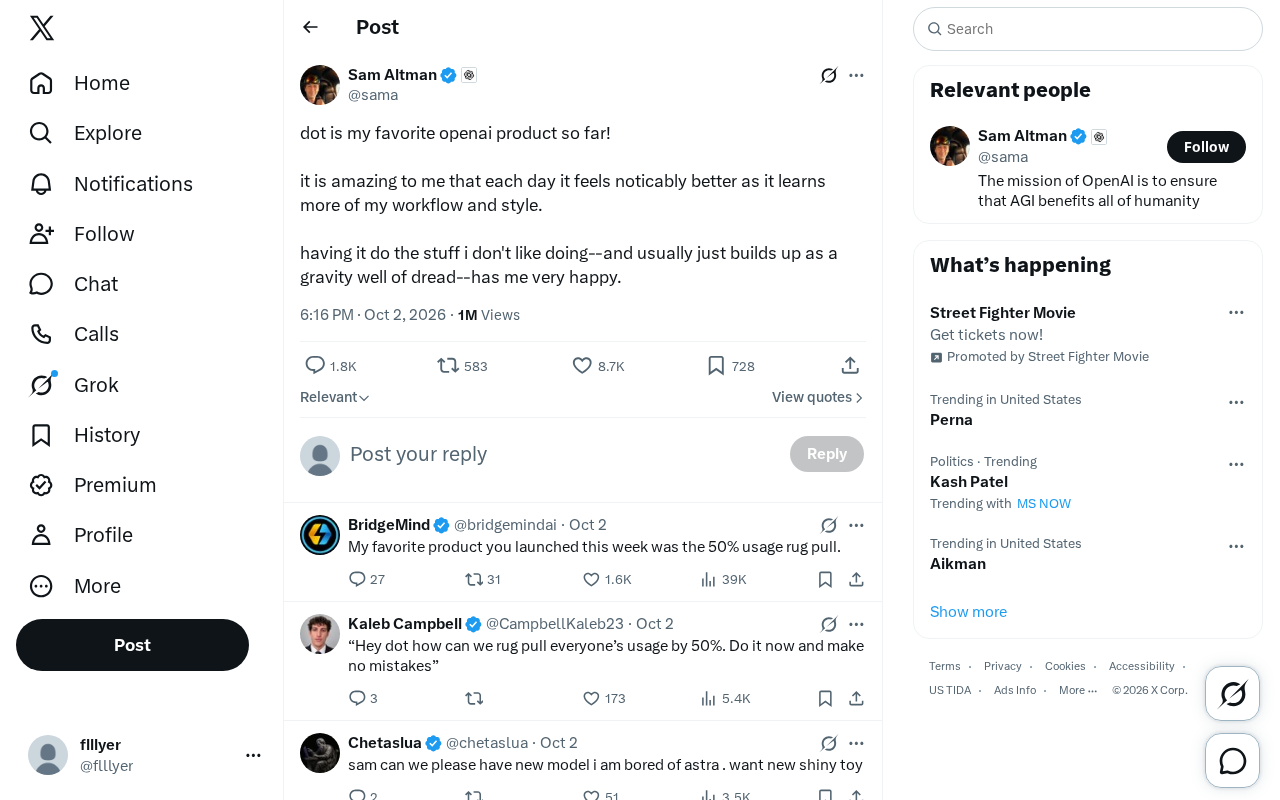
This brief share touches on the most core proposition of AI assistant products—personalized adaptability. When a tool can continuously learn a user's working methods and expression habits, it is no longer a general-purpose tool, but more like a collaborator that gradually gets in sync.
dot's Differentiated Experience: From Generic to Personalized
The user's core feelings center on two points:
Visible progress from continuous learning. "You can clearly feel it getting better every day"—this perception itself shows that dot's learning curve is steep enough, and the learning results can be intuitively captured by the user. This forms a sharp contrast with the experience of many AI tools where "after half a year, it's still the same."
Adaptation to personal workflow and style. The user mentioned that dot is learning their "workflow and style," which means it not only remembers the task itself, but also understands how the user handles tasks and their preferences.
The realization of this personalization capability usually involves technical paths such as memory mechanisms, context accumulation, and user behavior modeling. From user feedback, dot's performance in this area has already reached a level that makes people "feel surprised."
Memory mechanisms and context accumulation are currently two main technical paths for AI assistants to achieve personalization. Memory mechanisms usually refer to the system explicitly storing user preferences, habits, and historical interactions as structured data (such as user profiles and long-term memory banks), which are retrieved and injected as needed in subsequent conversations; context accumulation relies on the model's long context window or conversation history stitching, allowing the model to reference more information within a single session or across sessions. User behavior modeling goes a step further by analyzing implicit signals such as user task selection, modification behavior, and expression style to dynamically adjust model output. Only by combining the three can an AI assistant potentially evolve from "remembering what you said" to "understanding why you do it."
Why "Do the Things I Hate" Matters So Much
One usage scenario the user specifically mentioned is worth expanding on: letting dot do the things they dislike doing, and these things "usually accumulate like a gravity well into a sense of dread."
This passage precisely describes a common pain point. In daily work and life, there are always some tasks that are not difficult in themselves, but have extremely high psychological costs—procrastination, anxiety, irritation at the thought of them. They do not have deadlines forcing you like urgent tasks, yet like dark matter they continuously consume attention.
The value of AI assistants in such scenarios may be greater than in grand narratives like "improving efficiency." When a tool can digest the affairs you resist for you, it provides not only time savings, but also the offloading of psychological burden. The user said this made them "very happy," and this emotional feedback itself illustrates the product's actual value.
In psychology, task aversiveness is commonly used to describe this phenomenon: the task itself is not highly difficult, but emotional resistance makes the cost of starting extremely high. Researchers studying procrastination behavior have found that people's negative expectations about a task (such as boredom, anxiety, and self-doubt) often predict the degree of procrastination better than the task's actual time consumption. If an AI assistant can transform such tasks from "I must face them myself" to "I only need to review the results," it simultaneously reduces the emotional startup cost and sustained attention consumption. This is also why many users' gratitude toward AI does not come from how difficult the thing it did was, but from the fact that it did the things that had "been weighing on their minds but had not been acted on for a long time."
The Competitive Focus of Personalized AI Assistants
From this share, one can glimpse a competitive trend in AI assistant products: shifting from competing on basic capabilities to competing on the depth of personalized adaptation.
Basic capabilities (conversation quality, task execution accuracy) are gradually becoming commoditized, and the gap between products in this area is narrowing. The real moat is beginning to shift to: who can make users feel that "this AI understands me."
dot's user feedback provides a reference coordinate—when an AI assistant learns workflows fast enough that users can perceive progress every day, product stickiness will increase significantly. Because the switching cost is no longer just "changing to another tool," but "giving up an assistant that already understands me."
At present, specific technical details and product positioning information about dot remain limited, but this kind of spontaneous recommendation from real users often explains a product's actual experience better than official promotion.
For users currently choosing an AI assistant, this share suggests an evaluation dimension worth paying attention to: do not only look at whether it can complete tasks, but also whether it can increasingly understand your way of doing things as you use it.
Switching cost in software products usually includes data migration, learning a new interface, and rebuilding work habits. When an AI assistant has deep personalization capabilities, a new and hardest-to-quantify part is added to switching cost: giving up a collaborative partner that has already accumulated a large amount of personal context and understands your workflow. This is similar to input methods or note-taking software used for a long time—functionally replaceable, but the time required to retrain a new system to reach the same level of tacit understanding constitutes a de facto lock-in effect. Therefore, the depth of personalized adaptation is not only an experience advantage, but may also become one of the strongest moats for AI assistant products.
One-line Summary
Users spontaneously recommend OpenAI's dot, saying it gets better every day because it continuously learns their personal workflow.
Paragraph Summary
A Twitter user shared that dot is "my favorite OpenAI product so far," with the core experience being that it gets better every day because it increasingly understands their workflow and style. The article then discusses AI assistants' personalized adaptability: dot not only remembers tasks, but also understands how users handle tasks and their preferences. This visible progress brought by continuous learning forms a differentiated experience. The user specifically mentioned using dot to handle affairs with extremely high psychological costs that accumulate dread like a gravity well, considering this more valuable than merely improving efficiency. The article points out that competition among AI assistants is shifting from basic capabilities to the depth of personalized adaptation, and switching costs will become an important moat.
Related articles

Chain of Thought Isn't Just for AI: How Humans Can Use CoT to Improve Thinking Quality
Chain of Thought isn't just a prompt trick for large models. Starting from a Hacker News discussion, this article analyzes why CoT works for human thinking too, breaks down actionable ways to transfer it, and highlights the key differences between human CoT and machine CoT.
Cloudflare Teams Up with OpenAI: Closi…
Cloudflare Teams Up with OpenAI: Closing the Loop from Vulnerability Discovery to Defense with AI
Cloudflare uses OpenAI Daybreak to investigate security vulnerabilities and generate reviewable remediation plans, while developers use Codex to boost coding efficiency and quality.

Orca Multi-Agent Orchestration in Practice: A Guide to Parallel Collaboration with Claude and Codex
Orca is Stable AI's free open-source agent workbench supporting 34 agents like Claude Code and Codex in parallel. Learn its Git worktree isolation, multi-model orchestration, and mobile management.