Hands-On with Tencent's Open-Source Octopus: The Awkward Positioning of a Multi-Agent Collaboration Tool

Tencent's open-source Octopus is a geek-oriented multi-Agent tool with deep Tencent ecosystem integration, not a consumer AI assistant.
Tencent's open-source Octopus has earned 7,000+ GitHub stars, but comparing it to "China's Manus" misses the mark. It's a power-user-oriented multi-Agent collaboration tool whose standout strength is deep integration with WeCom, DingTalk, and Feishu, alongside built-in multi-Agent teams, long-term memory, skill recording, and cross-platform remote desktop. Its SQLite backend limits high-concurrency team use, and the setup barrier is high for casual users. Compared to Alibaba's enterprise-grade AgentScope framework, Octopus sits awkwardly between productized packaging and infrastructure. Its most promising direction is ACP-based multi-Agent orchestration.
What Is Octopus: A Collaborative AI Assistant Misread as "China's Manus"
Tencent recently open-sourced an Agent tool called Octopus, which has already accumulated over 7,000 stars on GitHub. Many online voices have labeled it "China's Manus" or a "domestic Grok Agent," but after hands-on testing, I don't think that comparison holds up — the two are fundamentally different.
Recent Western Personal Agents (such as the product Meta released) are built around a core idea: lowering the barrier for everyday users to operate complex Agents. They assume that tools like ChatGPT and Codex are still too difficult for non-technical users, and aim to simplify things even further. Octopus, by contrast, is fundamentally aimed at tinkerers and power users — it feels more like an upgraded, packaged version of OpenCode than a true consumer-grade Personal Agent.
In other words, if you're expecting an out-of-the-box AI assistant that anyone can pick up and use, Octopus will likely disappoint. But if you're willing to roll up your sleeves and configure it, the feature set it integrates is genuinely interesting.
Core Features: Multi-Agent Expert Teams and Tencent Ecosystem Connectors
Octopus bundles a range of capabilities into a single package. Here are the highlights worth noting:
Multi-Agent Expert Team. This design philosophy is similar to Tencent's internal WorkBody — essentially a collaborative team made up of multiple Agents. While you could build a similar architecture yourself using tools like OpenCode, Octopus packages everything out of the box, saving you the manual setup effort. Think of it as a "simplified WorkBody."
Connect Connector System. This is one of Octopus's more distinctive features — it can quickly integrate with the Tencent ecosystem and supports login and connection via WeCom (企业微信), DingTalk, and Feishu. Given how deeply embedded the Tencent ecosystem is in China, these pre-built integrations offer real practical value.
Long-Term Memory and Knowledge Base. It includes a memory module and knowledge base capabilities, both of which are also present in WorkBody. Notably, the knowledge base's vector model supports local deployment, making it a good fit for scenarios where data privacy is a priority.
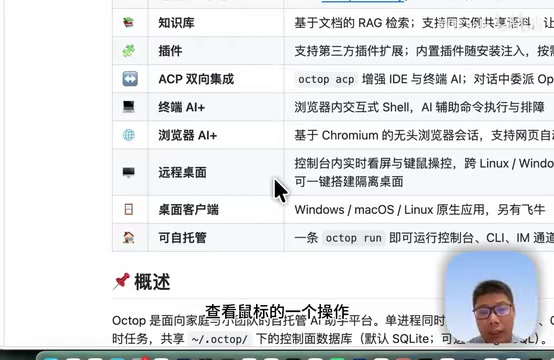
Cross-Platform Collaboration. The console provides real-time viewing of mouse operations and supports collaboration across Windows, Linux, and macOS. This is partly why observers have tried to position it alongside Personal Agents — but it's still a significant step removed from products like Computer Use or Browser Use.
Installation Experience: Simple Process, Questionable Deployment Positioning
The overall installation process isn't complicated. On macOS, you simply copy the install command from the official documentation, run it, and start the service.
During setup, you'll need to configure a secret key — the system will prompt you with the directory where it's stored, and you can view it with cat and paste it to complete verification. From there, you create an admin username and password, configure your model API Key (I tested it with the DeepSeekAd model), run a connectivity test, and you're ready to go.

However, this is where an awkward limitation surfaces: Octopus uses SQLite as its database, which means it's not well-suited for genuine high-concurrency multi-user team use. The official pitch targets teams, but the technical foundation is more realistic for household or small-team internal use — and those use cases are themselves fairly limited.
Workbench, Skills Marketplace, and Remote Desktop
Octopus also offers several advanced features:
Skills Marketplace and Skill Packages. There's a built-in skills marketplace where you can install skills directly from the interface and configure them to your needs.
Skill Recording and Playback. You can perform an operation manually once, have the system record it, and then have it execute automatically on replay — quite useful for repetitive tasks.
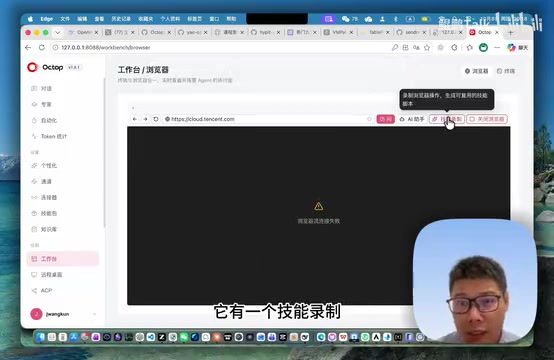
Remote Desktop and Sandbox Workbench. It can remotely launch a sandbox environment where the AI actually operates, and you can monitor what's happening inside from the interface. It also supports controlling remote desktops — for example, directly operating a Linux server's OS; using this on macOS requires additional authorization. This capability is the primary reason outsiders have tried to frame it as a Personal Agent, but in my view, it still falls well short of that goal.
ACP Connectivity: The Most Promising Direction
In my opinion, Octopus's most genuinely valuable direction is its ability to connect Agents via ACP. It essentially integrates locally installed Agents into a single system, acting as a "brain" that orchestrates and controls multiple Agents — similar in concept to Motia or Coze.

Currently, it works by detecting whether the relevant plugins or Agents are installed locally — if not, you still have to install them manually. I think the more meaningful evolution would be allowing a separate remote machine to be used as one of its Agents or hosts. If that becomes possible, its value as an orchestration hub would increase dramatically.
ACP (Agent Communication Protocol) is a protocol specification for communication and collaboration between Agents. Its core idea is to enable different AI Agents to discover, call, and hand off tasks to one another without caring about each other's underlying implementation. A similar concept is Anthropic's MCP (Model Context Protocol) — both aim to solve the standardization problem of "how multiple Agents collaborate." Within the ACP framework, Octopus plays the role of "orchestrator" — rather than executing all tasks directly, it delegates subtasks to specialized Agents better suited for specific domains, then aggregates the results. The architecture's strength lies in scalability: as long as a new Agent conforms to the protocol interface, it can be incorporated into the scheduling system without modifying the central logic. Octopus's ACP capabilities currently still depend on locally installed plugins, and remote Agent integration is not yet mature — but this direction is the core potential that distinguishes it from monolithic Agent tools.
Side-by-Side Comparison: How It Differs from Alibaba's AgentScope
Tencent doesn't open-source projects all that often, which is part of why Octopus is worth paying attention to. Comparing it with Alibaba's AgentScope makes the positioning clearer:
- Alibaba AgentScope is positioned as an enterprise-grade framework / Agent infrastructure, aimed at developers building complex projects.
- Tencent Octopus wants to be an out-of-the-box product for small teams, but lacks a particularly sharp differentiation from other existing Agent tools.
From a user experience perspective, Octopus feels somewhat similar to open-source products like LocalHub, but hasn't yet caught up in terms of feature richness. Its awkwardness is precisely this: it's not as specialized as a pure enterprise-grade infrastructure play, nor is it as accessible as a consumer-grade Personal Agent that any user can easily pick up.
AgentScope is a multi-Agent orchestration framework open-sourced by Alibaba in 2024, positioned as a developer-facing infrastructure layer. It provides enterprise-grade capabilities such as message passing, fault tolerance, and distributed deployment — ideal for building production-grade applications requiring complex process control. By comparison, Octopus targets users who have some technical background but don't want to build everything from scratch, with a stronger emphasis on productized packaging over framework flexibility. This positioning difference also reflects the two companies' divergent paths in AI infrastructure: Alibaba tends to expose low-level capabilities for developers to freely combine, while Tencent attempts to create differentiation through deep integration with its own ecosystem.
Conclusion: Ecosystem Integration Is the Main Selling Point, but the Barrier Remains High
Octopus is currently best classified as a "power-user" tool rather than a mainstream AI assistant. Its core strength lies in deep integration with the Tencent ecosystem — WeCom, DingTalk, Feishu, and other tools that are essential in the Chinese market are all pre-packaged, which offers genuine convenience for domestic teams.
However, its SQLite foundation, lack of standout differentiation, and the relatively high configuration barrier for everyday users leave its overall positioning feeling somewhat unclear. If future iterations continue to build around ACP and turn it into a true multi-Agent orchestration hub, this product still has significant untapped potential. If you're curious, it's worth following and giving it a try.
Related articles

JobRunner MCP Server: AI Agents Can Now Fix Failed Java Jobs
JobRunner launches an open-source MCP server enabling AI agents to view cluster status, diagnose failures, and recover Java jobs—incident response from any cloud coding environment or existing agent.

MLAI Digital Launches 9 Security Agents: MCP Server Safeguards the Full Lifecycle of Agentic AI
MLAI Digital launches Security MCP Server with nine built-in specialized security agents covering vulnerability discovery, attack simulation, prompt injection detection, API and infrastructure assessment, and accelerated remediation—embedding security validation across the full Agentic AI lifecycle from development to production.

Running Isaac Lab on H100 GPUs: Exploring Better Approaches
Exploring optimization methods for running Isaac Lab on NVIDIA H100 GPUs, including MIG configuration, mixed precision, TensorRT acceleration, and community experience to improve robotics simulation and reinforcement learning efficiency.