Hardcoded Database Password in Applebee's App Exposes Customer Data

Hardcoded database password in Applebee's app exposes customer data to unrestricted access, revealing a common mobile credential management flaw.
A security research team discovered hardcoded database credentials in Applebee's mobile app. Anyone with the installation package can extract the password through reverse engineering and bypass app logic to directly access customer personal data. The article notes that the severity lies not in password complexity but in storing credentials in publicly analyzable client code. Such vulnerabilities recur mostly due to process flaws—leftovers from development integration, outsourced code lacking review, and improper CI/CD configuration—rather than mere individual negligence. Mature industry practices include backend proxy access, replacing long-term keys with short-term revocable tokens, automated secret scanning before release, and least privilege with rapid rotation. Enterprises should treat mobile artifact audits with the same seriousness as backend penetration testing.
A security research team discovered hardcoded database credentials in Applebee's mobile app, allowing unrestricted access to customer personal data. This incident once again exposes systemic flaws in credential management during mobile app development.
The Core of the Incident: A Single Hardcoded Password Opens the Data Door
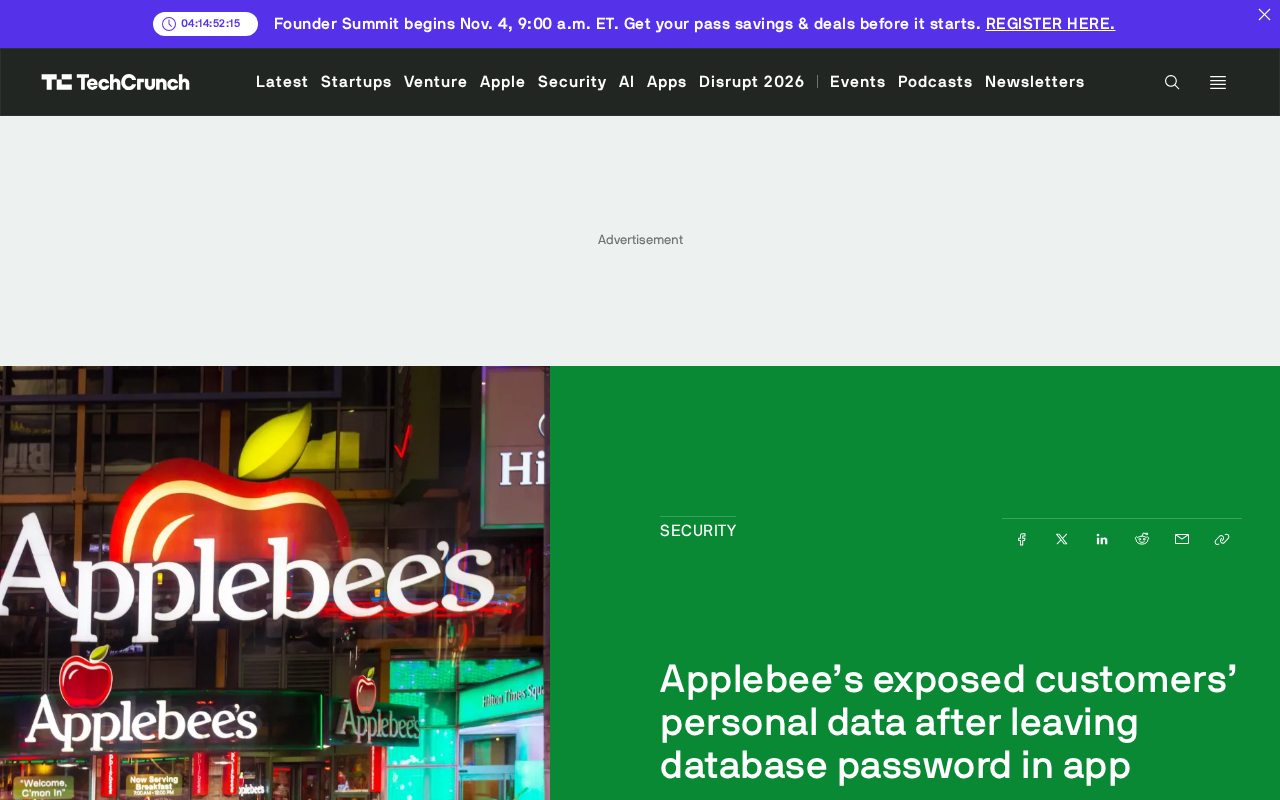
According to disclosures by security researchers, the Applebee's app embedded the database password directly into client-side code. This means anyone who obtains the app installation package can extract these credentials through reverse engineering, bypass application-layer logic, and directly access the backend database. The researchers stated that the credentials allowed "unrestricted access" to customer personal data.
The severity of the problem lies not in how complex the password is, but in where the credentials are stored. Once a client app is released, its code is in a state where anyone can analyze it. Putting a database password into an app is equivalent to welding the key to the lock—no matter how strong the lock, it becomes meaningless.
From an attack surface perspective, the exposure path for hardcoded credentials is extremely short: download the app, unpack it, search for strings, find the credentials, connect to the database. The entire process requires no complex vulnerability chain, nor social engineering or phishing. This is also why such issues have consistently been classified as high-priority risks in the security community.
Reverse engineering and string extraction are key background concepts for understanding this type of vulnerability. Android APKs and iOS IPAs are essentially distributable compressed packages. Attackers can use tools like apktool, jadx, and Hopper to decompile approximate source code, or directly run the strings command on binary files to scan for printable characters. Hardcoded passwords, API keys, and connection strings typically exist as plaintext constants in classes.dex, resource files, or compiled artifacts, and can be located by searching keywords such as "password," "jdbc," or "mongodb." Even if developers apply simple string obfuscation or Base64 encoding, this only raises the bar slightly and does not constitute real protection—because the decryption logic also runs on the client, and attackers can replicate it. This is precisely the fundamental reason the security community emphasizes that "clients must not store secrets": any data distributed with the app ultimately resides in an environment controlled by attackers.
Why Such Vulnerabilities Recur
Hardcoded credentials are not a new problem, but they have gained new destructive power in the mobile app era. In traditional web applications, database credentials are usually stored in server-side configuration inaccessible to users; mobile apps, however, push a large amount of logic to the client, amplifying the tension between development convenience and security boundaries.
There are several common causes. During development, engineers may write connection strings directly into code for rapid integration testing, planning to clean them up before release, but the cleanup action never enters the release checklist. Code delivered by outsourced teams lacks security review, and credentials are retained as ordinary constants. In CI/CD pipelines, improperly configured environment variables inject sensitive values into client artifacts during build.
These causes point to the same conclusion: hardcoded credentials are often a process problem rather than individual negligence. As long as the release process lacks an automated secret-scanning step, relying on human memory to clean up credentials will inevitably result in omissions.
CI/CD and build-time environment variable injection are key to understanding the causes. Modern mobile development widely uses continuous integration pipelines to automatically build and sign apps, with sensitive configuration typically injected via environment variables or secret management services. The problem is that if build scripts write server-side environment variables (such as DATABASE_URL) directly into BuildConfig, Info.plist, or package them into resource files, these values will be released along with the artifact. Additionally, chaotic management of multi-environment configurations (development/testing/production) often causes test-environment credentials to be mistakenly included in production builds. The preventive approach is to completely isolate client builds from server-side configuration and add a scanning step for the final artifact at the end of the pipeline—rather than only scanning source code repositories—because obfuscation, compression, or dynamic concatenation may cause source code scans to miss issues.
Correct Practices for Client Credential Management
The industry already has relatively mature practice paths for addressing this problem.
Backend proxy access. The client does not connect directly to the database; all data requests are forwarded through backend APIs, and credentials exist only on the server side. This is the most basic layering principle, but it is often skipped when pursuing development speed.
Short-term tokens instead of long-term keys. Even if the client needs to carry some kind of credential, it should use short-term, revocable, permission-restricted tokens rather than long-lived database passwords. Token permissions should be narrowed according to the principle of least privilege, avoiding a single credential that opens an entire table.
Automated scanning before release. Integrating secret-scanning tools into the CI process to perform string matching and entropy detection on build artifacts can intercept hardcoded credentials before code reaches the app store. The cost of such tools is far lower than post-incident remediation.
Credential rotation and least privilege. Database accounts should not use administrator privileges and must have rapid rotation capability. Once a leak is discovered, rotation speed determines the length of the exposure window.
The principle of least privilege and short-term token mechanisms deserve further explanation. Least privilege requires that each database account or token possess only the scope of operations necessary to complete its task—for example, read-only access, or access limited to specific tables or specific users' data. Short-term tokens are typically issued based on OAuth 2.0 or similar mechanisms, with validity periods ranging from minutes to hours, and support revocation at any time. Complementary to this is token binding, which associates tokens with devices, user sessions, or IP addresses, making stolen tokens difficult to reuse in other environments. By contrast, once a long-lived database password is leaked, attackers can maintain access for months with little detection. Credential rotation should be automated and rehearsable, ensuring that invalidation and replacement are completed within hours of discovering a leak, minimizing the exposure window.
Practical Reminders for Enterprises
The Applebee's case demonstrates that data breaches do not necessarily come from carefully planned advanced attacks. A single string left in code is enough to leave customer data openly accessible. For enterprises with consumer-facing apps, security audits of mobile artifacts should be treated with the same seriousness as backend penetration testing.
Given regulatory trends, personal data protection requirements continue to tighten, and data exposure caused by improper credential management may trigger both security and compliance liabilities. Security teams need to treat "clients must not hold server-side credentials" as a checkable, verifiable hard rule, rather than a suggestion that remains in development specification documents.
For ordinary users, such incidents also highlight a reality: reading app permissions and privacy policies has limited value; the true level of data security depends on the developer's engineering practices, which users can hardly judge from the outside.
Related articles

AI Comic Drama with WorkBuddy from Scratch: A Step-by-Step Skill Pack Installation Guide
Learn how to create AI comic dramas with WorkBuddy from scratch. This guide covers installation, Skill pack import and invocation, plus a script generation demo with manual revision tips to get you through the first step from script to storyboard.

WorkBuddy Agent Runs the Entire GEO Database Mining Pipeline with a Single Prompt
WorkBuddy agent automates GEO database mining: from data search and curation to batch correction, differential analysis, co-expression networks, feature gene screening, and immune infiltration—a single prompt generates a complete bioinformatics report, greatly lowering the barrier to bioinformatics analysis.

PC Memory Wasted? Hacker News Debates Centralized Data Centers
Hacker News users argue that personal computer memory is wasted and should be centralized in data centers, sparking debate on centralized vs. distributed computing resource allocation. This article analyzes the logic behind the claim, the costs of centralization, and new tensions in memory resource allocation in the AI era.