Harness AI Engineering in Practice: Enterprise-Grade Development Methodology with Claude Code and Codex

How Claude Code, Codex, and SDD bridge the gap from Vibe Coding to enterprise-grade AI engineering.
This article draws on a hands-on course to map the evolution of AI coding tools from toy projects to enterprise-scale systems. The core thesis: competitive advantage lies in the underlying model, not the tool. While Vibe Coding lowers the entry barrier, it produces unmaintainable code at scale — fixing which requires real engineering depth. The course outlines three progressive levels: basic web coding, plan mode, and SDD-based SuperPower pipelines. On the business side, profitable AI plays center on compute hardware, token sales, and aggregator platforms — not consumer apps. The conclusion is counterintuitive: engineers who embrace AI methodology become more essential, not less.
AI coding tools are reshaping every stage of software development. Between casual Vibe Coding side projects and enterprise-grade engineering pipelines lies not just a difference in tools, but an entirely different development methodology. This article is based on a hands-on course by Bilibili educator Zhuge, tracing how to build an e-commerce project and an AI model aggregation platform from scratch using Claude Code and Codex — and unpacking the Harness AI engineering methodology being adopted by leading tech companies.
The Current Landscape of AI Coding Tools
A core argument in the course is this: the two most capable AI coding tools in the world right now are Claude Code and Codex. Domestic Chinese tools like CodeBuddy, Zhipu's CodeTrae, and Cursor (which is built on top of VS Code) are solid options too — but among professional developers, Claude Code is considered the most powerful and widely used choice.
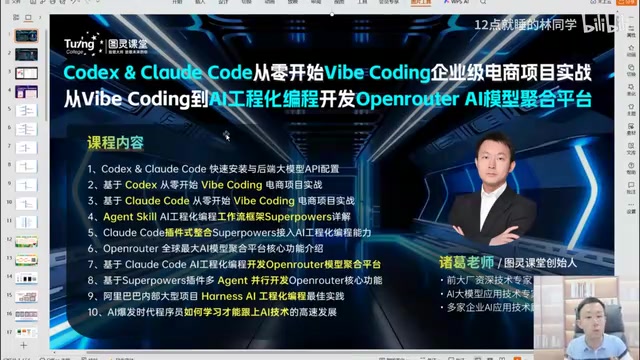
The instructor makes a point worth noting: the real competitive edge in AI coding isn't the tool itself — it's the underlying model. The tool is just a delivery layer; what actually determines code quality is the LLM powering it behind the scenes. This explains why plugging different models into the same tool can produce dramatically different results.
On model selection, the course offers a pragmatic tiering: the latest GPT versions and Claude are in the top tier; domestically, DeepSeekAd offers the best value for money — affordable and capable; Kimi, MiniMax, Alibaba Tongyi, Tencent Hunyuan, and others are all viable options too. The instructor candidly admits that due to Claude's high account ban risk and the hassle of recovery, he's increasingly shifted toward Codex for his actual teaching.
The Gap Between Vibe Coding and Engineering-Grade Development
Vibe Coding is where this course begins — and what it aims to move beyond. The idea is simple: product managers or anyone with an idea can describe their requirements to an AI tool without writing a single line of code, and get a working program in return.
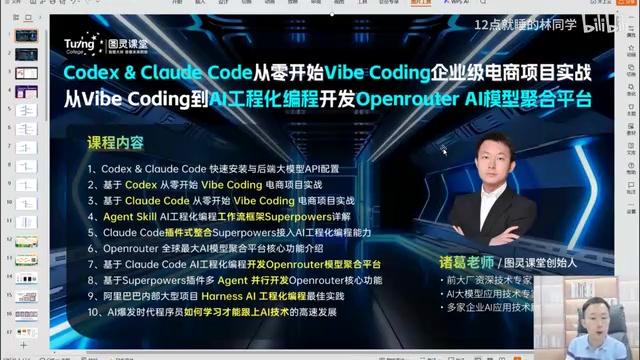
But the instructor is clear about Vibe Coding's ceiling: once a project grows in scale and complexity, the pure Vibe Coding approach breaks down. Two reasons: first, the output is often unmaintainable "spaghetti code"; second, when bugs appear in production, non-technical users can't effectively direct the AI to fix them — leading to endless loops and stalled projects.
This is exactly why influencers who claim "AI will replace programmers" typically end up producing nothing more than ring light utilities or small dropshipping websites — toy-level projects. Enterprise-grade systems involve high concurrency, distributed architecture, microservices, and complex tech stacks. Fixing errors in those environments requires genuine technical depth.
Harness AI Engineering: Three Progressive Levels
The course demonstrates three progressive modes of development, mapping out a clear path from beginner to enterprise-level.
Level 1: Web Coding Basics. The simplest approach — give the AI minimal requirements and let it start coding. You can have an e-commerce demo running within minutes. This is a great entry point for beginners, but strictly toy-grade.
Level 2: Plan Mode. Using Claude Code's Plan mode and Codex's planning capabilities, you can build moderately complex projects from relatively simple requirements. By having the AI plan before executing, output quality improves significantly.

Level 3: SuperPower Plugin and Engineering Pipelines. This is the centerpiece of the course — and what true enterprise-grade development looks like. The Claude Code SuperPower plugin is essentially a collection of AI engineering skills, containing dozens of individual skills that span the full development lifecycle: requirements analysis, development, testing, and deployment. It shares the same philosophy as the earlier Spec Kit and SDD (Spec-Driven Development) tools, and is already being used in production at a number of small-to-medium-sized companies.
SDD (Spec-Driven Development) is the core methodology behind engineering-grade AI coding. The idea: before letting the AI write a single line of code, you first create structured specification documents (Specs) that fully describe requirements, architecture, interface contracts, and expected test outcomes. The AI then generates code incrementally, guided by those specs. This mirrors the "design-first" principle in traditional software engineering, and addresses the fundamental problem with pure Vibe Coding — where AI "improvises freely and leaves an unmaintainable mess." Tools like Spec Kit and the SuperPower plugin are essentially toolkits that help developers quickly create and maintain these specification documents, giving the AI clear contextual constraints every time it generates code — significantly reducing contradictions and logic drift in large projects. For developers with real engineering experience, SDD means the AI becomes "an assistant that follows the spec" rather than "a black box that does whatever it wants." That shift is precisely what makes AI coding viable in enterprise settings.
Development Environment and Toolchain
The instructor's setup reflects a broader shift in tooling for the AI era: the primary IDE is Microsoft VS Code, not IntelliJ, which once dominated Java and Python development.
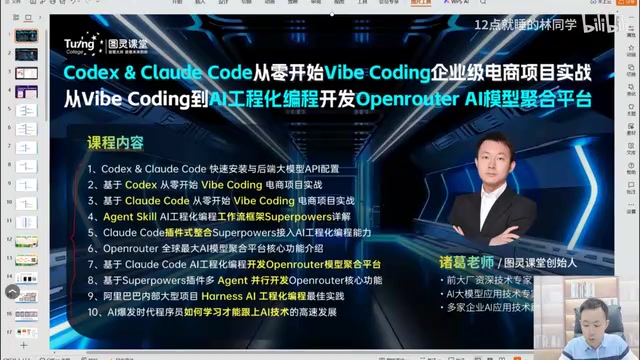
His take is striking: traditional IDEs like IntelliJ are already falling behind in the AI age. From Eclipse to IntelliJ to AI coding tools, we're witnessing another generational shift in development environments. Cursor itself is built as a fork of VS Code. This view may not be universal, but it does reflect a real trend in how developers at major tech companies are actually working.
In terms of toolchain, the instructor installs the Claude Code plugin in VS Code and uses both the Codex desktop app and CLI. The course deliberately covers Claude Code CLI, Codex CLI, and desktop interfaces — switching between tools across different projects so learners can get comfortable with the most common enterprise use cases.
The Business Logic of AI Applications: Who's Actually Making Money
Beyond the technical content, the course includes a sobering look at AI monetization. The instructor poses the question: in the AI space, what actually makes money?
The answer isn't consumer-facing apps like Doubao or Tencent Yuanbao — those are largely burning cash. The three categories that are genuinely profitable are: selling compute and hardware (the soaring stock prices of memory, chip, and semiconductor companies back this up); selling tokens (major players like Zhipu and Tencent); and aggregator platforms that resell tokens at a markup.
The second project in the course is exactly that — an OpenRouter-style AI model aggregation platform. OpenRouter is described as the world's largest AI model aggregation platform, covering virtually every major model on the market, with free tiers and model capability rankings. The instructor is frank: these "wrapper sites" look simple, but they have enormous commercial value. He knows of small teams of a dozen people generating 100–200 million RMB in annual revenue through this kind of platform. The logic is straightforward: buy tokens at wholesale prices and resell them at retail to end users.
OpenRouter's business model is a textbook example of the AI middleware platform category: the platform doesn't train any models — instead, it aggregates dozens of model providers (OpenAI, Anthropic, Google, Mistral, etc.) via a unified API, offering developers and enterprises "connect once, switch between models" flexibility. The profit engine is the token arbitrage margin — buying API call quotas from upstream model providers near cost, then selling them to end users at a slight premium, while using traffic volume to spread fixed costs. The moat here isn't technical; it's stable upstream supplier relationships, low procurement costs, and user trust and retention on the demand side. Domestic equivalents like SiliconFlow and 302.AI operate on the same logic. For entrepreneurs, the core risk is that upstream model providers can build their own retail channels or change API pricing at any time, squeezing margins without warning.
Conclusion: Embrace Engineering — Don't Just Let Tools Replace You
The central message of this course isn't "AI will replace programmers" — it's the opposite. It demonstrates that in enterprise contexts, developers who understand engineering principles and methodology are more indispensable than ever. Vibe Coding lowers the barrier to entry, but the barrier to enterprise-grade work is still defined by technical depth. Mastering Harness AI engineering, the SuperPower toolchain, and everything that lifts AI from "writing toys" to "building products" — that's the right posture for developers navigating the AI wave.
Related articles

Black Forager Alexis Nelson: From Foraging to Publishing, Happy Snacking, Don't Die
Black Forager Alexis Nikole Nelson visits Talks at Google, sharing her journey from childhood plant walks with her mother to publishing the cookbook Happy Snacking, Don't Die!, revealing the racial and land history behind foraging's rise and fall in America.

How to Present Your Ideas Effectively: Three Types of Revelation Talks
Revelation talks are the most direct way to convey ideas. This article breaks down three types — Wonder Walk, Dynamic Demo, and DreamScape — with classic examples from David Gayo, Michael Pritchard, and Sylvia Earle.

Modern Web Guidance: Letting AI Write Native Declarative Dialog Popovers
Google's Modern Web Guidance makes AI coding assistants prefer native declarative dialog capabilities over repetitive JavaScript event listeners, measurably cutting boilerplate code.