Harness AI Engineering Programming: A Practical Guide from Prompts to Mastering Engineering

Harness Engineering methodology solves the systematic challenge of scaling AI programming from prompts to enterprise deployment.
The article identifies that current AI programming struggles with poor code quality and hallucinations, rooted in the lack of systematic engineering methodology. It outlines three evolutionary stages of AI prompting: prompt engineering (single-turn Q&A), context engineering (providing context via RAG), and Harness Engineering (systematically mastering AI Agents). Enterprise projects demand far more than what beginners can achieve with AI demos due to business complexity, microservices architecture, and high-concurrency requirements — necessitating Harness Engineering's methodology for human intervention at critical nodes to prevent cascading failures.
Introduction: The Ideals and Reality of AI Programming
AI-assisted programming is no longer a novelty. Leading companies like Anthropic and OpenAI reportedly have over 90% of their code generated by AI large language models, and many domestic companies are also aggressively pushing AI programming adoption. However, numerous developers frequently hit walls in practice — non-standard code, severe hallucinations, declining generation quality — and some even revert to purely hand-written code after trying AI.
Where's the problem? The answer is: Most people are still stuck at the "prompt engineering" or "context engineering" stage, lacking a systematic engineering methodology. This is exactly the core problem that Harness AI Engineering Programming aims to solve.
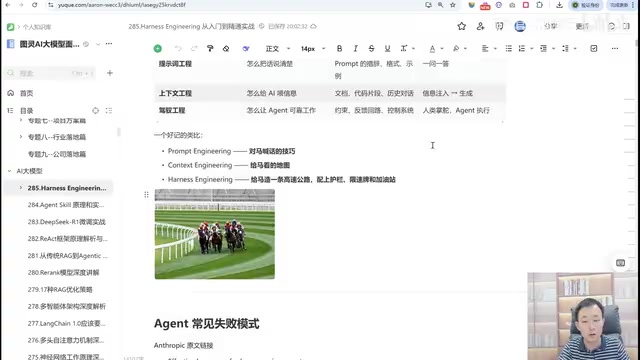
What is Harness Engineering? A Clear Explanation of the Core Concept
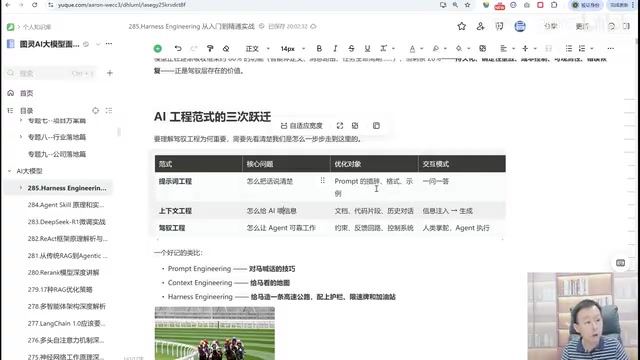
"Harness" in this context means to master and control. Harness Engineering is essentially "mastery engineering." To understand its value, we need to review the three stages of AI prompting technology development.
Stage One: Prompt Engineering
When ChatGPT burst onto the scene in late 2022, "prompt engineering" became the hottest concept. Its essence is single-turn Q&A — you articulate your question clearly, and the AI gives a decent answer. This approach works for simple, well-defined problems but falls short when facing complex tasks.
The theoretical foundation of prompt engineering stems from the "In-Context Learning" capability of large language models. Research found that models like GPT-3 could complete specific tasks without fine-tuning, solely through carefully designed input text. Early prompting techniques include Zero-shot prompting, Few-shot prompting, and Chain-of-Thought prompting — the latter proposed by the Google Brain team in 2022, which significantly improved model performance on reasoning tasks. However, the fundamental limitation of prompt engineering is that it's essentially stateless single-turn interaction, unable to handle tasks requiring multi-step reasoning, cross-session memory, or external tool invocation — which is why it quickly hits its ceiling in enterprise-level programming scenarios.
Stage Two: Context Engineering
As requirements grew more complex, prompts alone were no longer sufficient. For example: if you ask AI to "write an in-depth article mimicking a specific author's style," that single sentence alone gives the AI no idea what the target style actually is.
The solution: Provide context. Upload dozens of previously written articles to the AI, let it learn the style characteristics first, then execute the writing task. Similarly, in AI programming, many developers upload their company's core codebase, letting the AI mimic coding standards to generate new code.
One of the core technical pillars of context engineering is Retrieval-Augmented Generation (RAG), proposed by Meta AI in 2020. RAG works by vectorizing and storing external knowledge bases (such as codebases and documentation), dynamically retrieving the most relevant snippets during inference and injecting them into the context window, thereby breaking through the timeliness limitations of model training data. Mainstream tools like Cursor's Codebase Indexing feature are essentially engineered wrappers around RAG technology. The bottleneck of context engineering lies in the context window length limitation of large models (even though Claude 3.5 supports 200K tokens, ultra-large projects still face information truncation issues), as well as the "Lost in the Middle" phenomenon — models pay significantly more attention to information at the beginning and end of the context than the middle, causing critical logic in large codebases to potentially be overlooked.
This is the stage where most developers currently find themselves — over 90% of AI programming users remain at the context engineering level.
Stage Three: Harness Engineering
When the tasks AI needs to complete become even more complex — such as developing a complete enterprise-level system — context engineering also begins to fall short. This is when the concept of AI Agent needs to be introduced.
Take booking a flight as an example: the AI needs to decompose the task into multiple steps — opening a travel app, searching for flights, comparing prices, selecting seats, placing an order, and making payment. This is no longer simple Q&A but a complete workflow.
AI Agent architecture typically consists of four modules: a perception module (receiving environmental input), a memory module (short-term working memory and long-term knowledge storage), a planning module (task decomposition and decision-making), and an action module (calling tools or executing operations). In the programming domain, the Agent capabilities of tools like Claude Code and Cursor manifest as: autonomously reading/writing file systems, executing terminal commands, calling external APIs, running test cases, and self-correcting based on results. This "perceive-plan-act" loop enables AI to handle complex refactoring tasks spanning dozens of files. However, Agents also introduce new engineering challenges: planning errors can lead to Cascading Failure — where an early decision error gets amplified through subsequent steps, ultimately causing the entire task to fail.
Claude Code, Codex, Cursor, and other AI programming tools are essentially AI Agents in the programming domain. And Harness Engineering is a systematic methodology that teaches you how to master these AI Agents, making them truly effective in enterprise-level projects — including human intervention at critical nodes to prevent cascading failures.
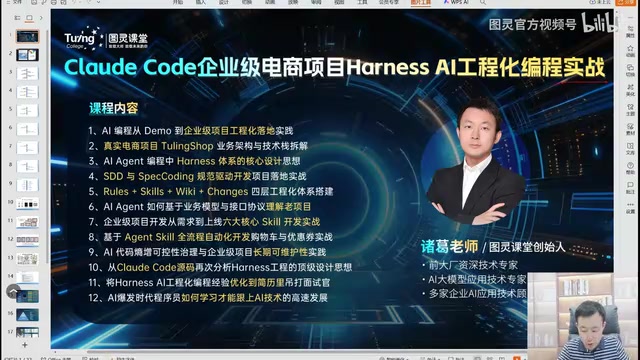
The Real Challenges of Enterprise AI Programming: Why Beginners Can't Handle Complex Projects
There's an abundance of marketing claiming "even beginners can use AI to build projects from scratch," but there's a critical cognitive gap here.
The Essential Difference Between Simple and Enterprise-Level Projects
Non-technical people using AI programming can indeed produce some things — a webpage, a small tool, a demo. But enterprise-level projects are fundamentally different:
- High business complexity: E-commerce systems, enterprise management systems, and similar projects involve extensive cross-cutting business logic
- Stringent technical requirements: Microservices architecture, high-concurrency handling, and distributed system design are all indispensable
- Strict coding standards: Code must be compatible with existing codebases and strictly follow team coding standards
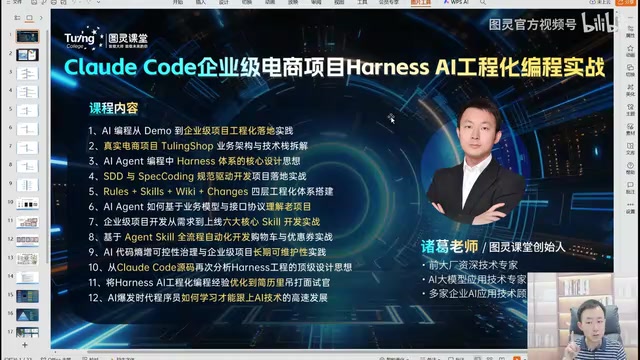
Microservices Architecture and high-concurrency handling are the core technical barriers that distinguish enterprise projects from personal demos. Microservices decompose monolithic applications into dozens of independently deployable services, each communicating via REST APIs or message queues (such as Kafka, RabbitMQ), involving complex mechanisms like service discovery, load balancing, circuit breaking, and distributed transactions. In high-concurrency scenarios, e-commerce systems need to handle flash sales, inventory overselling, and other race conditions, typically relying on Redis distributed locks, database optimistic locking, or message queue peak-shaving to ensure data consistency. AI large language models are extremely prone to "hallucinations" when generating such code.
Related articles
 Tutorials
ChatGPT Plus Subscription Guide: Are GPT-5.5, image-2, and Codex Worth the Upgrade?
A detailed look at ChatGPT Plus features — GPT-5.5, image-2, and Codex — with a Plus vs Pro comparison and a complete step-by-step subscription guide for users outside the US.
 Tutorials
Harness AI Engineering in Practice: Using Claude Code to Master Enterprise-Level E-Commerce Development
Deep dive into Harness AI Engineering: master enterprise e-commerce development with Claude Code using the Rules, Skills, Wiki, and Changes framework.
 Tutorials
Cursor + Codex Dual-IDE Collaboration: A Practical Methodology for Open-Source Project Customization
A complete methodology for open-source project customization based on real-world experience, detailing the Cursor+Codex dual-IDE workflow, seven-stage process, MVP validation, and AI source code reading techniques.