Harness Architecture in Practice: Breaking Down an Enterprise-Grade Agent Project and AI Career Advancement Guide

A practical breakdown of enterprise agent architecture using Harness, MCP, ASGI, and Docker sandboxing for AI job seekers.
This article uses a real-world intelligent procurement assistant project to systematically break down the core tech stack for LLM engineering roles. It distinguishes between algorithm research and productionization career paths, then dives into the Harness architecture — a multi-model orchestration framework for controlling agent behavior. Key components covered include FastAPI + uvicorn for ASGI production deployment, MCP protocol for integrating legacy ERP systems, and Docker-based sandboxing for Skill execution isolation and multi-user data separation.
The AI/LLM job market is quietly shifting. Interviewers now hold candidates to a higher bar than ever before — especially in the LLM application space, where basic API calls and fine-tuning experience alone are no longer enough to stand out. This article is based on a real-world enterprise-style project. It walks through the complete design philosophy of a complex agent built on the Harness architecture, helping job seekers understand what interviewers actually care about today.
Two Career Paths in AI/LLM
LLM-related roles broadly fall into two directions. The first is algorithm research — focused on training and developing new foundation models, such as participating in the pre-training of a model's next major version. These roles typically require strong academic credentials, usually a master's degree or higher from a top university.
The second is LLM engineering and productionization — and importantly, this is not the same as simple application development, though it includes that. The core of this direction is taking an existing foundation model and building customized solutions around real business needs. This may involve fine-tuning, agent development, inference optimization, or even integrating traditional algorithms (such as using YOLO for object detection). It generally does not involve pre-training models from scratch.
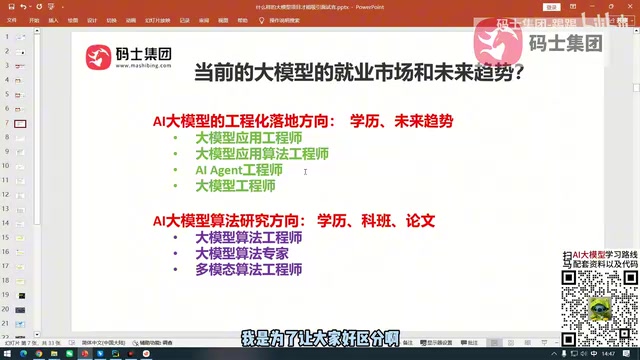
It's worth noting that job titles in this industry are far from standardized. The same fine-tuning work might be called "LLM Algorithm Engineer" at Company A and "LLM Application Engineer" or "Agent Engineer" at Company B. Job seekers should focus on what the role actually entails, not get hung up on the title. For most people, the engineering and productionization path has a more accessible entry point and currently drives the bulk of hiring demand.
What Is the Harness Architecture?
The standout feature of this project is its use of the Harness architecture — literally, the art of "harnessing" or controlling a system. This is a new type of agent architecture designed for complex task handling, and it's exactly the kind of technical direction that many interviewers are keenly interested in right now.
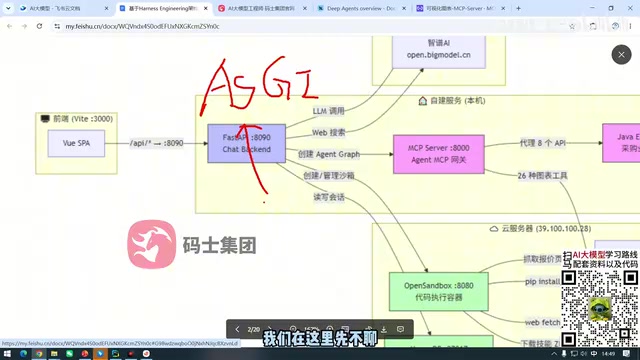
Unlike early-stage approaches of simply "calling an LLM API and returning the result," the Harness architecture emphasizes systematic orchestration and control over agent behavior. It requires connecting a substantial number of components: external reasoning models, summarization models, and existing enterprise systems. In this project, DeepSeekAd serves as the primary reasoning model, with Zhipu AI as a fallback, plus several summarization models configured alongside them. This multi-model design philosophy itself reflects the kind of trade-offs enterprise projects must make between stability and cost.
The core concept behind Harness comes from the "harnessing" metaphor — just as a rider controls a horse through reins, developers use a structured orchestration layer to constrain and guide LLM behavior, rather than letting the model generate freely. Compared to earlier agent frameworks like ReAct (reasoning + action loops) or AutoGPT, Harness places greater emphasis on managing the full lifecycle of an agent: task decomposition, tool call sequencing, error fallback, and multi-model switching strategies are all handled within a unified orchestration layer. Multi-model configuration (primary model + fallback model) is one of its defining characteristics — when the primary reasoning model hits rate limits, times out, or returns poor-quality results, the system automatically degrades to the fallback model, maintaining availability without sacrificing cost control. This design closely mirrors the circuit breaker and graceful degradation patterns in microservices architecture, making it especially intuitive for engineers with a distributed systems background.
Overall Project Architecture: Frontend/Backend Separation and ASGI Deployment
This project is an intelligent procurement assistant built on top of an existing ERP system, following a classic frontend/backend separation pattern. The frontend uses Vue (port 3000), and the backend uses FastAPI (port 8090).
Why does an agent project need this kind of backend service? The answer lies in production deployment standards. Python-based agents in enterprise environments typically run on an ASGI server — this project uses uvicorn.
ASGI has become the standard choice for agent deployment primarily because it solves two core problems:
- High-concurrency async processing: Capable of handling large volumes of asynchronous requests
- Streaming output: Enables genuine streaming responses from the agent, which is critical for a good user experience
In other words, personal side projects can be deployed however you like, but enterprise production environments almost always follow the chain: Agent → ASGI Server → Frontend Interface. Understanding this is extremely helpful when answering interview questions like "How would you deploy an agent to production?"
Integrating Existing Systems: MCP Protocol and Gateway
Most enterprises already have their own business systems — CRM, ERP, or other platforms — long before agents became a thing. A truly production-ready agent almost never stands alone; it must interface with these existing systems and exchange data with them.
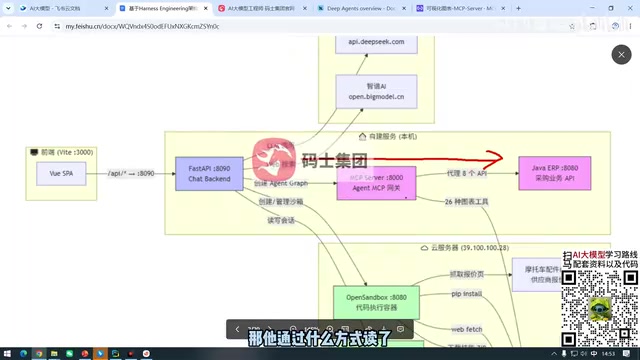
This project uses an ERP system as its example. The scenario assumes the company already has an ERP in place, and the intelligent procurement assistant needs to read data from it. The project specifically uses MCP protocol combined with a gateway to read ERP data from the existing Java-based system. This "agent + legacy system" integration pattern is exactly what real enterprise custom development looks like — and it's the dividing line between a toy project and a production-grade one.
Additionally, as a procurement assistant, it also needs to access supplier information, so it uses Skills or web crawlers to retrieve publicly available data such as pricing pages from supplier websites.
MCP (Model Context Protocol) is a standardized protocol proposed and open-sourced by Anthropic in late 2024. It was designed to solve the fragmentation problem in integrating LLMs with external data sources and tools. Before MCP, every agent project typically had to write custom adapter code for each external system (databases, APIs, file systems), resulting in extremely high maintenance overhead. MCP defines a unified Server/Client interface so that an agent can access different data sources using the same calling convention — whether local files, relational databases, or existing Java/Python business services — as long as the corresponding system implements an MCP Server. In this project, the Java-based ERP system exposes its data interface through an MCP Server, the FastAPI backend acts as the MCP Client, and the gateway layer handles authentication and routing. This pipeline represents one of the mainstream approaches for integrating agents with legacy enterprise systems today.
Security and Isolation: The Sandbox Mechanism
When an agent supports Skills, whether downloaded from the internet or generated by the agent itself, those Skills may pose security risks. A frontend also implies multiple concurrent users — Alice and Bob each operating the agent and generating intermediate files, all of which must be isolated from one another.
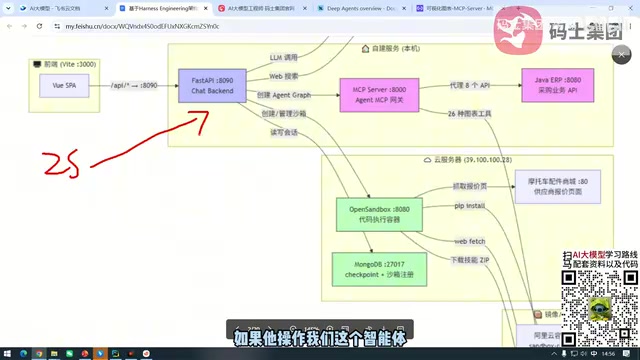
The project's solution is to introduce a Sandbox — which is essentially just a Docker container, nothing mysterious about it. The sandbox addresses two main problems:
- Security for Skill execution: Isolates the runtime environment for untrusted code
- Data isolation between users: Gives each user a dedicated sandbox, naturally preventing file cross-contamination
For example, Alice has her own dedicated sandbox. All intermediate files generated during complex tasks (such as producing analytical reports or processing files) remain inside her sandbox — Bob cannot access them. The sandbox service in this project is launched via OpenSandbox-Server and runs on a dedicated Linux server.
Because different users' container environments and capabilities may vary, the project also includes a container image registry with multiple pre-built images ready to be allocated to different users on demand.
Docker containers are well-suited as sandboxes because of their namespace and cgroup mechanisms: namespaces provide isolation for the filesystem, processes, and network; cgroups cap maximum CPU and memory usage, preventing any single user's runaway or malicious code from exhausting host machine resources. In agent scenarios, Skills (capability scripts) are often dynamically generated or downloaded from external sources as Python or Shell code — running them directly on the host machine carries significant risk. Confining each Skill execution to a dedicated container means that even if the code contains dangerous operations (such as deleting files or establishing external network connections), the blast radius is strictly limited to that container. The image registry design addresses the problem of "different users needing different runtime environments" — for instance, one user's task requires a PyTorch environment while another only needs basic Python. Pre-building multiple images and allocating them on demand is both more efficient and more secure than dynamically installing dependencies each time.
Why This Architecture Matters for Job Seekers
Viewing all these components together, this project presents a complete picture of what an enterprise-grade agent should look like: Harness architecture for task orchestration, multi-model configuration to ensure reasoning capability, ASGI service for production deployment, MCP protocol to integrate legacy systems, Sandbox for security and isolation, and an image registry for environment customization.
For job seekers, the value of understanding this architecture is that it directly maps to the dimensions interviewers care most about on the engineering and productionization track. Compared to candidates who only know how to call APIs, someone who can clearly articulate "how an agent safely handles complex tasks in a production environment while integrating with enterprise systems" has a clear and substantial competitive edge.
This article has only covered the macro-level framework of the project. The specifics of feature implementation and code structure still warrant deeper exploration. But even just grasping the overall design philosophy is enough to give you a structured, systematic understanding of complex agent projects when it counts most — in the interview room.
Related articles
The Harness Matters More Than the Model: YC's Deep Dive into Agent Architecture Evolution
YC's Harness Night reveals that agent scaffolding design—not model weights—determines AI agent performance ceilings. ARC-AGI scores jump from 30% to 95% with better Harness.

Building a LinkedIn Lead Scraping and Enrichment Automation Workflow with n8n
Build an n8n LinkedIn lead scraping and enrichment workflow: input job title, location, industry, and company size to auto-generate a verified email lead list in Google Sheets.

SageMaker HyperPod: Isolation and Fairness in Cross-Team GPU Cluster Sharing
Amazon SageMaker HyperPod's reference architecture for cross-team GPU cluster sharing uses IAM Identity Center, Kubernetes namespace isolation, Task Governance, and cost chargeback to enable secure, fair, and cost-transparent multi-tenant compute.