Harness Engineering Explained: The Third-Generation Development Paradigm for Taming AI Agents

Harness Engineering is the third-generation AI paradigm for systematically taming AI Agents
Harness Engineering is the third-generation AI engineering paradigm following Prompt Engineering and Context Engineering. Its core goal is ensuring AI Agents don't make mistakes, can self-validate, and self-correct when executing complex tasks. Through its three-layer architecture—information layer, constraint layer, and automated validation layer—it systematically addresses Agent failure modes like direction drift and error accumulation, shifting the developer's role from manual coding to rule definition and architecture design.
What is Harness Engineering?
Harness Engineering is an emerging third-generation paradigm in AI engineering, following Prompt Engineering and Context Engineering. Its core philosophy is: not only should AI understand your intent, but it must also avoid mistakes during execution, self-validate, and self-correct.
If Prompt Engineering focuses on "how to ask the right questions" and Context Engineering focuses on "how to provide sufficient background information," then Harness Engineering focuses on "how to systematically harness an Agent to complete complex tasks." This represents a qualitative leap from single interactions to full-process governance.
The Three Evolutionary Stages of AI Engineering Paradigms
Stage One: Prompt Engineering
Prompt Engineering is the first AI interaction approach most developers encounter. By carefully designing prompts, developers guide large models to generate desired outputs. However, its limitations are obvious—the ceiling for single interactions is low, and it struggles with complex projects.
The rise of Prompt Engineering is closely tied to the explosion of Large Language Models (LLMs) in 2022-2023. Core techniques include Few-shot Learning (guiding the model to understand task patterns by providing a few examples in the prompt), Chain-of-Thought (requiring the model to reason step-by-step rather than giving direct answers), and Role-playing (setting a specific identity for the model to constrain its output style). Developers guide models toward more precise results by carefully constructing the structure, tone, and examples of input text. However, Prompt Engineering is fundamentally a "single-turn optimization"—it optimizes the quality of a single request-response cycle and cannot address state management and error propagation in multi-step tasks.
Stage Two: Context Engineering
Context Engineering builds upon Prompt Engineering by emphasizing richer, more structured contextual information for the model, including project documentation, codebase structure, API specifications, and more. This enables AI to "comprehend" the broader project landscape, but still lacks systematic constraints on the execution process.
The rise of Context Engineering stems from the maturation of RAG (Retrieval-Augmented Generation) technology. RAG solves the problems of model knowledge cutoff and insufficient domain knowledge by dynamically retrieving relevant document fragments at inference time and injecting them into the model's context window. As context windows expanded from 4K tokens to 128K and beyond, developers could provide the model with an entire codebase's structure, API documentation, and design specifications in a single pass. But Context Engineering's limitation is clear: sufficiency of information does not equal correctness of execution—the model "seeing" all the information doesn't mean it can "correctly use" that information. This is like giving a junior engineer complete project documentation without code reviews and testing processes to ensure output quality.
Stage Three: Harness Engineering
Harness Engineering is the most cutting-edge paradigm today. It encompasses the capabilities of the previous two stages while introducing constraint layers, validation layers, and auto-correction mechanisms, forming a complete Agent development closed loop. The core objective is: keeping the Agent effectively "harnessed" throughout the entire development process, rather than letting it operate freely and then manually correcting course afterward.
Common Failure Modes of AI Agents
In real-world projects, developers frequently encounter the following problems when using AI Agents for code generation and project development:
AI Agents are AI systems with autonomous planning, tool invocation, and environment interaction capabilities. Unlike traditional single-turn Q&A, Agents can decompose complex tasks into multiple sub-steps and call external tools (such as code executors, file systems, and API endpoints) to complete tasks. Current mainstream Agent frameworks include LangChain, AutoGPT, CrewAI, and others. In code development scenarios, tools like Cursor, Windsurf, and Claude Code are essentially code generation Agents—they can read project files, generate code, and execute commands, but lack systematic constraint and validation mechanisms. It's precisely this state of "capability without boundaries" that leads to the following common failure modes:
- Direction drift: The Agent generates code that deviates from the intended direction, producing content the developer doesn't need at all
- Context loss: In long conversations or complex tasks, the Agent gradually "forgets" key constraints
- Error accumulation: Small errors from previous steps are amplified in subsequent steps, causing the entire project to go off track
- Style inconsistency: Generated code doesn't match the project's existing code style or architectural patterns
- Lack of validation: The Agent cannot autonomously judge whether generated results are correct, requiring extensive manual review
Among these, Error Accumulation is particularly severe, manifesting in AI Agents as an "avalanche effect." Due to the autoregressive generation nature of large language models, each step's output is based on the previous step's result. When an Agent produces a minor deviation at step N, this deviation becomes part of the input context for step N+1, causing subsequent steps to continue reasoning on an erroneous foundation. In software engineering, this is analogous to exponential growth of technical debt—one wrong architectural decision can cause dozens of subsequent modules to deviate from the correct design. Traditional software engineering mitigates this through code reviews and continuous integration, while Harness Engineering internalizes this mechanism into the Agent's execution flow.
The root cause of these failure modes is: we gave the Agent capability but didn't give it boundaries and feedback mechanisms. Harness Engineering was born precisely to systematically solve these problems.
The Three-Layer Core Architecture of Harness Engineering
Harness Engineering addresses Agent failure through a layered architecture, consisting of three core layers:
Information Layer: Enabling Full Project Understanding
The information layer is the foundation of the entire Harness. Its goal is to give the Agent comprehensive understanding of the project's tech stack, architectural design, coding standards, and business logic. This isn't simply dumping code at the AI—it requires building a structured project knowledge base, including:
- Project architecture documentation and module dependency maps
- Coding standards and naming conventions
- Documentation explaining core business logic
- Design patterns and style references from existing code
Constraint Layer: Defining Agent Behavioral Boundaries
The constraint layer is Harness Engineering's most critical innovation. Through predefined rules and boundary conditions, it restricts the Agent's behavioral space. For example:
- Specifying that the Agent can only use particular technology frameworks and dependency libraries
- Defining templates and structural constraints for code generation
- Setting core modules and files that cannot be modified
- Explicitly defining output formats and interface specifications
The technical implementation of the constraint layer typically relies on a combination of mechanisms: First, rule files (such as .cursorrules, CLAUDE.md, etc.) that define Agent behavioral boundaries in natural language or structured formats; second, Schema validation using JSON Schema or TypeScript type definitions to constrain output formats; third, sandboxed execution environments that limit the file system scope and executable command sets available to the Agent; and finally, Guard Rails mechanisms that check whether Agent output meets predefined safety and quality standards through additional validation models or rule engines after generation. Together, these mechanisms form a multi-layered defense system.
The core principle of this layer is: it's better to prevent errors upfront than to correct them after the fact. By narrowing the Agent's decision space, the probability of errors is dramatically reduced.
Automated Validation Layer: Building the Generate-Validate-Correct Closed Loop
After development is complete, Harness Engineering drives the Agent to automatically execute validation processes: running unit tests, checking code standards, and verifying interface compatibility. If issues are found, the Agent automatically corrects them based on error information, forming a "generate-validate-correct" closed loop.
This closed loop is typically implemented in engineering practice through a variant of CI/CD (Continuous Integration/Continuous Deployment) pipelines. Specifically: the generation phase has the Agent produce code based on requirements and constraints; the validation phase automatically triggers unit tests (e.g., JUnit, pytest), static code analysis (e.g., ESLint, SonarQube), type checking (e.g., TypeScript compiler), and integration tests; the correction phase feeds validation failure error messages back to the Agent, which performs targeted fixes based on error logs and original constraints. This cycle can iterate multiple times until all validations pass or the maximum retry count is reached. Industry practice shows that 3-5 iterations can typically resolve most auto-fixable issues.
This means the developer's role shifts from "reviewing code line by line" to "designing validation rules"—an order-of-magnitude improvement in efficiency.
Practices from Leading Industry Companies
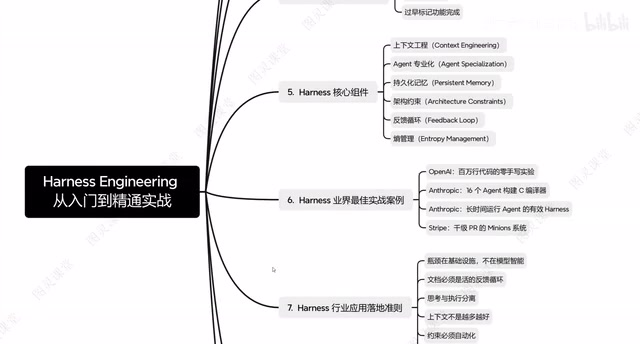
Leading AI companies like OpenAI and Anthropic are already applying Harness Engineering principles at scale internally. Their practices demonstrate:
- Rules first: Spend sufficient time defining constraint rules before letting the Agent write its first line of code
- Progressive authorization: Start with small modules and gradually expand the Agent's operational scope
- Continuous feedback: Establish automated quality detection pipelines to monitor Agent output quality in real-time
- Toolchain integration: Choose the most appropriate AI programming tools for different development phases, rather than relying on a single tool for everything
Progressive Authorization borrows from the "principle of least privilege" in software engineering. In practice, this means: initially only letting the Agent generate individual functions or utility classes; after verifying stable output quality, expanding to entire module generation; and only finally authorizing the Agent to make cross-module architectural modifications. The technical foundation of this strategy is: when the Agent's operational scope is smaller, its output is more verifiable and the impact of errors is more containable. By analogy, this is like assigning tasks to newly hired engineers—starting with bug fixes, then feature development after proving capability, and only then participating in architecture design.
The core insight from these practices can be distilled into one principle: The essence of Harness Engineering is not controlling AI, but building an efficient and safe execution environment for AI.
Practical Implementation: Building a Harness Development Process from Scratch
In real-world implementation, developing a project from scratch based on Harness Engineering (using a Java project as an example) generally follows this process:
- Environment setup: Choose appropriate AI programming tools and configure the project's basic structure
- Information layer construction: Write project description documents, architecture specifications, and coding standards
- Constraint layer definition: Establish Agent behavioral rules, code templates, and prohibited operation lists
- Code generation: Have the Agent generate code module by module within the Harness framework
- Automated validation: Run test suites to check the quality of generated code
- Iterative correction: Automatically or semi-automatically fix issues based on validation results
Interestingly, in ideal Harness Engineering practice, developers essentially don't need to write code manually, but instead focus their energy on rule definition and architecture design. This represents an entirely new software development model.
Common Pitfalls and Implementation Recommendations
In practicing Harness Engineering, several common mistakes should be avoided:
- Constraints too loose: Giving the Agent too much freedom, leading to uncontrollable output
- Constraints too tight: Rules that are too rigid, limiting the Agent's ability to creatively solve problems
- Neglecting the information layer: Not providing sufficient project context, causing the Agent to work blindly
- Skipping validation: Over-trusting Agent output without automated quality checks
The implementation checklist for Harness Engineering can be summarized as: sufficient information input + reasonable constraint boundaries + automated validation closed loop. Master these three elements, and you can effectively harness AI Agents, transforming them from "unreliable assistants" into "controllable productivity tools."
With the rapid iteration of AI programming tools, Harness Engineering is likely to become one of the most important methodologies in AI engineering during 2025-2026. For developers, the earlier you master this paradigm, the better positioned you'll be in the AI-driven development wave.
Key Takeaways
- Harness Engineering is the third-generation AI engineering paradigm following Prompt Engineering and Context Engineering, with its core focus on systematically harnessing Agents to complete complex tasks
- Its architecture consists of three core layers: the information layer (enabling Agent project comprehension), the constraint layer (preventing Agent errors), and the automated validation layer (enabling Agent self-correction)
- Common Agent failure modes include direction drift, context loss, and error accumulation—Harness Engineering systematically addresses these through predefined rules and feedback mechanisms
- Best practices from companies like OpenAI and Anthropic demonstrate that rules-first, progressive authorization, and continuous feedback are keys to successful Harness Engineering implementation
- In ideal Harness Engineering practice, developers shift their focus from manual coding to rule definition and architecture design, achieving efficient AI-driven development
Related articles
Deep Dive into AI Agent Skill Design: …
Deep Dive into AI Agent Skill Design: Engineering Practices from Anthropic and Perplexity
A deep dive into Skill design philosophy from Anthropic's Claude Code team and Perplexity's Agent team, covering the Tax Test, Gotchas Flywheel, progressive disclosure, and Eval-First practices for building high-quality AI Agent skill systems.
Deep Dive into OpenAI's Official GPT-5…
Deep Dive into OpenAI's Official GPT-5.6 Prompting Guide: The Shift from Manual to Automatic
A deep dive into OpenAI's official GPT-5.6 Sol prompting guide: conciseness-first, outcome-oriented design, autonomy boundaries, tool routing, and reasoning intensity tuning.
 Deep Dives
Deep Dive into How OpenClaw (Open-Source Crayfish) AI Agent Works
Deep analysis of OpenClaw AI Agent internals: System Prompt, tool calling, SubAgents, Skill system, memory, and Context Engineering explained.