Harness Engineering Explained: The Underlying Principles and Practical Methods for Controlling AI Agents

Harness Engineering steers AI models through rules, tools, and workflow design, enabling small models to tackle complex tasks.
Professor Hung-yi Lee demonstrates how Google's open-source Gemma 4 E2B (2B parameters) dramatically improves with simple working guidelines, introducing the concept of Harness Engineering. This practice builds supporting frameworks around LLMs through three dimensions — controlling cognitive frameworks via rules, defining capability boundaries through tool configuration, and designing multi-turn interaction workflows — to steer models toward completing complex tasks, distinct from Prompt Engineering and Context Engineering.
Introduction: Models Aren't Lacking Intelligence — They Lack Guidance
In 2026, major companies continue to release new language models, but one repeatedly validated fact remains: the same model, with just a few lines of instructions added, can perform drastically differently. Professor Hung-yi Lee demonstrated this vividly in his latest course using Google's open-source Gemma 4 E2B as an example.
Gemma 4 E2B is a lightweight open-source model released by Google in 2025, with only 2 billion parameters that can run locally on consumer-grade hardware. Compared to mainstream commercial models like GPT-4, which are estimated to have over a trillion parameters, this is an extremely "compact" model. However, the enormous gap in parameter count doesn't translate to an equivalent gap in task completion capability — and this is precisely the core insight of Harness Engineering: between a model's "raw intelligence" and its "task completion ability" lies a vast engineering space. This has profound implications for AI democratization, meaning developers don't need to rely on expensive large model APIs — through carefully designed Harnesses, small models can equally handle complex automation tasks.
He assigned the model a bug-fixing task — modifying the ExtractEmail function in parser.py to pass the tests in verify.py. On the first attempt, the model didn't realize that parser.py was in the same directory, directly "hallucinated" file contents, and claimed the task was complete. But after adding fewer than 80 characters of working guidelines (such as "check directory files first," "read contents before modifying," "task is only complete when criteria are met"), the same 2B model could correctly execute ls, cat, edit files, run verification, and successfully complete the task.
This case introduces today's core topic — Harness Engineering.
What Is Harness Engineering?
The Two Major Components of an AI Agent
The concept of AI Agents originates from artificial intelligence research in the 1990s, referring to autonomous systems capable of perceiving environments, making decisions, and taking actions to achieve goals. Modern LLM-based Agents combine traditional Agent architecture with the natural language understanding capabilities of large language models, forming an entirely new technical paradigm. A typical Agent architecture contains four layers: the perception layer (receiving input), the memory layer (short-term working memory and long-term knowledge storage), the planning layer (task decomposition and strategy formulation), and the action layer (tool invocation and environment interaction).
An AI Agent consists of two parts: the Large Language Model (LLM) itself, and a set of supporting programs and frameworks surrounding the LLM — these "other things" now have a unified name: Harness. The Harness is the framework for systematically engineering the four layers mentioned above, determining how the Agent coordinates its operations rather than relying solely on the LLM's spontaneous behavior.
The metaphorical meaning of "Harness" is quite intuitive: AI is a horse with tremendous power, but you need a saddle and reins to control it. The process of crafting this harness is Harness Engineering.
How Harness Engineering Differs from Prompt Engineering and Context Engineering
These three concepts overlap significantly, but their core emphases differ:
- Prompt Engineering: Focuses on how to word a single input to change the output (e.g., the classic incantation "Think Step by Step," though as models grow stronger, the marginal returns of such tricks diminish)
- Context Engineering: Focuses on how to provide the model with sufficient contextual information — a more systematic and automated form of Prompt Engineering
- Harness Engineering: Focuses on how to control the model across multi-turn conversations and tool interactions throughout the complete workflow, ensuring the task is ultimately completed
In short, the problem Harness Engineering aims to solve is: how to steer a model to get things done well across multiple rounds of interaction.
The Three Control Dimensions of a Harness
1. Controlling the AI Agent's Cognitive Framework Through Rules
We can use rules written in human language to influence the model's "cognitive framework." These rules are typically stored in fixed files like agents.md or claude.md. Each time the model starts, the Harness forcibly injects the contents of these files into the Prompt — like having an employee read the company charter before starting work.
Taking OpenClaude as an example, it's preset to read agents.md before a conversation begins, which defines the model's "soul" (soul.md), memory storage location (memory.md), and other behavioral norms. When Claude stopped supporting OpenClaude, migrating to Claude's official CoWork was actually very simple — just rename agents.md to claude.md, and the Agent can "revive" on the new Harness with almost identical behavior.
Research Findings: Multiple papers this year have systematically studied the effects of agents.md. One study showed that agents.md can speed up model operation, especially helping significantly with extremely time-consuming tasks. Another study found that human-written agents.md doesn't always work, and LLM-generated agents.md often performs even worse. OpenAI's blog specifically emphasized: agents.md shouldn't be written as an "encyclopedia" but rather as a map — telling the model where to find information rather than stuffing in all the information.
2. Defining the AI Agent's Capability Boundaries Through Tool Configuration
Tool configuration directly determines what an AI Agent can and cannot do. OpenClaude runs on a local computer and can freely manipulate files and browsers; CoWork runs in a cloud sandbox where each directory mount requires human authorization — offering higher security but significantly reduced convenience.
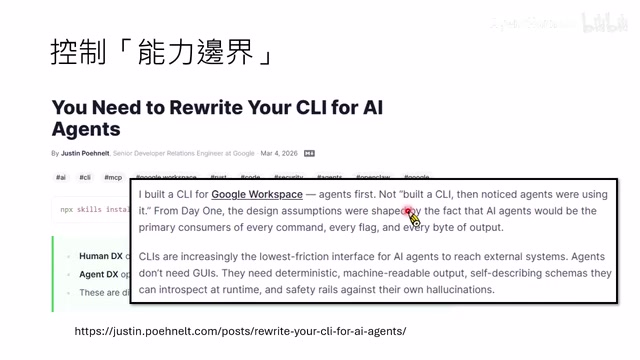
More critically, tools suitable for humans aren't necessarily suitable for AI models. The SWE-Agent paper (2024) revealed several counter-intuitive findings. SWE-Agent is a groundbreaking study from Princeton University focused on enabling AI Agents to autonomously solve real software engineering problems on GitHub. It introduced the SWE-bench benchmark — containing 2,294 real bug-fix tasks from 12 mainstream open-source projects, becoming the industry standard for measuring AI programming capability. The study proposed the ACI (Agent-Computer Interface) concept — a human-computer interaction interface designed specifically for AI — which is fundamentally different from traditional CLI/GUI designed for humans, directly catalyzing the exploration of "AI-native tool design" in the Harness Engineering field.
Related articles
Deep Dive into AI Agent Skill Design: …
Deep Dive into AI Agent Skill Design: Engineering Practices from Anthropic and Perplexity
A deep dive into Skill design philosophy from Anthropic's Claude Code team and Perplexity's Agent team, covering the Tax Test, Gotchas Flywheel, progressive disclosure, and Eval-First practices for building high-quality AI Agent skill systems.
Deep Dive into OpenAI's Official GPT-5…
Deep Dive into OpenAI's Official GPT-5.6 Prompting Guide: The Shift from Manual to Automatic
A deep dive into OpenAI's official GPT-5.6 Sol prompting guide: conciseness-first, outcome-oriented design, autonomy boundaries, tool routing, and reasoning intensity tuning.
 Deep Dives
Deep Dive into How OpenClaw (Open-Source Crayfish) AI Agent Works
Deep analysis of OpenClaw AI Agent internals: System Prompt, tool calling, SubAgents, Skill system, memory, and Context Engineering explained.