Harness Engineering in Practice: From Concept to Enterprise-Grade Agent Deployment

Harness Engineering is becoming the core engineering methodology for enterprise-grade agent delivery and interview assessment.
The article traces the origin and rise of Harness Engineering: the term appeared in Michelle Hashimoto's blog and OpenAI's blog in February 2026, but similar architectures were already being explored in parallel by multiple companies in late 2025—an industry convergence rather than a single blog's product. Enterprise agent interviews have shifted from demo reproduction to delivery, focusing on retry and fallback for tool-call failures, multi-tenant data isolation, session and resource scheduling under high concurrency, and memory-gap repair. The author advises developers to self-check at the tool, data, and session layers and embed Harness thinking into engineering details.
Title
Harness Engineering in Practice: From Concept to Enterprise-Grade Agent Deployment
Meta Description
Harness Engineering is becoming the core methodology for agent development. This article traces its conceptual origins and, in the context of enterprise-grade Agent project delivery requirements, analyzes key engineering issues interviewers care about—tool-call fault tolerance, tenant isolation, high concurrency, and memory gaps—to help developers move from demos to deliverable projects.
Article Content
Agent development is moving from "it runs" to "it ships." Interviewers are no longer satisfied with you reproducing a demo—they press further: How do you handle tool-call errors? How do you implement tenant isolation? How do you repair memory gaps? Behind these questions points to a methodology that is taking shape—Harness Engineering.
What Harness Engineering Is, and Why It's Gaining Traction Now
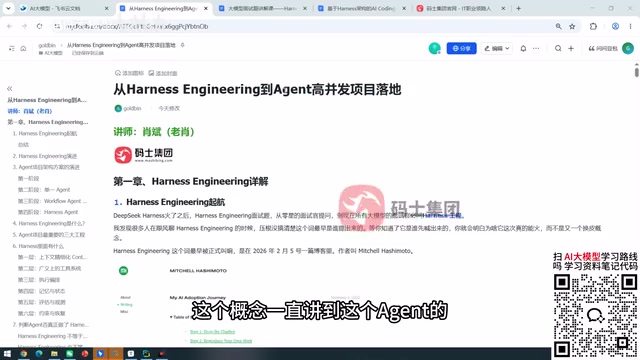
According to a summary by Bilibili creator "Teacher Xiao of Ma's Education," the term Harness formally appeared in the agent context in a blog post by author Michelle Hashimoto on February 5, 2026, whose Chapter 5 was titled "Engineer the Harness." Six days later, on February 11, OpenAI published a blog post using the term "Harness Engineering" and expanded it into systems engineering for agent development. Since then, products such as Cloud Code, Codex, OpenClawAd, Hermos Agent, and DeepSync's DSH have emerged one after another, and the industry has gradually reached a consensus.
A common misconception needs clarification: this does not mean Harness Engineering did not exist before February 2026. According to the same source, in the second half of 2025, OpenAI, Anthropic, and several domestic companies were already exploring similar architectures—they simply had no unified name at the time. Harness Engineering is the result of convergence after multiple companies evolved independently, not the direct product of a single blog post.

The original meaning and extension of Harness: Harness originally refers to the "harness" in horse tack, whose function is to transmit the horse's power safely and controllably to the carriage. In software engineering, the term has long been used in testing (test harness, test fixture/framework), referring to the shell program that hosts and drives the code under test. Harness in the agent context follows this metaphor: the model itself is the power source, while the Harness is the runtime framework that wraps the model, schedules tools, manages context, and constrains execution boundaries. It determines whether the agent can stably "transmit" its capabilities to real tasks.
The relationship between context engineering and Harness Engineering: Context engineering focuses on how to construct, prune, and order the information entering the model window; Harness Engineering has a broader scope. In addition to context, it also includes tool interface definitions, failure handling, state persistence, permissions, and secure execution—runtime mechanisms. You can think of it this way: context engineering solves "what the model sees," while Harness Engineering solves "in what system the model acts."
Enterprise-Grade Agent Projects: What Interviewers Are Really Looking At
Teacher Xiao mentioned that, based on student interview feedback, interviewers have very high requirements for project details, design implementation, and delivery. If your resume lists agent, fine-tuning, or RAG projects, interviewers will scrutinize the details to verify whether the project has delivery capability.
Specifically, a deliverable agent project must answer at least the following questions:
- When a tool call fails, is there a retry, fallback, or last-resort strategy?
- In multi-tenant scenarios, how is data isolation between users and tenants implemented?
- Under high-concurrency requests, how are session state and resource scheduling kept stable?
- When the agent experiences a memory gap, how is it repaired through external memory or context reconstruction?
These questions are not isolated theoretical questions; they are assessments of engineering capability embedded in project details. Only with these elements is a project not at the demo level.

Causes of memory gaps: An agent's memory is usually divided into a short-term context window and external long-term memory (vector databases, structured storage, summary logs, etc.). When the conversation length exceeds the window limit, the session is switched, the service restarts, or summary compression loses key information, a "memory gap" occurs—the agent forgets previously confirmed constraints or user preferences. Remediation methods include: hierarchical summarization of long conversations while retaining original key entities, writing task state to external storage and injecting it every turn, setting up explicit fact-retrieval lookups, and proactively clarifying with the user when a context conflict is detected.
Common implementations of multi-tenant isolation: In enterprise-grade Agents, multi-tenant isolation is not just row-level permissions at the database level; it also involves namespace or collection isolation in vector databases, per-tenant injection of tool credentials, tenant prefixes in cache and session keys, and tenant-specific archiving of logs and tracing data. Insufficient isolation granularity can lead to security issues such as unauthorized retrieval and cross-tenant leakage via prompt injection.
From Concept to Implementation: A Reusable Learning Path
Teacher Xiao's course design goes from the concept of Harness Engineering to high-concurrency Agent project delivery, combining the code and demonstration process of two actual projects (explained in different months). This "concept—code—demonstration" path has reference value for developers preparing for interviews or implementing enterprise projects.
According to his introduction, interviewers now always ask Harness-related questions, so he also compiled relevant interview question materials. For learners, the point is not to memorize the timeline of when the term appeared, but to understand how Harness Engineering, as an agent architecture philosophy, forms systematic engineering practice in areas such as tool calls, long tasks, context management, and secure execution.

Practical Advice: Embed Harness Thinking into Project Details
If you are developing an agent project, you can self-check from three levels: first, the tool layer—whether there is failure retry and error classification handling; second, the data layer—whether tenant isolation and sensitive information filtering are in place; third, the session layer—whether there are mechanisms for memory compression and gap recovery in long conversations. These details can both improve project delivery quality and serve as a hook for demonstrating engineering depth in interviews.
The value of Harness Engineering lies not in a new term, but in pulling agent development back from "prompt tuning" to systems engineering. For developers, reviewing your own projects through this lens as early as possible is more meaningful than chasing the concept itself.
One-line Summary
Harness Engineering is becoming the core engineering methodology for enterprise-grade agent delivery and interview assessment.
Paragraph Summary
The article traces the origin and rise of Harness Engineering: the term appeared in Michelle Hashimoto's blog and OpenAI's blog in February 2026, but similar architectural exploration had already been advancing in parallel at multiple companies in the second half of 2025—it is an industry convergence rather than the product of a single blog post. The article points out that enterprise-grade agent interviews have shifted from "can you reproduce a demo" to "can you deliver," focusing on implementation details such as retry and fallback for tool-call failures, multi-tenant data isolation, session and resource scheduling under high concurrency, and reconstruction and repair of memory gaps. The author suggests developers self-check projects at the tool, data, and session layers and embed Harness thinking into engineering details rather than stopping at chasing new terms.
Related articles

JobRunner MCP Server: AI Agents Can Now Fix Failed Java Jobs
JobRunner launches an open-source MCP server enabling AI agents to view cluster status, diagnose failures, and recover Java jobs—incident response from any cloud coding environment or existing agent.

MLAI Digital Launches 9 Security Agents: MCP Server Safeguards the Full Lifecycle of Agentic AI
MLAI Digital launches Security MCP Server with nine built-in specialized security agents covering vulnerability discovery, attack simulation, prompt injection detection, API and infrastructure assessment, and accelerated remediation—embedding security validation across the full Agentic AI lifecycle from development to production.

Running Isaac Lab on H100 GPUs: Exploring Better Approaches
Exploring optimization methods for running Isaac Lab on NVIDIA H100 GPUs, including MIG configuration, mixed precision, TensorRT acceleration, and community experience to improve robotics simulation and reinforcement learning efficiency.