Harness: One Command Center to Manage All Your Coding Agents

Harness is an open-source command center for coding agents, aggregating multiple agents across machines with multi-platform support.
Harness by Autonomous is an open-source command center for coding agents, solving the switching cost when developers use Claude Code, Codex, and cloud Hermes simultaneously. It aggregates agent sessions across machines into one interface, offering native desktop, terminal hn command, and iOS/Android apps with voice replies for async approvals. It emphasizes end-to-end encryption and open source, with free Mac and Linux versions. Beyond coding, 49 harnesses cover CAD, circuits, robotics, games, and music, pointing to a general-purpose agent runtime platform.
When developers use Claude Code, Codex, and cloud-based Hermes simultaneously, the biggest pain point is often not model capability, but switching costs. Harness, launched by the Autonomous team, positions itself as an open-source command center for coding agents, letting agents across all machines collaborate side by side and be managed from a single entry point.
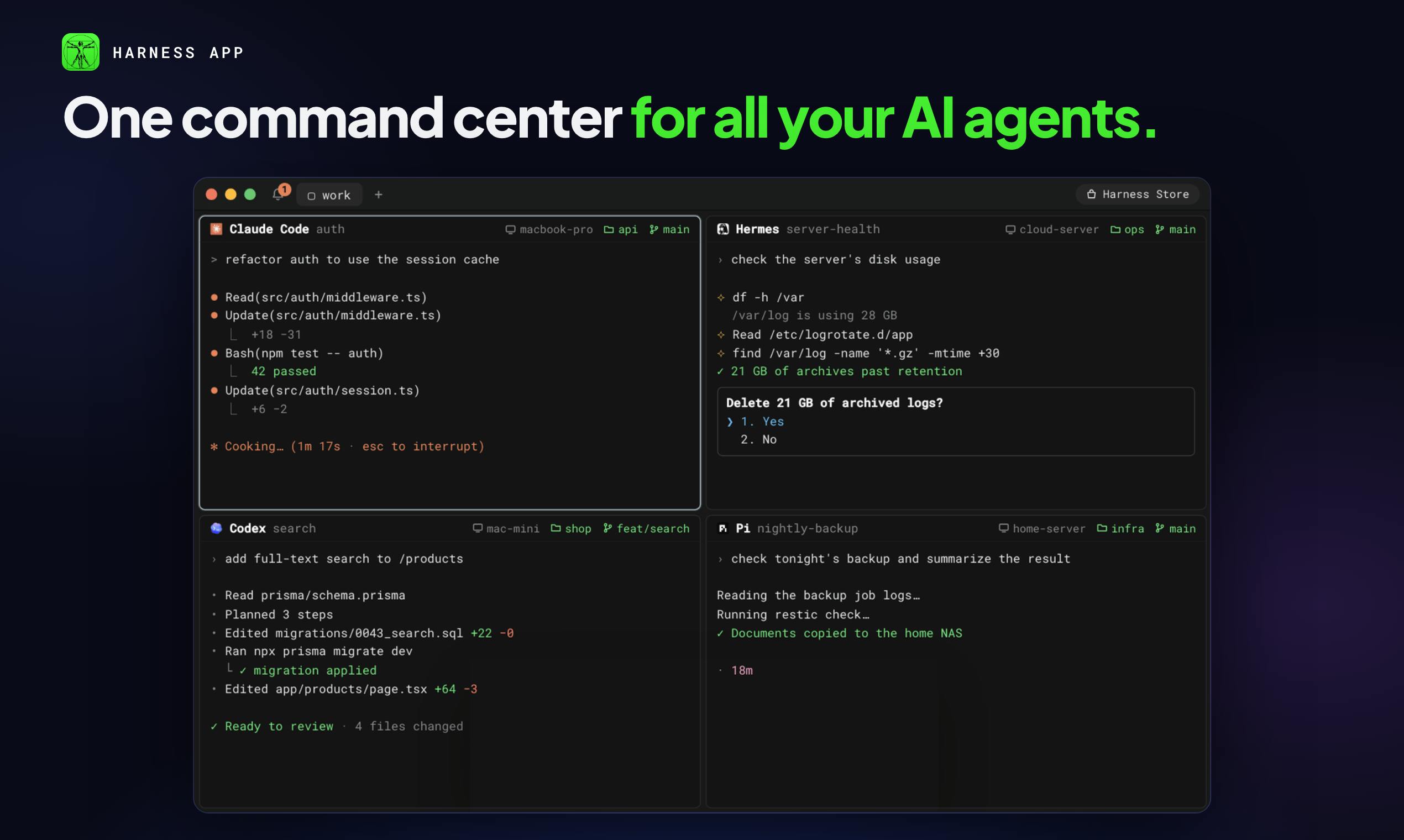
One Entry Point to Manage All Coding Agents
The core idea of Harness is to decouple "where the agent runs" from "where you operate it." Claude Code runs on your work computer, Codex stays at home, Hermes is deployed in the cloud — these previously fragmented sessions can be aggregated into a single interface. The Product Hunt description puts it bluntly: Every coding agent, every machine, one command center.
For developers already accustomed to running multiple agents in parallel, this aggregation isn't just a nice-to-have — it's infrastructure for avoiding context confusion. You no longer need to remember which task was assigned to which terminal, nor repeatedly switch windows to check status.
Coding agents are AI programs that can autonomously read and write codebases, execute terminal commands, run tests, and iteratively modify based on results. Unlike traditional code completion tools (such as early Copilot) that only suggest the next line based on the current cursor position, coding agents have a complete task loop: understanding requirements, planning steps, invoking tools (file I/O, shell, browser), observing execution results, and correcting the approach until the task is complete or human approval is needed. Claude Code, Codex CLI, and Hermes all belong to this category. They typically run as command-line tools or IDE plugins, with session state stored locally or in the cloud. So when the same developer uses multiple agents simultaneously, task context gets scattered across different terminals and machines — precisely the fragmentation problem Harness aims to solve.
Works on Desktop, Terminal, and Mobile
Harness offers three modes of operation: a native desktop app, the hn command in the terminal, and iOS and Android apps. The most distinctive mobile capability is voice replies to agents, which means you can approve or guide running tasks even when you're away from your workstation.
This multi-platform design points to a reality: coding agents are running for increasingly longer durations, and developers can't sit in front of a computer watching progress indefinitely. Moving approvals and interventions to mobile is a key step toward letting agents truly "work asynchronously."
End-to-End Encryption and Open-Source Approach
Officially, Harness emphasizes end-to-end encryption and is an open-source project. For teams that need to hand company code to cloud-based agents, encryption is not optional. Open source makes security auditing and self-hosting possible, and aligns with the current developer tool market's expectations for transparency.
Mac and Linux versions are free, lowering the barrier to trial. On Product Hunt it received 167 upvotes, 17 comments, and ranked #2 for the day — showing that the need for "unified management of coding agents" is real.
End-to-end encryption (E2EE) means data is encrypted on the sender's device and decrypted on the recipient's device, with intermediary servers (including Harness's own cloud) only seeing ciphertext and being unable to read the content. For teams handing private code to cloud agents, this goes further than the traditional "transport-layer encryption + server-readable" model: even if the service provider is breached or receives a data request, code content won't leak. However, E2EE also brings limitations — for example, the server cannot directly perform code indexing, search, or intelligent routing, and some features must be handled on the client side. Combined with being open source, teams can also audit the encryption implementation themselves, or even self-host relay nodes, enabling use in scenarios with high compliance requirements.
Beyond Code: 49 Harnesses Cover CAD, Circuits, Robotics, and Music
Harness's ambition goes beyond software engineering. Officially, it provides 49 harnesses covering CAD, circuit design, robotics, games, and music. This suggests the same command center can orchestrate domain-specific agents, rather than just serving code completion.
If this direction holds, Harness is more of an agent runtime management platform than a pure coding tool aggregator. How far it can go depends on whether the community is willing to contribute harnesses for these vertical scenarios.
Harness here is not the product name, but a set of agent runtime configurations packaged for specific domain tasks, typically including system prompts, available tool sets, permission boundaries, and domain knowledge bases. For example, a CAD harness might allow agents to call geometry modeling APIs and read DXF/STEP files, while a circuit harness would integrate SPICE simulation and netlist parsing tools. 49 harnesses means the Harness platform wants to position itself as a general-purpose agent orchestration layer: the bottom layer uniformly handles sessions, approvals, and cross-platform sync, while the top layer has the community contribute specialized configurations for different engineering domains. This model is similar to a package manager or plugin marketplace, with success depending on whether vertical domain developers are willing to continuously maintain these harnesses.
Developer Tools Are Entering the "Agent Orchestration" Phase
Individual agent capabilities are already improving fast enough — the bottleneck has shifted to the orchestration layer: how to parallelize, how to approve, and how not to lose context. Harness is betting that this orchestration layer should be open source, cross-platform, and extend from coding to other engineering domains.
Its challenges are also obvious — aggregating multiple agents means keeping up with each vendor's API and permission model changes, and maintenance costs are not low. But for developers using multiple coding agents simultaneously, Harness offers a unified entry point worth watching.
One-line Summary
Harness is an open-source coding agent command center that aggregates multiple agents across machines with multi-platform support.
Paragraph Summary
Harness, launched by the Autonomous team, is positioned as an open-source command center for coding agents, solving the switching cost problem for developers who use tools like Claude Code, Codex, and cloud-based Hermes simultaneously. It aggregates agent sessions distributed across different machines into a single interface, offering three modes: native desktop app, terminal hn command, and iOS/Android apps, with mobile also supporting voice replies to agents for asynchronous approvals and interventions. The team emphasizes end-to-end encryption and open source, with Mac and Linux versions free. Beyond coding, Harness offers 49 harnesses covering CAD, circuits, robotics, games, and music, pointing toward a more general-purpose agent runtime management platform. The product ranked #2 on Product Hunt for the day with 167 upvotes, showing that demand for unified coding agent management is real.
Related articles

Chain of Thought Isn't Just for AI: How Humans Can Use CoT to Improve Thinking Quality
Chain of Thought isn't just a prompt trick for large models. Starting from a Hacker News discussion, this article analyzes why CoT works for human thinking too, breaks down actionable ways to transfer it, and highlights the key differences between human CoT and machine CoT.
Cloudflare Teams Up with OpenAI: Closi…
Cloudflare Teams Up with OpenAI: Closing the Loop from Vulnerability Discovery to Defense with AI
Cloudflare uses OpenAI Daybreak to investigate security vulnerabilities and generate reviewable remediation plans, while developers use Codex to boost coding efficiency and quality.

Orca Multi-Agent Orchestration in Practice: A Guide to Parallel Collaboration with Claude and Codex
Orca is Stable AI's free open-source agent workbench supporting 34 agents like Claude Code and Codex in parallel. Learn its Git worktree isolation, multi-model orchestration, and mobile management.