HarnessHive: An AI-Native Wiring Harness Collaborative Design Tool

HarnessHive challenges traditional wiring harness design toolchains with an AI-driven integrated live document, with prospects yet to be validated.
HarnessHive is a wiring harness design tool on Product Hunt that consolidates schematics, layout, BOM, and 1:1 templates into a single real-time live document, replacing scattered CAD and Excel workflows. It features an AI assistant throughout the design process and targets multi-role collaboration. The market is dominated by heavy tools like Zuken E3 and Siemens EDA Capital, and HarnessHive seeks differentiation through lightweight, AI-native design. However, AI depth, data import/export, and pricing remain unclear. Initial Product Hunt traction is insufficient to judge real user acceptance — small-scale validation is recommended first.
Wiring harness design has long relied on scattered CAD tools and manual BOM compilation. Engineers constantly switch between different software applications, resulting in significant efficiency losses. HarnessHive, launched on Product Hunt, aims to change this — it consolidates schematics, layout, BOM, and 1:1 templates into a single live document, with an AI assistant woven throughout the entire design process.
One Document Replaces the Entire Toolchain
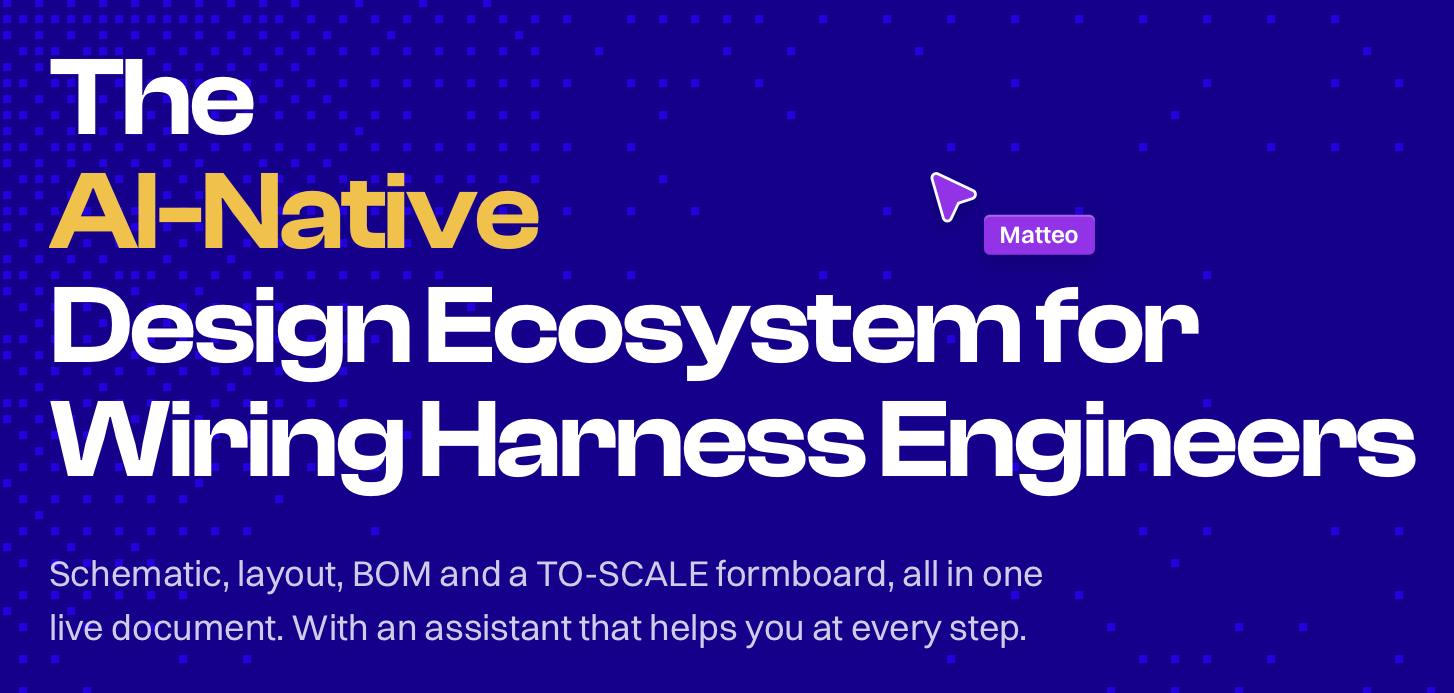
In traditional wiring harness design workflows, schematics are drawn in one tool, layout in another, BOMs are manually maintained in Excel, and templates are output separately. HarnessHive's core idea is the "live document": all design data is linked in real time within a single document — change one schematic detail, and the layout and BOM update simultaneously.
This integrated approach isn't entirely novel — high-end PLM systems in automotive and aerospace have long supported similar capabilities — but those systems typically require months of deployment and dedicated administrators. HarnessHive positions itself at the lightweight end, targeting small-to-medium teams and independent engineers, lowering the barrier to collaborative design.
AI Assistant Embedded in Every Design Phase
HarnessHive positions AI as a design partner that's "present at every step," rather than a standalone chat window. Based on the product description, AI capabilities cover schematic drawing suggestions, layout optimization, and automated BOM generation.
The depth of specific AI features is currently limited by publicly available information. AI assistance in wiring harness design faces inherent challenges: industry standards (such as IPC/WHMA-A-620) are complex, and different customers have vastly different preferences for wire gauges, terminals, and jacket selection. For AI to truly help, it needs access to a company's own component library and historical project data. Whether HarnessHive can achieve this will determine whether it's a "nice-to-have" or "indispensable."
IPC/WHMA-A-620 is the most authoritative international acceptance standard in the cable and wire harness assembly field, jointly published by IPC and the Wire Harness Manufacturers Association (WHMA). It systematically specifies acceptable conditions, defect criteria, and rework guidelines for processes including crimping, soldering, terminal insertion, jacket stripping, and bundling/fastening, covering the complete manufacturing flow from single wires to complex harness assemblies. Because wiring harnesses are widely used in safety-sensitive industries such as automotive, aerospace, and medical, this standard is often directly cited as an acceptance basis in procurement contracts — any violation can result in rejection of entire batches. For AI-assisted design, this means the tool must not only understand electrical connection relationships but also internalize hundreds of pages of process criteria — such as crimp height tolerances, insulation strip lengths, and strain relief requirements — to provide compliant design recommendations.
Collaboration Capabilities Target Team Pain Points
A real-world problem in wiring harness design is that schematic engineers, layout engineers, and procurement staff often work on different file versions, resulting in high communication costs. HarnessHive's collaboration positioning directly addresses this scenario, enabling multiple roles to work in parallel on the same document.
A score of 91 votes, 7 comments, and 18th place on the daily leaderboard indicates the product has gained initial attention, but the low comment count is insufficient to judge real user evaluations of the collaborative experience.
Competitive Landscape of Wiring Harness Design Tools
The wiring harness design software market has long been dominated by professional tools such as Zuken E3 and Mentor Graphics (now Siemens EDA) Capital, while open-source solutions like WireViz cover only a small slice — BOM visualization. HarnessHive's differentiation lies in: AI-native architecture + lightweight collaboration + integrated document.
But wiring harness engineers are famously conservative users — design errors can lead to recalls or even safety incidents, so they won't easily switch tools. HarnessHive needs to demonstrate the reliability of AI suggestions and provide a path for importing data from existing tools before it can truly disrupt this market.
Zuken E3 series is the flagship platform from Japan's Zuken for wiring harness and electrical control cabinet design, offering end-to-end capabilities from schematic capture and harness topology planning to manufacturing documentation output, with leading installed base in automotive and industrial equipment sectors. Siemens EDA Capital (formerly Mentor Graphics Capital) is deeply entrenched in the aerospace, defense, and automotive OEM markets, known for its powerful electrical system data management and variant configuration capabilities, often deeply integrated with PLM systems like Teamcenter. What both share is: comprehensive functionality but a steep learning curve, deployment that often requires professional implementation teams, and high licensing costs. The open-source tool WireViz takes a different path — it uses YAML text to describe harness connection relationships and automatically generates BOM tables and wiring diagrams. It's lightweight and version-control friendly, but covers only the document generation phase and lacks interactive schematic editing or layout capabilities. HarnessHive attempts to carve out a middle ground between heavy professional tools and lightweight text-based tools.
Worth Watching but Needs Validation
HarnessHive represents a clear trend: AI is moving from general-purpose chat assistants toward deep embedding in vertical engineering domains. Wiring harness design is a good entry point — rule-intensive, heavy on repetitive labor, and with strong collaboration needs.
However, the product page on Product Hunt contains limited information. The specific implementation of AI features, data import/export capabilities, and pricing model remain unclear. For wiring harness engineers, this product is worth adding to a watch list, but before replacing existing toolchains in actual projects, small-scale validation is recommended first.
Product Hunt is a community platform for early-stage tech product launches and discovery, where users can vote, comment, and rank products launched on the day. Its leaderboards are often used as a reference indicator for gauging early product traction. Daily rankings are calculated based on a combination of votes and engagement, but the sample is skewed toward early adopters and tech enthusiasts, creating a gap with genuine evaluations from vertical industry professionals. Therefore, a score of 91 votes and 7 comments means the product gained some exposure in the broader tech community, but is insufficient to reflect actual acceptance among wiring harness engineers. For B2B engineering tools, Product Hunt data is better suited as a marketing event record rather than reliable evidence of product-market fit.
One-line Summary
HarnessHive challenges traditional wiring harness design toolchains with an AI-driven integrated live document, with prospects yet to be validated.
Paragraph Summary
HarnessHive is a wiring harness design tool launched on Product Hunt. Its core idea is to consolidate schematics, layout, BOM, and 1:1 templates into a single real-time linked live document, replacing traditional scattered CAD and Excel toolchains. It introduces an AI assistant throughout the entire design workflow and targets multi-role collaboration scenarios. The wiring harness design market has long been dominated by heavy professional tools like Zuken E3 and Siemens EDA Capital, and HarnessHive seeks differentiation through lightweight design and AI-native architecture. However, the depth of AI features, data import/export capabilities, and pricing model remain unclear, and the wiring harness engineer community is conservative, requiring reliability validation. Initial attention on Product Hunt (91 votes / 7 comments / 18th place) is insufficient to judge real user acceptance — small-scale validation is recommended before replacing existing tools.
Related articles

Python 3.15 New Feature: Is the sentinel Type Better Than None?
Python 3.15 adds the sentinel type, using named unique sentinel objects to replace None and bare object(), resolving confusion among missing values, explicit emptiness, and invalid input while avoiding type hint failures.

Deep Learning's Three Architectures and the Universal Approximation Theorem: A Complete Guide to MLPs, CNNs, and Transformers
Explaining the inductive bias differences among MLP, CNN, and Transformer, the existence meaning of the Universal Approximation Theorem (UAT), and the role of Taylor expansion in approximation analysis, while clearing up common misconceptions.

GitLab Emergency Patch Release: Analysis of Critical Security Fixes
GitLab releases critical patch 19.5.1, sparking 355 points of discussion on Hacker News. This article analyzes the background, upgrade steps for self-hosted instances, and verification points to help DevOps teams respond quickly to security updates.