Harvard Study: AI Coding Agents Shift the Bottleneck to Code Review

AI coding agents compress coding time, making code review the new bottleneck in software delivery.
A Harvard research team observed that the spread of AI coding agents is shifting the efficiency bottleneck of software engineering from coding to code review. AI can generate large amounts of code quickly, but human review still requires understanding intent line by line and checking edge cases and security risks, so the gap between fast generation and slow review creates a backlog. Reviewing AI-generated code also demands extra reverse reasoning about design intent, changing the nature of the review burden. The article notes that measuring AI benefits by code generation volume overestimates value, while review queue length, average review time, and rollback rate better reflect real throughput; review fatigue may also lead to quick approvals, creating a hidden risk of faster speed but lower quality. Teams should ease pressure through review checklists, intent explanations, earlier automation, and smaller change sizes, and re-examine where the bottleneck lies across the entire delivery pipeline.
When Writing Code Is No Longer the Bottleneck
A recent observation from a Harvard research team points out that the spread of AI coding agents is changing the working rhythm of software engineering teams: the coding phase that used to be the most time-consuming has been greatly compressed, while code review has instead become the new efficiency bottleneck. This conclusion sparked discussion on Hacker News. Although the post itself did not gain much traction (8 points, 3 comments), the issue it points to deserves serious attention from every engineer using AI-assisted development.
In the past, teams focused their optimization on "how to write code faster." When AI can generate functions, tests, and even complete modules from natural language descriptions, the improvement in coding speed is on an order of magnitude. But software delivery is a pipeline, and once the upstream accelerates, the pressure naturally shifts to downstream stages.
The Mechanism of Bottleneck Shift
The Scissors Gap Between Generation Speed and Review Speed
AI agents can produce large amounts of code in a very short time, but reviewing that code still relies on human engineers to understand intent line by line, check edge conditions, and assess security risks. Generation is fast and review is slow, and the speed difference between the two creates a backlog. The core of the research is precisely this mismatch: the team's overall throughput is no longer determined by "writing" but by "reviewing."
A Qualitative Change in Review Burden
The more subtle problem is that reviewing AI-generated code is not entirely the same as reviewing a colleague's code. Human colleagues' code usually comes with context and design intent, whereas AI-produced code may be syntactically completely correct but logically deviate from team conventions, or introduce assumptions that are hard to notice. Reviewers need to put in extra effort to "reverse-engineer" why the code was written this way, which further lengthens review time.
Bottleneck shift originates from the Theory of Constraints: at any given moment, a system usually has only one tightest constraint that determines overall output, and after that constraint is alleviated, it automatically migrates to the next stage. The same applies to software delivery pipelines—when the capacity of the coding stage is amplified by AI agents, the system's throughput ceiling shifts to downstream stages such as code review, integration testing, or deployment verification. The key to understanding this mechanism is that local efficiency gains are not equivalent to system efficiency gains; only by identifying and optimizing the current constraint point will overall delivery speed truly improve. Therefore, after introducing AI tools, teams should re-measure queue lengths and dwell times at each stage of the pipeline rather than assuming that speedups happen at the coding end by default.
Code review in engineering practice is not only about finding bugs; it also carries functions such as knowledge transfer, alignment on conventions, and collective code ownership. Research shows that reviewers can usually find more defects in small batches of changes, and review speed drops significantly as change size increases—which is why the industry generally recommends keeping a single change within a few hundred lines. When changes are generated by AI, reviewers lack the design context that authors provide in commit messages or face-to-face communication and need more cognitive load to reconstruct intent. In addition, AI-generated code often looks superficially standardized and neat, which easily induces "automation bias," meaning reviewers tend to trust seemingly professional output and lower their guard. Together, these two points explain why the burden of reviewing AI code is not only an increase in quantity but also a change in nature.
Impact on Engineering Practice
Bottleneck shift brings a series of chain reactions. If teams continue to measure the value of AI tools by "coding capacity," they may overestimate the benefits. The metric that truly determines delivery speed is shifting from the amount of code submitted to the length of the review queue and the average review time.
Another impact worth noting is the dilution of review quality. When reviewers face a large number of AI-generated changes, they are prone to "review fatigue" and tend to approve quickly. Combined with bottleneck shift, this may create a hidden risk of faster speed but lower quality.
Review fatigue refers to the decline in reviewers' attention and judgment after continuously handling a large number of changes, making them inclined to approve code in less time and with fewer questions. Research shows that review effectiveness declines noticeably after a single session exceeds about 60 to 90 minutes, and an overly large review queue also pushes reviewers toward "rubber-stamp" approvals. When combined with AI-generated code, this effect may be amplified: a surge in the number of changes and unclear intent in individual changes both accelerate the onset of fatigue. Mitigation measures include limiting daily review volume, rotating reviewers, and introducing mandatory waiting periods or secondary spot checks into the process so that review quality is not diluted by throughput pressure.
How Teams Can Respond
Optimizing around the review stage is becoming more urgent than optimizing coding. Feasible directions include: establishing clearer review checklists for AI-generated changes and requiring the submitting party (whether a human or an agent) to include an explanation of intent; moving automated tests and static checks earlier so that human reviewers can focus on design and logic; and controlling the size of individual changes to avoid exposing reviewers to overly large diffs.
The value of this Harvard study is not that it provides conclusive solutions, but that it reminds engineering teams: after introducing AI coding agents, they need to re-examine where the bottleneck lies across the entire delivery pipeline rather than focusing only on speedups in the coding stage.
Frequently Asked Questions
Will AI coding agents replace code review?
From the perspective of this study, not in the short term. AI can assist with review, but the core of review is judging intent and risk, which still requires human engineers to take responsibility. The bottleneck shift precisely shows that the human value of the review stage is increasing.
What metrics should teams use to measure the benefits of AI programming?
Compared with code generation volume, review queue length, average review time, and change rollback rate better reflect changes in real throughput.
Do the conclusions of this study apply to all teams?
The study observes a trend phenomenon, and the specific degree of impact depends on the maturity of the team's review process and the intensity of AI tool usage.
One-line Summary
AI coding agents compress coding time, making code review the new bottleneck in software delivery.
Paragraph Summary
The Harvard research team observed that the spread of AI coding agents is shifting the efficiency bottleneck of software engineering from coding to code review. AI can generate large amounts of code in a short time, while human review still requires understanding intent line by line and checking edge cases and security risks. The speed difference—fast generation and slow review—leads to a backlog in the review queue. More critically, reviewing AI-generated code requires extra reverse reasoning about its design intent, causing the review burden to change qualitatively. The article points out that measuring AI benefits by code generation volume overestimates value, while review queue length, average review time, and rollback rate better reflect real throughput; review fatigue may also lead to quick approvals, creating a hidden risk of faster speed but lower quality. Teams should ease the pressure through review checklists, intent explanations, earlier automation, and smaller change sizes, and re-examine where the bottleneck lies across the entire delivery pipeline.
Related articles
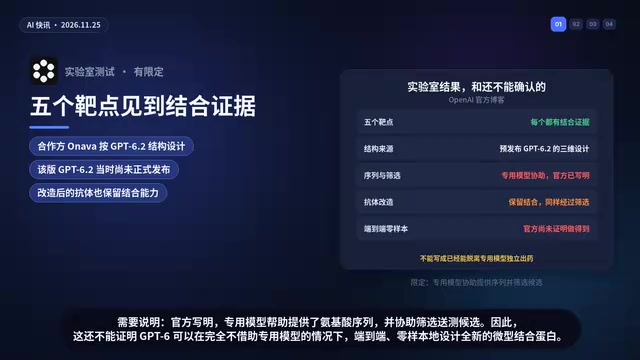
GPT-6 Designs Proteins, Claude Creations Become Apps with One Click, DeepMind Releases New Benchmark
OpenAI says GPT-6 can design protein 3D structures, Anthropic lets Claude creations install as desktop apps, DeepMind's HIP benchmark tests stability on simple questions, Google Workspace opens agent MCP interfaces.
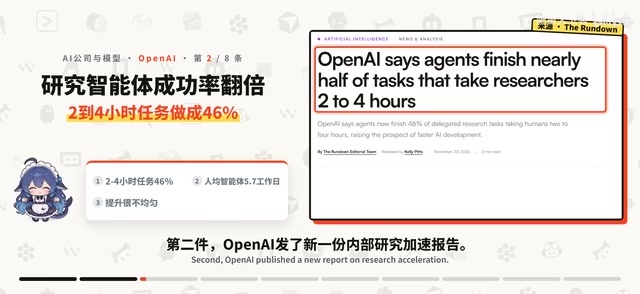
OpenAI Weekly Roundup: GPT-6.2 Rolls Out to ChatGPT, GPT-6 Designs Proteins
OpenAI's week: GPT-6.2 rolls out to ChatGPT, GPT-6 claims independent protein design, agent research share surges, perplexity proposed as a shared metric, and internal safety concerns surface.

Is the Crypto Industry About to "Turn Blue"? The Truth Behind Tech and Politics' Shifting Allegiances
Vergecast discusses whether the crypto industry will shift from the right to the Democrats, revealing the pragmatic nature of tech's politics and the costs of a crypto pivot.