Harvey Labs: An Open-Source Benchmark Framework for Legal AI Agent Evaluation

Harvey open-sources a benchmark framework for evaluating AI agents in real-world legal workflows.
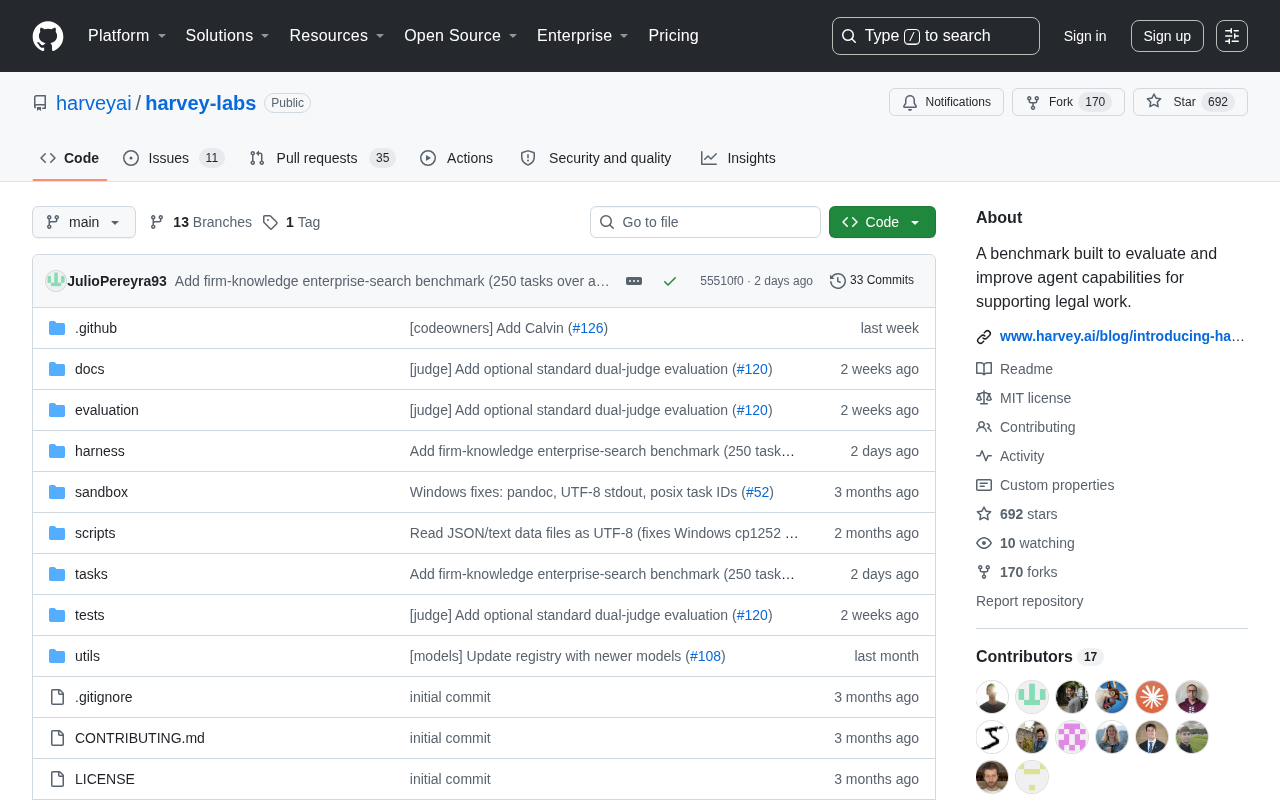
Harvey Labs is an open-source Python benchmark framework from legal AI company Harvey, designed to evaluate AI agents' capabilities in real legal workflows including contract review, case law research, and legal reasoning. It addresses the gap left by general benchmarks like MMLU by focusing on domain-specific challenges such as factual traceability, long reasoning chains, and low error tolerance, marking legal AI's entry into a measurable, verifiable maturity stage.
Legal AI Enters the 'Evaluation Era'
As large language models and AI agents accelerate their deployment across industries, the legal sector is emerging as a high-value yet high-risk application domain. Contract review, case law research, legal opinion drafting — these tasks demand extreme accuracy, logical rigor, and factual traceability. A single "hallucination" can lead to serious consequences.
AI hallucination refers to the phenomenon where large language models generate factually nonexistent or incorrect information with a highly confident tone. This problem is especially dangerous in the legal domain — in 2023, a New York lawyer was discovered by a judge to have submitted legal briefs generated by ChatGPT that cited entirely fictitious case law, resulting in sanctions. This incident triggered widespread discussion in the legal community about AI tool reliability and directly fueled demand for dedicated legal AI evaluation systems.
Against this backdrop, Harvey, a company focused on legal AI, open-sourced the Harvey Labs project. This is a benchmark framework specifically designed for evaluating and improving AI agents' ability to support legal work. Written in Python, the project has already garnered 685 Stars and 170 Forks on GitHub, with 47 new Stars in a single day, demonstrating strong community interest in legal AI evaluation tools.
Why Does Legal AI Need a Dedicated Evaluation Benchmark?
Limitations of General-Purpose Benchmarks
Currently, the industry primarily relies on general benchmarks like MMLU, GPQA, and HumanEval to evaluate large models, measuring comprehensive capabilities in mathematics, programming, and commonsense reasoning. Specifically, MMLU (Massive Multitask Language Understanding) was introduced in 2021 by UC Berkeley and other institutions, covering multiple-choice questions across 57 subjects; GPQA (Graduate-Level Google-Proof Q&A) focuses on graduate-level scientific questions requiring deep specialized reasoning; and HumanEval primarily evaluates code generation ability. While each benchmark has its focus, their common limitation is that test formats typically involve single-turn Q&A or isolated tasks, unable to reflect sustained reasoning and tool coordination capabilities within complex workflows.
However, legal work has unique characteristics:
- Dense specialized terminology: Legal language is precise and highly context-dependent; ordinary semantic understanding is insufficient.
- Factual traceability: Lawyers need every conclusion to have clear statutory or case law support — nothing can be generated from thin air.
- Long reasoning chains: From fact-finding to legal application, rigorous multi-step reasoning is often required.
- Extremely low error tolerance: Unlike creative writing, errors in legal contexts can directly affect litigation outcomes or compliance judgments.
General benchmarks cannot adequately reflect a model's true performance across these dimensions — this is precisely the gap Harvey Labs aims to fill.
The Leap from 'Model Evaluation' to 'Agent Evaluation'
You may not have noticed, but Harvey Labs is not positioned to simply evaluate a language model's Q&A ability — it evaluates the performance of AI agents in real legal workflows.
An AI agent refers to an AI system capable of autonomously perceiving its environment, formulating plans, and executing multi-step tasks, distinguishing it from traditional single-turn dialogue models. A typical legal AI agent might need to: first understand the user's legal question, then search relevant statute and case law databases, filter and analyze search results, perform legal reasoning based on multiple information sources, and finally generate a structured legal opinion. This process involves the coordinated work of multiple technical modules including Planning, Memory management, Tool Use, and Reflection. Current mainstream agent frameworks include LangChain, AutoGPT, CrewAI, and others.
This means the evaluation target is not just the quality of model output, but also its comprehensive capabilities in tool invocation, Retrieval-Augmented Generation (RAG), and multi-step task orchestration.
Retrieval-Augmented Generation (RAG) is a technical architecture that combines external knowledge retrieval with large model generation capabilities. In legal scenarios, RAG's value is particularly prominent: the model no longer relies solely on knowledge from training data, but retrieves relevant content from legal databases, case law repositories, and regulatory texts before generating answers, then produces evidence-based outputs based on retrieval results. This significantly reduces hallucination risk and makes outputs traceable — lawyers can verify whether every statute cited by the AI actually exists. Core challenges in RAG systems include: retrieval precision (whether the most relevant statutes are found), context window management (how to effectively process long documents), and conflict resolution across multiple sources.
This leap from model evaluation to agent evaluation is highly aligned with the current macro trend of AI evolving from "chatbots" to "autonomous agents."
Harvey's Industry Background
Harvey is one of the most watched startups in the legal tech space. Its core product serves law firms and corporate legal teams, providing large model-based legal work assistance. Harvey was co-founded in 2022 by former OpenAI researcher Winston Weinberg and former O'Melveny lawyer Gabriel Pereyra. The company raised $80 million in Series B funding led by Sequoia Capital in 2023 at a valuation of approximately $715 million; in 2024, it completed a further $100 million Series C round, pushing its valuation past $1.5 billion and officially entering unicorn status. Its clients include Allen & Overy, PwC, and other top global institutions, and it has also received investment support from the OpenAI Startup Fund.
Harvey's rapid rise reflects the explosive growth of the legal tech space in the large model era — according to Grand View Research, the global legal AI market is projected to grow from approximately $1.5 billion in 2023 to over $9 billion by 2030.
For a company deeply rooted in a vertical domain, open-sourcing an evaluation benchmark carries multiple strategic implications:
- Establishing industry standards: Through open benchmarks, Harvey has the opportunity to become the de facto standard-setter for legal AI capability evaluation.
- Driving ecosystem development: Attracting researchers and developers to improve legal AI, collectively raising industry-wide standards.
- Enhancing product credibility: Demonstrating technical strength to clients through transparent evaluation methods — particularly important in the conservative legal industry.
Technical Architecture and Features of Harvey Labs
Reproducible Standardized Evaluation Process
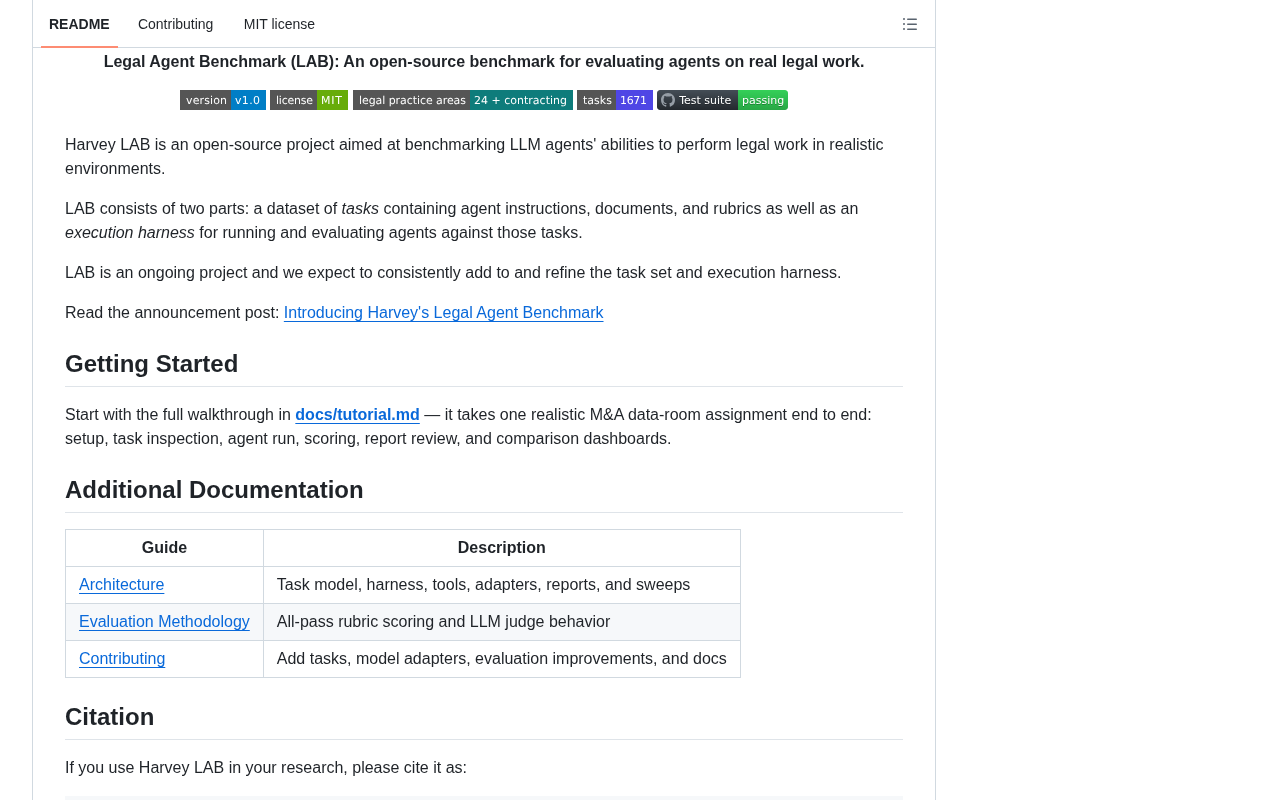
As a Python project, Harvey Labs provides a standardized, reproducible evaluation process. This is crucial for researchers conducting horizontal comparisons of different models (such as GPT-4, Claude, Gemini, etc.) on legal tasks.
Reproducibility is one of the foundational principles of scientific research, requiring that experimental results can be replicated by independent third parties using the same methods. In AI evaluation, reproducibility faces unique challenges: model API version updates, random seed settings, prompt fine-tuning, and other factors can all lead to inconsistent results. A 2023 Stanford University study found that GPT-4's performance on the same benchmark showed significant fluctuations over several months, sparking discussion about the reliability of evaluating closed-source models. By open-sourcing complete evaluation code and processes, Harvey Labs enables any researcher to repeat experiments under identical conditions, providing a solid foundation for establishing credible legal AI capability rankings.
Task Design Oriented Toward Real Legal Work
Unlike many academic benchmarks, Harvey Labs emphasizes the practical goal of "supporting legal work." This means its task design is closer to lawyers' actual daily work — such as document analysis, clause extraction, legal research, and contract review — rather than abstract multiple-choice questions. This "work-oriented" evaluation approach reflects the trend of AI benchmarks evolving from "exams" to "real-world practice."
Implications for the Legal Tech Industry
The open-sourcing of Harvey Labs marks legal AI's entry into a more mature stage focused on measurability and verifiability. As more law firms adopt AI tools, "Is this model actually reliable?" is no longer a vague question but one that can receive quantified answers through standardized benchmarks.
For other vertical industries (such as healthcare, finance, and education), Harvey's approach provides a replicable paradigm: proactively establishing industry-specific evaluation systems while driving AI adoption, earning trust in high-risk scenarios through transparency and reproducibility. In fact, similar trends have already emerged in other fields: healthcare has benchmarks like MultiMedQA and MedBench for evaluating clinical reasoning capabilities; finance has frameworks like FinBen for evaluating financial analysis and risk assessment performance. The common characteristics of these vertical benchmarks are: emphasis on domain knowledge accuracy, requirements for output explainability and traceability, and focus on model performance in complex workflows. Harvey Labs' open-source practice sets a benchmark for this trend — it is not merely a technical tool but a model of industry governance: domain-specialized companies leading standard-setting, winning professional user trust through openness and transparency.
As AI agent capabilities continue to strengthen, domain-specific benchmarks like Harvey Labs may become the key yardstick for measuring technology's true maturity.
Key Takeaways
Related articles

Chain of Thought Isn't Just for AI: How Humans Can Use CoT to Improve Thinking Quality
Chain of Thought isn't just a prompt trick for large models. Starting from a Hacker News discussion, this article analyzes why CoT works for human thinking too, breaks down actionable ways to transfer it, and highlights the key differences between human CoT and machine CoT.
Cloudflare Teams Up with OpenAI: Closi…
Cloudflare Teams Up with OpenAI: Closing the Loop from Vulnerability Discovery to Defense with AI
Cloudflare uses OpenAI Daybreak to investigate security vulnerabilities and generate reviewable remediation plans, while developers use Codex to boost coding efficiency and quality.

Orca Multi-Agent Orchestration in Practice: A Guide to Parallel Collaboration with Claude and Codex
Orca is Stable AI's free open-source agent workbench supporting 34 agents like Claude Code and Codex in parallel. Learn its Git worktree isolation, multi-model orchestration, and mobile management.