Harvey Raises $500M — I Open-Sourced a Legal AI Alternative
As Harvey raises $500M, a developer open-sources a reproduced legal AI, sparking the capital-vs-open-source debate.
The article uses Harvey's $500M funding as an entry point, contrasting it with a developer on Hacker News announcing an open-source reproduction of similar legal AI. The author notes open-source solutions can reproduce workflows like document retrieval and clause extraction but struggle with data licensing, compliance review, and customer delivery; the real moat in legal AI is trust and liability backing — open source offers transparency but has a responsibility vacuum. Capital and open source target different customers — enterprise law firms vs. small/mid-sized legal teams — and will coexist and compete long-term, with open-source maturity potentially reshaping enterprise pricing. The article concludes that scarce legal AI benchmarks are where the open-source community has the best chance to establish discourse power.
When Legal AI Becomes Capital's Darling
The legal tech space recently saw a landmark event: Harvey announced it had raised $500 million. That funding scale is rare in the legal AI field, and it has once again drawn attention to "AI + law" — a direction long considered high-barrier and slow to deploy.
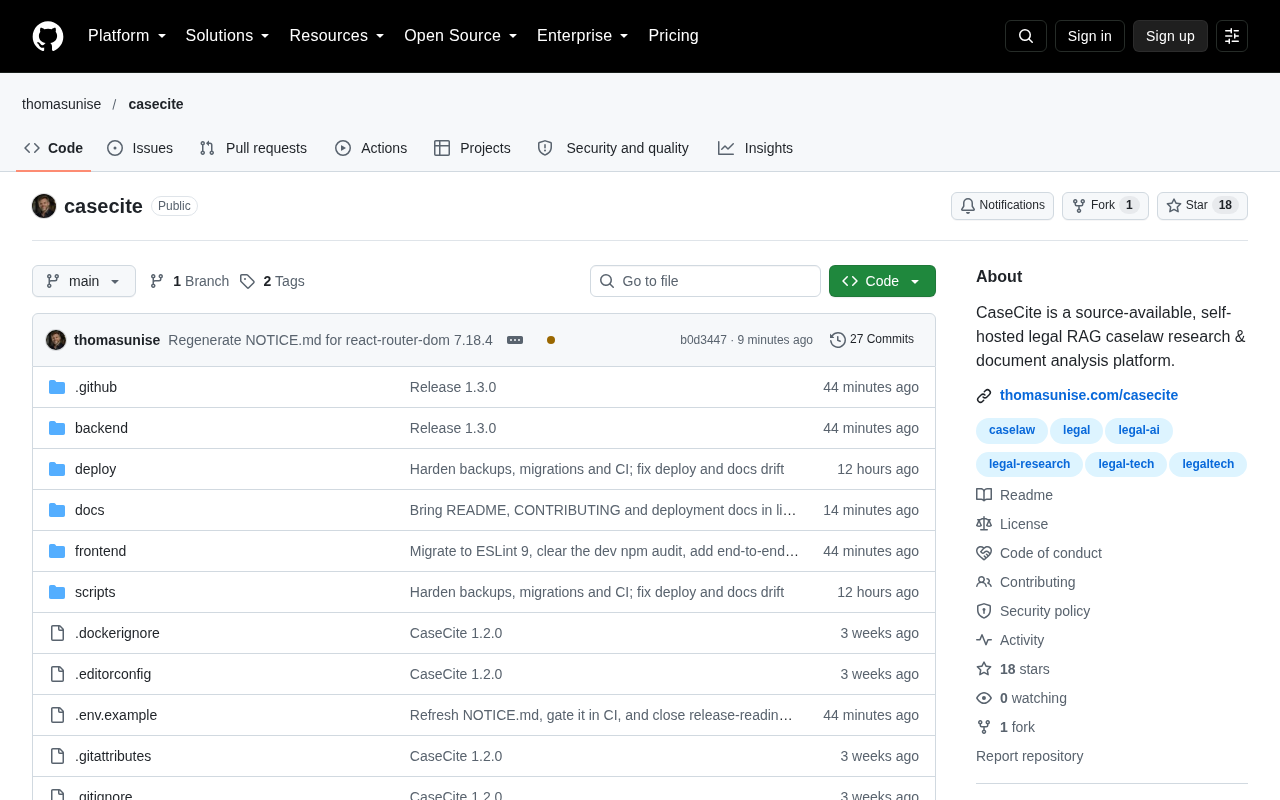
On Hacker News, one developer responded to the news in a different way — he wrote: "Harvey raised 500M for legal AI, I built the same and open sourced it." No funding press conference, no business plan — just runnable code and an open-source repository.
The post itself got only 22 upvotes and 1 comment, far less discussion than the funding news, but it raises a question worth taking seriously: when the leading company takes home enormous capital, to what extent can one person or a small team reproduce similar capabilities? And in this highly sensitive industry, what does the open-source route actually mean?
Where the Limits of Open-Source Reproduction Lie
The phrase "built the same" needs to be unpacked. Legal AI products typically involve three layers of capability: document retrieval and Q&A, contract clause extraction and comparison, and reasoning and generation based on case law and statutes. Once open-source models and vector databases matured, the reproduction barrier for the first two layers dropped noticeably; the third layer — involving data quality, evaluation systems, and domain fine-tuning — is the real dividing line.
From public information, such open-source projects generally adopt a "large model API + retrieval augmentation" architecture, chunking legal documents into a store and then constraining output format via prompts. What it can do is let lawyers or legal staff quickly locate clauses in natural language, generate drafts, and run consistency checks — not replace professional judgment.
In other words, open source reproduces the workflow, not the moat. Much of Harvey's $500 million will flow toward data licensing, compliance review, customer delivery, and sales networks — precisely the parts open-source projects struggle most to cover. The developer's value isn't in proving "I can do this too," but in proving "this path can be validated."
Retrieval-Augmented Generation (RAG) is the architectural foundation commonly adopted by such open-source legal AI projects. Its core idea: rather than "training" legal knowledge directly into model parameters, it first retrieves relevant fragments from an external document store when a user asks a question, then feeds those fragments as context to the large model to generate an answer. For legal scenarios, RAG's significance lies in traceability — every piece of evidence the model cites can be traced back to a specific statute or the original contract text, making human verification easy. Compared with fine-tuning, RAG has lower deployment cost and faster knowledge updates: after regulations are revised, you only need to replace the document store, not retrain the model. But its ceiling depends on retrieval quality: chunking strategy, embedding model choice, and the recall-and-rerank stages all significantly affect final accuracy — one of the engineering details that separates open-source projects from commercial products.
The Legal Industry's Trust Cost Is Underestimated
The biggest difference between legal AI and general chatbots is that the cost of error is extremely high. Missing a liability limitation clause in a contract could cause millions in losses; citing a nonexistent precedent directly damages professional reputation. This makes the legal industry naturally conservative about AI adoption.
Open source presents two sides here.
One side is the transparency advantage: code and prompts are auditable, and law firms can deploy and verify on their own without handing sensitive case files to a third-party SaaS. For organizations with strict data compliance requirements, this is a decisive factor.
The other side is the responsibility vacuum: open-source projects have no service-level agreements, no professional indemnity — when something goes wrong, no one backs you up. Companies like Harvey never sell just model capability, but also the certainty that "someone is accountable if things go wrong." This point is almost undiscussed in the comments, yet it is the core of commercialization.
According to the Hacker News post itself, the author did not elaborate on technical details or deployment cases, so it's impossible to judge its completeness or usability. This is both the limitation of a single source and a common shortcoming of open-source showcases — between a demo and production lies a great deal of engineering and compliance work.
Indemnity is an often-overlooked yet crucial clause in enterprise software procurement. It refers to a vendor's commitment: if a product defect causes the customer to suffer losses or face third-party claims, the vendor bears the corresponding liability. Once legal AI outputs an erroneous clause or fabricates a precedent, the customer may face litigation or professional penalties, so large law firms often require vendors to provide explicit indemnity and liability caps when procuring. Such commitments require insurance, legal teams, and contract systems to support — essentially converting technical risk into priceable commercial risk. Open-source projects released under licenses like MIT or Apache typically carry disclaimers stating they are "provided as-is, without any liability," making it inherently impossible to offer such protection — the structural reason they struggle to directly replace commercial products in the enterprise market.
Capital and Open Source: Dislocated Competition
Looking at the two together, you realize they aren't actually competing on the same battlefield.
Harvey's $500 million points to the enterprise market: large law firms, multinational corporations, and legal departments of financial institutions. This market has long procurement cycles and complex decision chains, requiring sales teams, customer success teams, and compliance certifications. Capital's role is to accelerate capturing these seats.
Open-source projects point to a different group: solo practitioners, small and mid-sized legal teams, legal tech entrepreneurs, and developers who want to study how legal AI is implemented. What they need is customizable, privately deployable, cost-controllable tools — not enterprise software charged per seat.
The two routes will coexist over the long term. Open-source projects are validating demand and cultivating the ecosystem; commercial companies are harvesting the customers most willing to pay. What's really worth watching is whether, once open-source solutions mature enough, the pricing logic of enterprise products will be redefined — something that has already happened in fields like databases and machine learning frameworks.
Per-seat pricing is the most mainstream pricing model for enterprise SaaS, charging by number of users or accounts. Legal AI products adopt this model because their value is directly tied to the number of lawyers and usage frequency, and it simplifies procurement budgeting. But this model also means the larger the customer, the higher the cost, creating a barrier for small and mid-sized legal teams. Open-source solutions typically charge only the marginal cost of deployment and operations, or are entirely free, creating substitution pressure in the price-sensitive long-tail market. Historically, the maturity of open-source databases like MySQL and PostgreSQL forced commercial databases to shift from per-seat licensing to usage-based or subscription pricing; the open-sourcing of machine learning frameworks also reshaped the business models of AI infrastructure. Whether legal AI will repeat this path depends on whether open-source solutions can reach the baseline of enterprise procurement in terms of accuracy and compliance.
Takeaways for Developers
There are three lessons here for technical practitioners.
First, AI opportunities in vertical domains don't belong only to the best-funded teams. Engineering domain knowledge — organizing statutes, case law, and contract templates into retrievable, evaluable data assets — is itself hard and correct work, and the open-source community's collaboration efficiency in this area is often underestimated.
Second, choosing open source means choosing a different growth path. Without a sales team, you can only win trust through documentation quality, completeness of examples, and community responsiveness. This actually demands higher engineering capability.
Third, competition in legal AI will ultimately come down to evaluation. Whoever establishes an accuracy benchmark recognized by the industry holds the discourse power. Public legal AI evaluation sets are still scarce, and this may be where the open-source community has the best chance to contribute.
Back to that post with only 22 upvotes. It may not turn into a successful project, but it records a real signal: in a high-barrier industry like law, open-source reproduction is moving from impossible to "worth a try." Whether it can reach production depends on whether the author is willing to do the dirty, tedious work that funding news never mentions.
One-line Summary
As Harvey raises $500M, a developer open-sources a reproduced legal AI, sparking the capital-vs-open-source route debate.
Paragraph Summary
Taking Harvey's $500M funding as its entry point, the article contrasts it with a developer on Hacker News announcing an open-source reproduction of similar legal AI. The author notes that open-source solutions can reproduce workflows like document retrieval and clause extraction, but struggle to cover data licensing, compliance review, and customer delivery; the real moat in legal AI is trust and liability backing — open source has advantages in transparency but suffers a responsibility vacuum. Capital and open source target different customer groups — enterprise law firms and small/mid-sized legal teams — and will coexist and compete long-term, with open-source maturity potentially reshaping enterprise pricing logic. The article concludes by stressing that legal AI evaluation benchmarks are scarce, making this the area where the open-source community has the best chance to establish discourse power.
Related articles

Last Week Tonight Exposé: The Dangerous Ties Between Politicians and White Supremacy
Last Week Tonight investigates Georgia Senate candidate Mike Collins and Florida candidate Marshall Rawson, exposing their multiple ties to white supremacists and the Republican Party's silent response.
AI Buzz Weekly: GPT-6.5 Leak, New Claude Model, and MiniMax's Cost-Effectiveness
This week's AI buzz roundup: suspected GPT-6.5 leak, Microsoft configs showing GPT-6.1 Tera, Anthropic's new model that can identify entire classes of bugs, disappointing early Gemini 4 Carbon results, and MiniMax M3.1 Flash beating Claude Opus 5 and GPT-5.6 Sol in benchmarks at extremely low cost.

AI Briefing: Gemini 4 Carbon Released, Ant Open-Sources Ling-3.1
AI Briefing: Google releases Gemini 4 Carbon qubit model, claiming to surpass Opus 5.5 with half-price tokens; Ant open-sources Ling-3.1-1019 for real-task Personal Agents; domestic AI drug discovery succeeds in 18 of 19 projects, hitting all 6 GPCR targets; zero-revenue company valued at $20B raises another $1B; Sichuan convenience store robot sales fail.