Has Qwen3.8-27B Become "Dumber"? Users Suspect the Model Was Secretly Weakened

Users say the local Q4 version of Qwen3.8-27B has recently gotten worse and suspect secret official weakening, but quantization and usage factors are more likely.
A Reddit user reported that the locally run Qwen3.8-27B (Q4 quantization, RTX 4090, llama.cpp) performed impressively at launch but recently frequently fails basic tasks and forgets instructions; the user suspects the official team intentionally weakened the model through quantization or updates to pave the way for Qwen4. The article analyzes that this perception may stem from multiple factors such as quantization precision loss, version or quantization file confusion, changes in prompts and workload, and inference framework updates. The community has similar feedback, but there is no official evidence. Users are advised to record versions and parameters, evaluate with a fixed test set, try Q8 or FP16 versions, and manage expectations reasonably.
Introduction
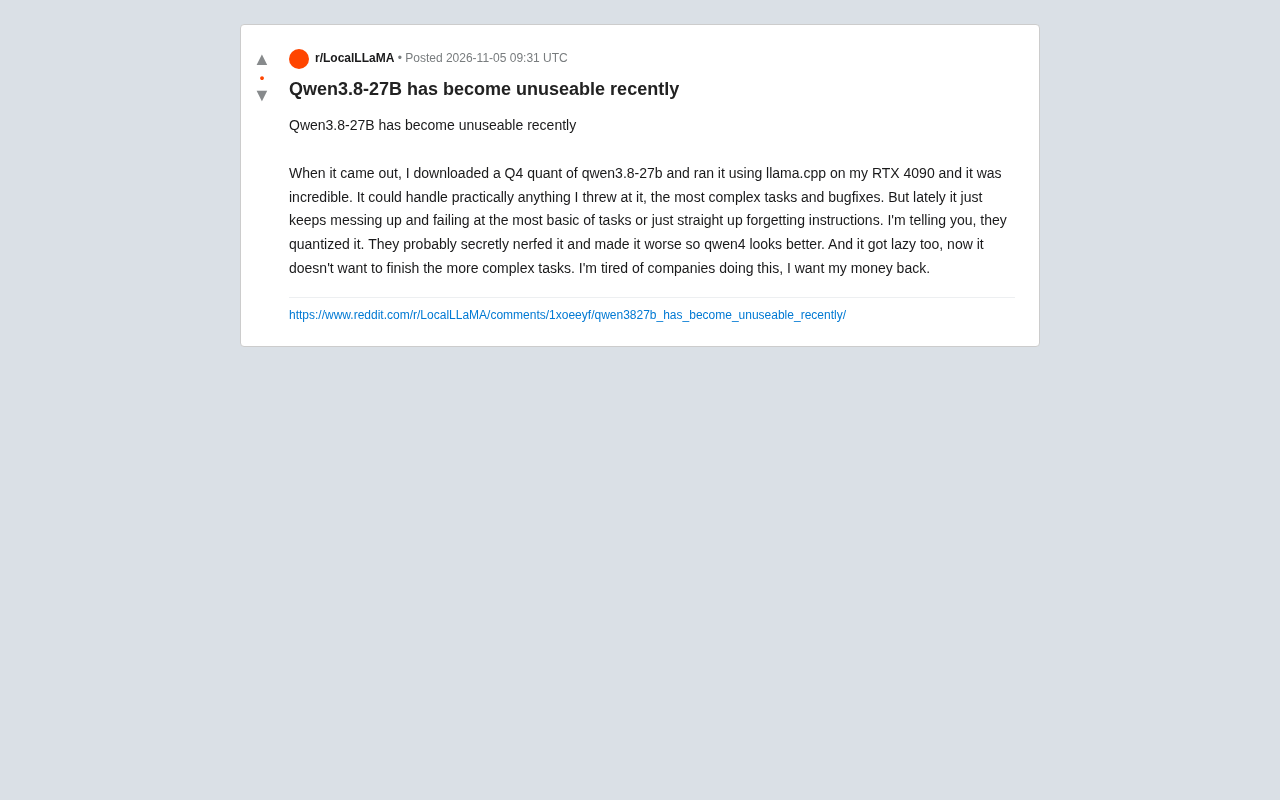
Recently, a post on Reddit sparked heated discussion in the community. A user complained that his locally run Qwen3.8-27B model (using Q4 quantization, running via llama.cpp on an RTX 4090) performed impressively when first released—handling extremely complex tasks and bug fixes—but now frequently fails even basic tasks and even forgets instructions. The user suspects that the official team "quantized" the model to secretly weaken its performance, paving the way for the upcoming Qwen4.
The User's Experience: From Amazing to Disappointing
Initial Experience: Capable of Everything
According to the user, Qwen3.8-27B (Q4 quantized version) performed excellently in its early days. Deployed locally on an RTX 4090 with llama.cpp, the model could understand complex requirements and fix code bugs—almost "answering every request." This convenience and capability of a local large model left him very satisfied.
Current State: Even Basic Tasks Fail
But recently, the model started "falling apart": simple tasks fail frequently, instructions are forgotten, and it even refuses to complete more complex tasks. The user believes the model has become "lazy" and directly accuses the official team of possibly intentionally degrading model capability through quantization or updates—aiming to make the subsequent Qwen4 appear more powerful.
Analysis of the Underlying Causes: Was the Model Really "Weakened"?
Quantization Differences and Version Confusion
The user is using the Q4 quantized version, and quantization itself loses precision. If the official team adjusted the quantization strategy or released a new version in subsequent updates, this could cause changes in local model behavior. In addition, the user may have inadvertently downloaded quantization files from different sources, causing differences in experience.
Quantization refers to the technique of compressing model weights from higher precision (such as FP16, BF16) to lower bit widths (such as 8-bit, 4-bit), with the goal of reducing VRAM usage and improving inference speed. Common schemes include GPTQ, AWQ, and the GGUF series (such as Q4_K_M), among others; different schemes and parameters bring different precision losses. Q4 means weights are stored at approximately 4 bits, which theoretically saves about 75% of VRAM compared to FP16, but degradation is more likely on tasks such as mathematical reasoning and long instruction following. The "dumbness" users perceive is sometimes precisely because quantized versions are more sensitive to prompt format and context length, rather than the model itself being modified by the official team.
llama.cpp is an open-source large model inference framework implemented in C/C++, supporting running GGUF-format models on consumer GPUs and CPUs. Its updates may change default sampling parameters, context handling, or quantization kernel implementations, thereby affecting the actual performance of the same model file. Therefore, when users say "the model got worse," the inference framework version, quantization file source, and runtime parameters are all variables that need to be investigated.
Evolution of Prompts and Usage Habits
As users' expectations of the model increase, prompts may become more complex or vague, causing fluctuations in model performance. It is also possible that the user's workload shifted from simple tasks to more complex scenarios, hitting the boundaries of the model's capability.
Context Window refers to the total number of tokens the model can "see" in a single inference. When conversations are long, early instructions may be truncated or diluted, and the model appears to "forget instructions." Many local inference tools have limited default context lengths; if users do not manually increase them, forgetting in long conversations becomes more obvious. In addition, when prompts change from simple instructions to complex tasks with multiple steps and implicit constraints, the model's sensitivity to format and wording increases—performance fluctuations do not necessarily mean the model's capability has been weakened.
No Official Response, Community Speculation Swirls
Currently, the Qwen official team has not responded to this matter. Some in the community believe that model updates are normal, but "intentional weakening" lacks evidence. Other users share similar experiences and suspect that updates to quantization or the inference framework (such as llama.cpp) are the cause.
Community Reaction and Similar Cases
Many users replied to the post saying they encountered similar situations. Some pointed out that the model tends to forget early instructions in long conversations, which may be related to context window management. Other users suggested trying higher-precision quantized versions (such as Q8) or checking inference parameter settings.
Discussions about "models becoming lazy" are not uncommon in the AI community. Previously, users have reported that other open-source models performed worse after updates, but most cases were ultimately attributed to changes in usage or environment.
Advice for Developers
Maintain Version Control and Records
Users are advised to record model versions, quantization files, and inference parameters to facilitate comparison of performance across different periods. Use a fixed set of test cases to evaluate changes in model capability.
Try Different Quantization Levels
If you suspect quantization is causing performance degradation, try Q8 or FP16 versions to see if there is improvement. Also pay attention to official model update logs.
Manage Expectations Reasonably
Large models have capability boundaries, and complex tasks may require more refined prompt design. Community collaboration and feedback help drive model improvement.
Conclusion
Currently, there is no conclusive evidence that the Qwen official team intentionally weakened the model. The "dumbness" users perceive may stem from multiple factors such as quantization, version, and usage patterns. However, this discussion reflects the community's concern about the transparency and sustained quality of open-source models. For developers, maintaining careful evaluation and active feedback is the best strategy for coping with change.
One-line Summary
Users say the local Q4 version of Qwen3.8-27B has recently gotten worse and suspect secret official weakening, but quantization and usage factors are more likely.
Paragraph Summary
A Reddit user reported that the locally run Qwen3.8-27B (Q4 quantization, RTX 4090, llama.cpp) performed impressively at launch but recently frequently fails basic tasks and forgets instructions; the user suspects the official team intentionally weakened the model through quantization or updates to pave the way for Qwen4. The article analyzes that this perception may stem from multiple factors such as quantization precision loss, version or quantization file confusion, changes in prompts and workload, and inference framework updates. The community has similar feedback, but there is no official evidence. Users are advised to record versions and parameters, evaluate with a fixed test set, try Q8 or FP16 versions, and manage expectations reasonably.
Related articles
 Tech Frontiers
Coldframe: A Honeypot Disguised as a Supermarket Freezer Controller
Coldframe is a honeypot disguised as Danfoss AK-SM 800A and Dixell XWEB freezer controllers, built as a single Python file that detects CVE-2025-41450 attempts and is identified as real devices on Shodan.
 Tech Frontiers
GRFNet: A Lightweight PyTorch Model Designed for Multichannel Time-Series Classification
GRFNet is a lightweight PyTorch model for multichannel time-series classification, originating from EEG decoding research. With only 3,847 parameters, it is based on the ROCKET architecture, combining random convolution kernels with learnable spatial filters, supports arbitrary input lengths, and will soon be evaluated on the PhysioNet dataset.
 Tech Frontiers
CUDA-Accelerated Rocket League Simulator: A Player-Made Hardcore Experiment
A Reddit post shows a "100% Accurate" Rocket League simulator accelerated with CUDA. We analyze its technical context, CUDA's value in game physics simulation, and the significance and limitations of such community projects.