Has the Riemann Hypothesis Been Proven by AI? Two Candidate Proofs Appear on the Same Day

Two candidate proofs of the generalized Riemann hypothesis appeared on the same day, with AI both proposing and checking them, posing new verification challenges.
On November 20, two candidate proofs of the generalized Riemann hypothesis emerged: Anthropic mathematician Alpöge and Claude presented a four-page statement plus a Lean formalization, while mathematician Masullo released a 940-page draft nearly 12 years in the making. Claude had earlier raised the lower bound on the proportion of zeros on the critical line from about 41.67% to about 67.25%, but the full proof awaits verification. Alpöge's approach uses color lifting to simulate multiplicity constraints in function fields, with Claude suggesting a lifting chain length of about the square root of X. Lean formalization enables machine step-by-step checking, but whether the final theorem covers finite or arbitrary height still needs independent verification. AI's role in mathematics is dividing into proposing proofs, checking natural-language drafts, and assisting formal verification.
Title
Has the Riemann Hypothesis Been Proven by AI? Two Candidate Proofs Appear on the Same Day
Meta Description
On November 20, Anthropic mathematician Levent Alpöge and Claude publicly released a four-page candidate proof of the generalized Riemann hypothesis along with a Lean formalization project. On the same day, another 940-page draft was found by AI to have problems. This article outlines the core issues of the Riemann hypothesis, Claude's role in the proof, the significance of formal verification, and the various ways AI participates in mathematics review.
Article Content
On November 20, the mathematical world saw two candidate proofs of the generalized Riemann hypothesis on the same day. One came from Anthropic mathematician Levent Alpöge in collaboration with Claude, who released a statement of only four pages—yet the proof code was placed in 14 compressed volumes; the other, titled The Music of Counting, was a draft mathematician Alessandro Maria Masullo spent nearly 12 years writing, with a public PDF running to 940 pages.
On the same day, AI participated in proposing a proof in one work and helped peers check a proof in another. Both arguments are still under review. As of November 21, the Clay Mathematics Institute still lists the classic Riemann hypothesis, with its $1 million prize, as unsolved.
This piece aims to clarify one thing: if one day a computer can finish checking a proof before even the mathematicians involved have had time to understand it, what exactly has the mathematical community gained?
What the Riemann Hypothesis Actually Governs
Prime numbers are integers greater than 1 divisible only by 1 and themselves: 2, 3, 5, 7, 11… Primes are sometimes close together and sometimes far apart. But as you widen the range, the frequency with which they appear follows a describable trend. Mathematicians have long been able to estimate roughly how many primes you would encounter counting from 1 up to some very large number.
The next question is: each time you actually finish counting, how far does the actual total deviate from the estimate? Subtract the estimate from the actual count and you get a sequence of errors. The Riemann hypothesis governs precisely this sequence of errors—how large the error can grow as you count further and further out. If the hypothesis holds, mathematicians can place very strong controls on this deviation.
In 1859, Bernhard Riemann discovered that these errors could be studied from a different angle: the ζ function he studied is tightly connected to the distribution of primes. You can think of the zeros of the function as points on the complex plane, with the real part as the horizontal coordinate and the imaginary part as the vertical coordinate. Riemann proposed that, excluding a class of zeros whose locations were already clear, all remaining zeros should have a real part exactly equal to one-half—they all lie on the same vertical line, called the critical line.
Why can a single vertical line govern the primes? Because in the relationship Riemann established, each zero contributes a term to the counting error. Roughly speaking, the further right a zero's real part lies, the faster that term can grow as the counting range expands. Locking all relevant zeros onto the one-half line limits how fast the error can grow.
The generalized Riemann hypothesis extends this problem to a class of objects called Dirichlet L-functions, and includes the classic Riemann hypothesis as a special case. Alpöge now claims that his method with Claude can achieve this, requiring every zero to lie on the line.
The difficulty lies in "every." The Clay Mathematics Institute notes that the first ten trillion or so relevant zeros have already passed computational checks. However large that number is, it still only checks a finite segment. A mathematical proof needs to explain why, no matter how far up you go, you will never encounter a zero that has wandered off the line.
Dirichlet L-functions are a class of generalizations of the Riemann ζ function. The ζ function corresponds to the distribution of primes in the ring of integers, while Dirichlet L-functions correspond to the distribution of primes in arithmetic progressions—that is, primes of the form a, a+d, a+2d, … that are coprime to d. Each Dirichlet character χ corresponds to an L-function L(s,χ), whose zero locations control the counting error for primes in the corresponding arithmetic progression. The generalized Riemann hypothesis asserts that the nontrivial zeros of all these L-functions lie on the critical line with real part equal to 1/2. Since the L-function corresponding to the principal character is essentially the ζ function, the classic Riemann hypothesis is a special case of the generalized Riemann hypothesis. Proving the generalized Riemann hypothesis is therefore stronger than proving the classic version, and it means simultaneously handling infinitely many L-functions.
What Role Claude Played in the Proof
In August of this year, Claude had already conducted research along these lines. According to a paper published by Anthropic, an unreleased research model raised a lower bound on a proportion from about 41.67% to about 67.25%. How is this proportion calculated? Count the nontrivial zeros by multiplicity, then see how many of them lie on the critical line with multiplicity exactly one. As the counting range grows, mathematics can guarantee that such zeros make up more than two-thirds of the total. Whether there are in fact any zeros off the line remains an open question.
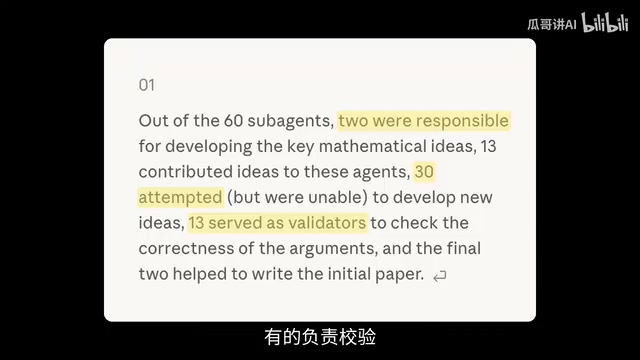
Anthropic also judged at the time that the techniques used here probably could not reach a complete proof. In the first round, Claude proposed and tried 650 ideas, none of which worked. In the second round, Claude coordinated about 60 sub-agents to continue the work; the ones that actually contributed the key mathematical ideas were two of them, while others supplemented lines of thinking or handled verification—30 of them tried new ideas without producing any new progress. Later, Alpöge and colleague Ralph Furman worked together to synthesize the results and their relationship to existing work. What was published was a proportion, backed by round after round of search and elimination, along with human review of the surviving arguments.
By November, Alpöge described a different route in his statement. As a student he had prepared himself to spend decades researching the Riemann hypothesis. This time, he first connected two lines of thinking within a simplified mathematical problem, then sought a structure that could carry this combination over to the target problem.
One example he gave was how to bring the "world Pennov" method into the world of integers. The original method dealt with an analogue of the Riemann hypothesis in function fields and could exploit something mathematicians call multiplicity. Take the simplest polynomial: if an expression contains three identical factors, then at the same location it vanishes to a higher order, and you can recognize this structure by taking repeated derivatives. Such a constraint is far stronger than merely knowing that a certain point equals zero. But once you return to number-theoretic problems involving integers, finding an operation that plays the same role requires a different approach.
Alpöge said that for this they tried stringing together an operation called color lifting. This operation can move a mathematical object with symmetry from one framework to another. Under their conception, each lift accumulates some multiplicity-like constraints. This raises a very concrete question: to handle a weighted sum of length X used to study primes and their distribution, how long does this lifting chain need to be? Claude's suggestion was roughly the square root of X. Alpöge specifically wrote this choice into his statement because, for him, it is an example of Claude taking over a large amount of technical derivation in the final stage.
The research timeline begins with a construction on October 6, with progress on iterative lifting and divisibility concentrated on November 15, and the final entry on November 16 being the generalized Riemann hypothesis. Alpöge also said that in areas such as automorphic forms of higher-rank groups, his grasp of the relevant tools is limited. According to Terence Tao's publicly stated preliminary judgment, the argument appears to use many modern results from the Langlands program and arithmetic geometry, and how exactly he connected these tools remains to be sorted out by researchers from the code.
Color lifting is a type of operation in algebraic number theory and the Langlands program. Its basic idea is to "lift" a mathematical object with symmetry from one framework to a richer framework, making previously hidden structures (such as multiplicity and ramification information) visible. In the function field setting, researchers can exploit multiplicity—that is, how high an order a zero vanishes to—to obtain constraints far stronger than "the zero exists." Alpöge's conception is: by repeatedly applying color lifting, gradually accumulate multiplicity-like information, thereby simulating in the integer setting the advantages that multiplicity provides in function fields. The length of the lifting chain determines how many constraints can be accumulated; Claude suggested a length of about the square root of X, a technical choice that requires rigorous justification.
The Contrast Between a Four-Page Statement and 250,000 Pages of Generated Text
This brings us back to the contrast at release: the statement is only four pages, yet when Alpöge tried to fully expand the derivation, the generated text exceeded 250,000 pages. He even gave an example: the first theorem in the draft begins by explaining that if a θ number is not equal to one-half, it must be either greater or smaller.
Alpöge said that he and Claude had completed a formalized argument "without additional conjectures as premises." He first made the Lean project public, hoping to understand the argument more thoroughly later and then write it up as mathematical text that peers can read.
What does Lean do here? It is a proof assistant. Researchers write definitions, conditions, conclusions to be proved, and every step of reasoning in strict formal terms, and Lean's kernel checks whether later steps can be derived from earlier conditions. Normally, when reading a paper, you see a sentence like "from this it follows" and may have to work it out on paper for a while to figure out what was omitted; once formalized, that step must have a sufficiently explicit basis for the checker to judge whether it is legitimate.
For this public project, reviewers need to reproduce the check results, trace from the final theorem to the definitions and premises actually used, and confirm that the theorem truly covers the claimed conjecture. For example, "proving that zeros below a certain height all lie on the line" and "proving that it holds for any height" may differ by only a few words when written in code; the former covers only a finite segment, while the latter answers Riemann's question.
As for the Millennium Prize, according to the Clay Mathematics Institute's rules, a candidate solution must be published in an approved venue for at least two years and gain general acceptance from the international mathematical community before it enters review. Tao also mentioned that this work has at least one human author who can be communicated with, which is especially important after verification. If a key conclusion has to be traced back through dozens of layers of lemmas, later researchers who want to use it will need to know which steps really matter, why the lifting chain has to be the square root length, which specific estimate makes this move work, and which steps can be carried over to another L-function. Only when these questions can be answered do peers have a chance to turn this derivation into their own tool.
Lean is an interactive theorem prover based on dependent type theory and also a programming language. Researchers use Lean to write mathematical definitions, theorem statements, and proof steps, and Lean's kernel checks step by step whether each one is valid. Unlike paper-and-pencil proofs, Lean requires all details to be written explicitly; steps like "obviously" or "similarly provable" cannot be skipped. A Lean project typically contains multiple files defining basic concepts, lemmas, and the main theorem, and reviewers can independently run the compilation to confirm that the whole proof has no gaps. However, formalization only guarantees that "if the theorem statement is correct, then the proof is valid"; it does not automatically guarantee that the theorem statement faithfully reflects the original mathematical problem—so reviewers still need to confirm that the final theorem truly covers the claimed scope of the conjecture.
Another Draft on the Same Day and AI Error-Checking
The Music of Counting, made public the same day, adds another dimension. Masullo began working on this topic near the end of his first year as a PhD student at Stanford; he wanted to take a route involving operators. The draft attempts to use an identity called the trace formula to connect information about zeros with quantities on the other side that can be decomposed into local components. If this identity can be established as planned, the computable and analyzable structure on the right can in turn constrain the zeros on the left that are hard to grasp directly. Building this framework is the work he spent nearly 12 years on.
His advisor Brian Conrad had already carefully reviewed it for several months and offered many suggestions for revision. According to Ravi Vakil, the original plan was to set aside a year to polish the writing and have more peers look at it before making it public. Masullo said in the draft that, given the research environment at the time, some people suggested he release the version he had ahead of time. Vakil posted the draft on November 20, and about eight hours later, Vakil updated the announcement saying that several researchers had used different AI models to assist in checking and had reported problems in the manuscript to him, problems that would need peer-accepted resolutions. Vakil also retained his judgment on the overall proof strategy.
Checking a proof in this way actually involves two kinds of work. A model reading Masullo's draft can point out that a certain lemma uses conditions not fully provided in the main text and ask people to focus on those pages; a human then has to check whether that condition can be derived from the preceding text and whether the issue found could affect the main theorem all the way through. The other kind of work is step-by-step verification of an argument already written in formalized form. A natural-language draft has many places worth reading closely, and being able to identify the steps most in need of checking earlier can itself change how peers allocate their time.

From Navier-Stokes to Nine-Loop Amplitudes: The Many Ways AI Mathematics Gets Checked
This division of labor becomes easier to see in another class of problems. In September, OpenAI announced a set of candidate solutions to the three-dimensional incompressible Navier-Stokes equations. Intuitively, it constructs a fluid starting from rest that, under smooth external forces, has its vortex center continuously contract and its velocity continuously increase, eventually developing a singularity in finite time, while the energy of the whole process remains finite. OpenAI mapped this to the counterexample option among the Clay problems. According to the company, the team producing the solution used about 10,000 concurrent agents; from the launch of the first batch of agents to obtaining the solution took about 88 hours, and the subsequent Lean formalization and verification took another 17 hours.
By November, Tao also described another argument on the same equation by Alpöge and Tristan Buckmaster. This time they studied the case without external forces, and the overall route is already roughly visible: they first use numerical methods to construct an approximate solution, then try to prove through rigorous perturbation analysis that an exact solution satisfying the equation exists nearby. Tao believes the paper still needs to be organized into a professional formal proof. Once peers understand the idea, they can know where to look—for example, how accurate the initial approximation has to be for the later mathematical estimates to support the exact solution. That is what an explanation with research value can provide.
Take another example from theoretical physics, where some work ends in a concrete formula. In September of this year, Matt von Hippel, who comes from theoretical physics, described a calculation by Claude on the nine-loop six-particle scattering amplitude in a simplified physical model. You can think of it as researchers trying to push the calculation of particle scattering forward using layer upon layer of more complex corrections. In this work, Claude used two existing routes to compute the same result, and physicists working on the problem also participated in checking it. Von Hippel estimated that, at the prices users pay for this tool, either route would cost about one to two thousand dollars. In this case, existing methods can be written as computations that run continuously, and there is another route to compare against during checking, so the problem researchers face also becomes concrete. For something like the nine-loop amplitude, there is a set of ready-made constraints, and you can compute it another way; for something like the generalized Riemann hypothesis, researchers first have to figure out what mathematics in this vast argument can actually be used by other work. Different results require different ways of checking. If the public materials consist only of a conclusion and a pile of files, peers will first have to spend time understanding how the research is organized before they can judge where to put their effort next.
Public Manuscripts, Funding, and "Mathematics 2.0"
In October of this year, OpenAI released hundreds of internal model-generated mathematics manuscripts at once, along with some Lean formalizations, some reasoning summaries, and statistics on the number of problems attempted and compute used; the repository also keeps revision records.
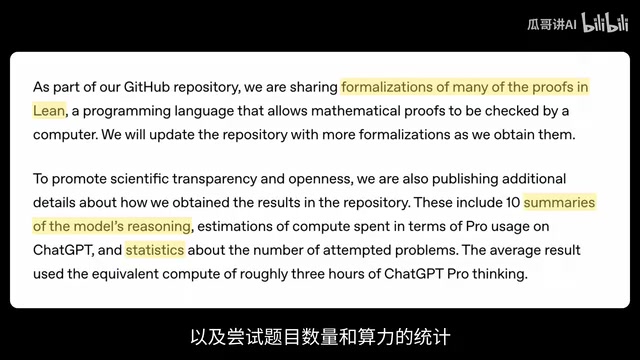
This approach has a practical use: when researchers see a result they are interested in, they can trace it to the corresponding manuscript, see which parts already have formalizations available for checking, which arguments are still being revised, and also know how large a pool of attempts these results were filtered from.
In responding to this batch of manuscripts, the Mathematics and AI Advisory Group focused on the choices researchers have in their hands. Imagine you are working in a very obscure direction, your problem is not included in model evaluations, and it is hard for it to become an example at a launch event—can you have enough model access and compute for your own problem? And can you find collaborators to spend several months turning the result into a paper that peers can use? If these conditions are concentrated in the hands of a few laboratories, how those laboratories choose topics will affect which problems more easily obtain resources.
On October 15, the Simons Foundation announced that the foundation, together with Anthropic and OpenAI, would jointly invest $15 million in funding and resources. The foundation manages and distributes grants and supports workshops and other projects so that researchers have the conditions to evaluate AI-assisted results, learn the tools, and participate in setting rules; the two companies will also provide models and compute to some foundation-supported researchers. Once a team has these tools, it can experiment with an existing proof, try to remove a deep theory it relies on, and then see whether the same conclusion can be derived using more elementary mathematics. If so, a proof originally usable by only a few experts may become an approach more people can work with.
This connects with Tao's October description of "Mathematics 2.0." In his description, famous problems are like lighthouses: as researchers move toward them, they discover along the way which structures are worth studying; whether they finally arrive, and what they see along the way, both matter. AI can help people try routes faster and can also be used to go back and dissect existing proofs. For example, in the candidate argument for the generalized Riemann hypothesis, if a shorter explanation can later be distilled—under what conditions lifting can simulate multiplicity—then someone who never intended to study the Riemann hypothesis might also be able to use it in their own problem.
So for the next piece of news, I will first look at whether this Lean project can be independently verified and to what level the final theorem can prove; then I will look at whether some mathematician can stand at the blackboard and explain clearly what that square-root-length lifting chain is actually doing, and where else this step can be used. The first question concerns the status of the conjecture; the second concerns how far this line of thinking can go. The path between the two may be the most worthwhile place to keep tracking after AI's entry into mathematics.
One-line Summary
Two candidate proofs of the generalized Riemann hypothesis appeared on the same day, with AI both participating in proposing and assisting in checking them, leaving the mathematical community facing new challenges in how to verify and understand them.
Paragraph Summary
On November 20, two candidate proofs of the generalized Riemann hypothesis appeared simultaneously: Anthropic mathematician Alpöge, working with Claude, presented a four-page statement and a Lean formalization project, while mathematician Masullo released a 940-page draft nearly 12 years in the making. Claude had previously raised the lower bound on the proportion of zeros on the critical line from about 41.67% to about 67.25%, but the complete proof still awaits verification. Alpöge's route attempts to use a color-lifting chain to simulate multiplicity constraints in function fields, with Claude suggesting the lifting chain length be about the square root of X. Lean formalization allows the proof to be checked step by step by machine, but whether the final theorem covers a finite height or any height still needs independent verification. AI's role in mathematics is differentiating into proposing proofs, checking natural-language drafts, and assisting formal verification, with different results requiring different ways of checking.
Related articles

Prompt Engineering for Beginners: From Writing Prompts to Engineering Thinking
Starting from the essence and four functions of prompts, this article systematically explains the six-step process, four success criteria, learning value, and practical limitations of prompt engineering to help you build a complete understanding.

Anthropic Launches Nasdaq IPO: AI Giant's Listing and Risk Disclosures
Anthropic officially launches its Nasdaq IPO under ticker ANT, with market valuation expected to potentially exceed SpaceX's record. The prospectus devotes nearly 100 pages to AI risks, while first-half revenue grew over 14x but net losses widened sharply, reigniting the AI bubble debate.

Rust cURL Clone Uses 4,832 unsafe Blocks—Is the Memory Safety Myth Broken?
A Rust cURL clone uses 4,832 unsafe keywords, challenging Rust's memory safety narrative. We analyze what unsafe really means, compare Fil-C, and examine rewrite motives.