HashiCorp Archives Boundary Open Source Repo, Raising Community Concerns

HashiCorp archives the Boundary open source repo, continuing its post-BSL pivot away from open collaboration.
HashiCorp has archived the open source repository for Boundary, its zero-trust access tool, rendering it read-only and closing it to community contributions. This follows HashiCorp's earlier switch of core products like Terraform and Vault from MPL to the more restrictive BSL license. Commercial and enterprise versions are expected to continue, limiting short-term user impact — but the move is a warning sign for teams relying on open source ecosystems. It mirrors a broader industry trend seen at Elastic, MongoDB, and Redis, where competitive pressure from cloud vendors has driven open source retrenchment and community forks.
Overview
HashiCorp has archived the open source repository for Boundary, its zero-trust secure access tool. The move means the project will no longer accept new commits, issues, or pull requests — the repository is now read-only. The news sparked discussion across technical communities including Hacker News.
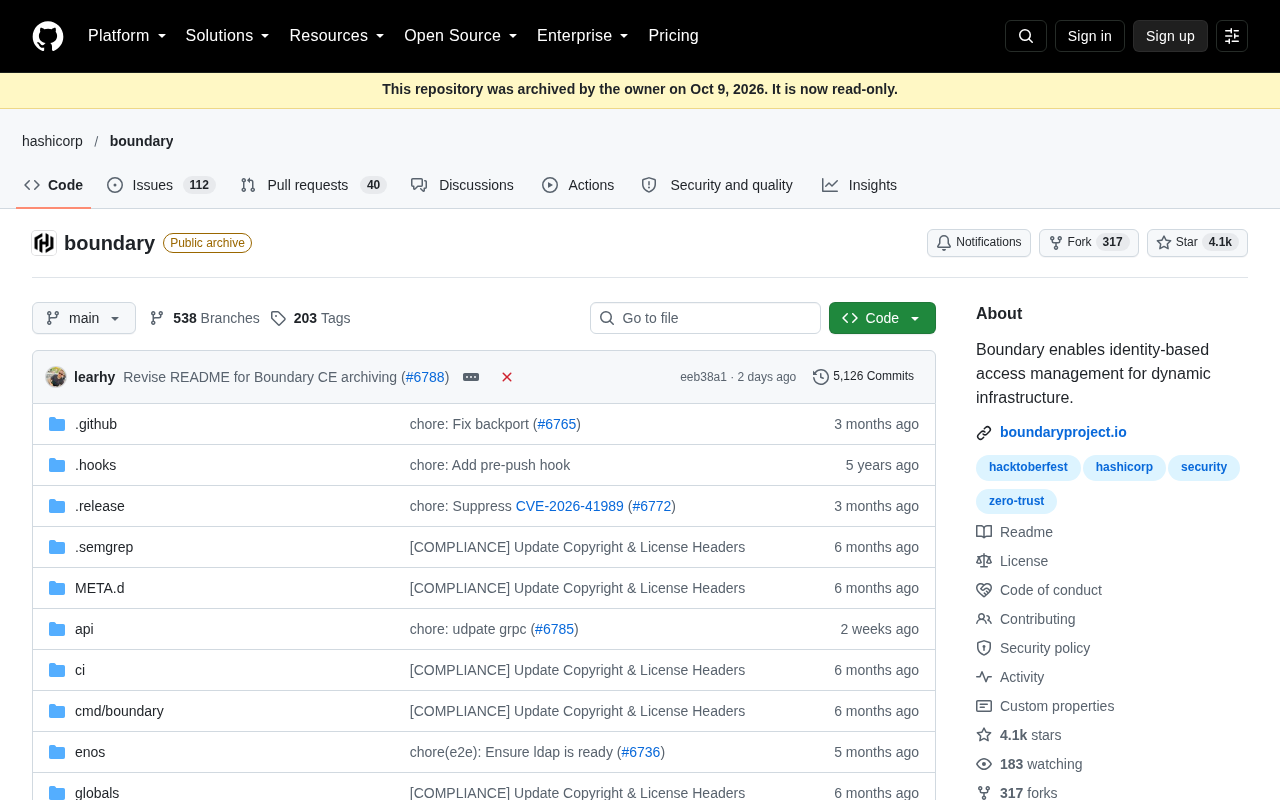
Boundary is the identity-driven access management component in HashiCorp's product lineup, designed for scenarios requiring secure connectivity to infrastructure resources. It helps teams grant users controlled access to hosts, databases, and services without exposing sensitive network credentials. This archival is the latest milestone in HashiCorp's ongoing adjustments to its product licensing and open source strategy.
Background: From Open Source to Archived
To understand the significance of this archival, it helps to revisit HashiCorp's recent licensing changes. The company previously switched several core products — Terraform, Vault, Consul, Boundary, and others — from the permissive MPL (Mozilla Public License) to the BSL (Business Source License). That shift triggered a strong backlash in the open source community and directly spawned OpenTofu, a community fork of Terraform.
The underlying logic of the license switch was to prevent competitors from directly leveraging HashiCorp's open source code to build competing commercial managed services, while preserving freedom for ordinary users and internal enterprise use. Archiving the open source repository takes this a step further — after the licensing change, it now also closes off the public collaboration channel, meaning community contributors can no longer participate in development through the original repository.
BSL (Business Source License) was designed by MariaDB and is a source-available license with restrictions. Unlike truly open source licenses such as Apache or MIT, BSL allows users to view, modify, and self-host the code, but prohibits using it for production commercial services — especially competing managed offerings — within a specified time window (typically four years). After that period, the code generally converts automatically to a more permissive open source license. For this reason, BSL is widely regarded in the open source community as a "source-available license" rather than a true open source license, and the Open Source Initiative (OSI) does not recognize it as meeting the open source definition. MPL (Mozilla Public License), by contrast, is a weak copyleft license that requires modifications to MPL-licensed files to be contributed back under the same license, while allowing combination with proprietary code and imposing relatively few restrictions on commercial use. HashiCorp's move from MPL to BSL was broadly interpreted by the community as a significant pivot toward commercial self-interest.
What Archival Means for Users
For existing Boundary users, archiving the repository does not mean the product is disappearing. HashiCorp's commercial and enterprise offerings are typically still actively maintained. The archival's impact is felt primarily at the open source collaboration level:
- The community can no longer submit code or report issues to the original repository
- The pace and transparency of future updates to the open source version becomes uncertain
- Teams relying on the open source edition may need to reassess their long-term technical roadmap
This type of change hits hardest for teams that treat open source sustainability as a key factor in their technology decisions. When evaluating infrastructure tools, the vitality of an open source community is often used as a proxy for project health — and archiving a repository can erode confidence among a portion of the user base.
An Industry Trend: Open Source Retrenchment
HashiCorp's moves are not an isolated case. They reflect a broader commercial dilemma facing infrastructure software vendors in recent years. Many companies that started as open source projects have adjusted their licenses or narrowed their open source perimeters under competitive pressure from cloud providers and managed service operators, in order to protect their commercial interests.
Elastic, MongoDB, Redis, and others have all followed similar paths. These shifts typically fracture communities: some users remain within the original vendor's ecosystem, while others drive or migrate to community forks. Whether Boundary will see a community takeover project similar to OpenTofu remains to be seen. Public information about this event is still limited, and more details will depend on HashiCorp's official communications.
This phenomenon is commonly referred to in the industry as "relicensing" or "open source retreat." Elastic switched Elasticsearch and Kibana from Apache 2.0 to SSPL (Server Side Public License) in 2021, directly prompting AWS to collaborate with the community on the OpenSearch fork. MongoDB adopted SSPL as early as 2018. Redis Labs (now Redis) switched Redis core from BSD to a dual RSALv2 and SSPL license in 2024, after which the Linux Foundation and several cloud vendors launched the Valkey fork. These cases follow a recognizable pattern: the original vendor tightens the license → the community or cloud vendors fork the project → two parallel ecosystems compete. For enterprise users, this means that when evaluating open source tools, it's no longer enough to assess current technical capabilities — you also need to consider the vendor's commercial trajectory and the maturity and sustainability of any community forks.
Summary
The archival of the Boundary open source repository reflects a further tightening of HashiCorp's open source strategy, following its earlier pivot to BSL licensing. For most users, the short-term impact is limited. But for teams that depend on open source collaboration and community ecosystems, this is a signal worth taking seriously. It serves as another reminder to the industry: when adopting open source infrastructure tools, vendors' commercial direction and licensing terms need to be part of any long-term evaluation.
Related articles

Felix Rieseberg Personal Homepage
Felix Rieseberg's personal homepage sparks attention on Hacker News. This article covers the Slack engineer's technical background, the rise and fall of nativefier, and the value of a developer homepage as a tech calling card.

@ai-sdk/vue 3.0.306 Patch Release Syncs with [email protected] Update
@ai-sdk/vue 3.0.306 released, synced with [email protected]. A routine patch release for the Vercel AI SDK ecosystem with no public API changes; the Vue adapter layer stays version-aligned with the core package.

Gemini 4 Argon API Launches: The Era of Million-Token Output Begins
Google launches Gemini 4 Argon with sparse MoE architecture, up to 1M output tokens, and a 68.90% Vals Index score, available across API, AI Studio, and the Gemini app.