Hassabis Shortens AGI Timeline: General Artificial Intelligence in Two to Three Years?
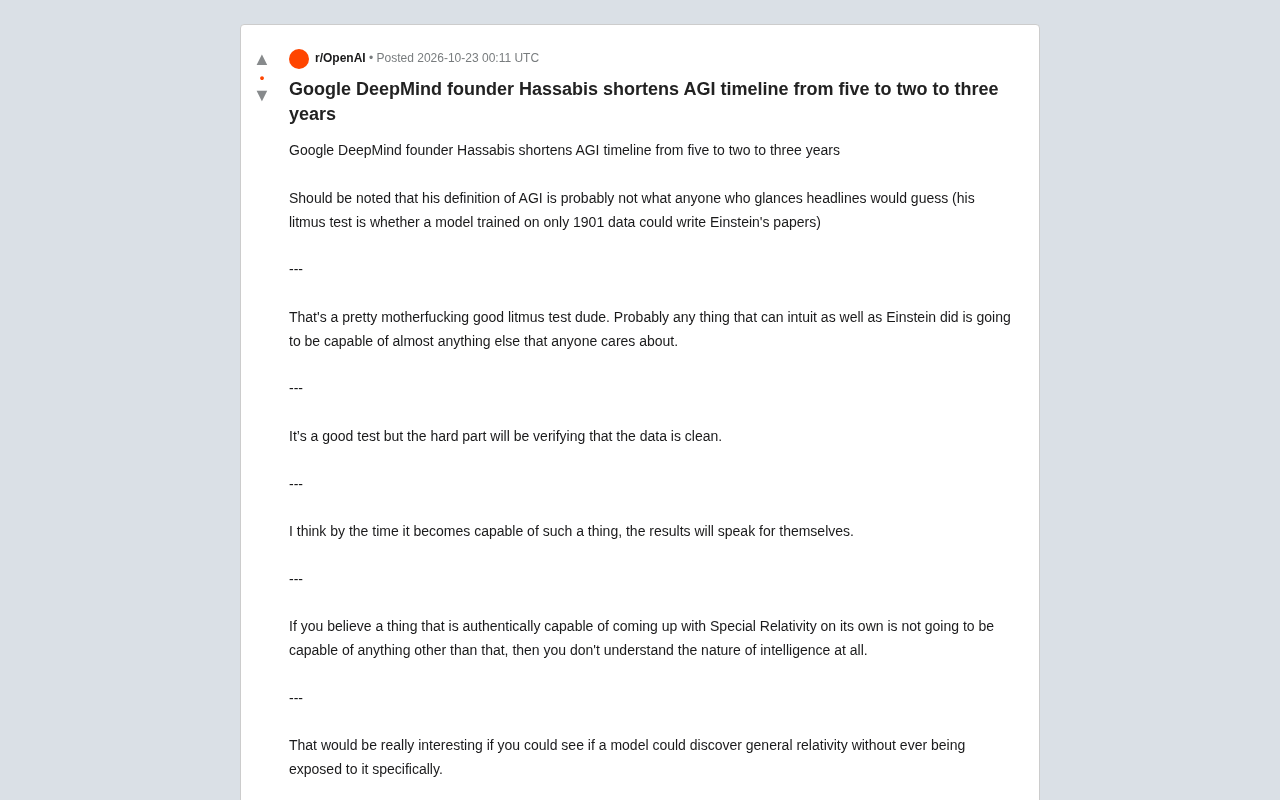
Hassabis shortened the AGI timeline to two or three years, and his 1901 data test sparked heated discussion on Reddit.
Google DeepMind founder Demis Hassabis shortened the AGI timeline from five years to two to three years, but the focus of the Reddit discussion was his unique AGI test: can a model trained only on data from before 1901 independently write Einstein's special relativity paper? The community generally believes that this test is deeper than conventional benchmarks and can simultaneously examine knowledge, creativity, and reasoning ability. The core controversy is how to ensure that the training data is completely limited to before 1901, as verifying data purity is extremely difficult. Some argue that if a model achieves a breakthrough with less data, it would instead better prove reasoning ability beyond that of humans.
Google DeepMind founder Demis Hassabis recently revised his prediction for when Artificial General Intelligence (AGI) will be achieved, shortening it from five years to two to three years. This change sparked heated discussion in the Reddit community, and the focus was not on the timeline itself, but on the unique test Hassabis uses to define AGI: can a model trained only on data from before 1901 write Einstein's paper?
Why Did the AGI Timeline Suddenly Shrink?
Hassabis compressed the AGI timeline from five years to two to three years. Behind this adjustment is the accelerated leap in large model capabilities in recent years. From multimodal understanding to complex reasoning, the capability boundaries demonstrated by AI systems are expanding rapidly. However, the shortened timeline itself is not surprising—what is truly worth pondering is his criterion for judging AGI.
Unlike mass media, which often treats "passing the Turing test" or "surpassing humans on benchmarks" as the mark of AGI, Hassabis proposed a more concrete and more demanding touchstone: expose the model only to data from before 1901 and see whether it can independently derive Einstein's special relativity paper.
Artificial General Intelligence (AGI) refers to AI systems with general cognitive abilities comparable to or beyond those of humans, capable of autonomous learning, reasoning, and adaptation across a wide range of task domains rather than being limited to specific tasks. In contrast, Narrow AI refers to the AI currently widely used for specific tasks (such as facial recognition and voice assistants). The core features of AGI include cross-domain transfer learning, abstract reasoning, creative problem-solving, and self-improvement capabilities. There is broad disagreement in academia about the definition and implementation path of AGI, but it is generally believed that it needs to break through the limitations of current large models in continual learning, causal understanding, and common-sense reasoning.
The 1901 Data Test: An Ingenious Touchstone
Reddit users highly praised this test. One commenter said bluntly: "This is a fucking excellent touchstone." The reason is straightforward: any system capable of intuitively grasping the essence of physics the way Einstein did would almost inevitably be able to handle any other problem humans care about.
The ingenuity of this test lies in the fact that it examines multiple dimensions at once. The model not only needs to master physics knowledge, but also needs creative intuition, mathematical derivation ability, and the capacity to extract a revolutionary theory from limited information. As another user said: "If you think something that can genuinely independently propose special relativity can't do anything else, then you don't understand the nature of intelligence at all."
Why 1901?
The year 1901 was not chosen at random. Einstein's special relativity paper was published in 1905, and 1901 happened to be the period when he graduated from university and began to think deeply about foundational problems in physics. Training a model on data from before 1901 means the model cannot directly access relativity itself and must rely on its own reasoning ability to discover the problem from the cracks in classical physics.
Special relativity is a physical theory proposed by Einstein in 1905, based on two fundamental assumptions: the laws of physics take the same form in all inertial reference frames (the principle of relativity), and the speed of light in vacuum is constant for all observers. This theory overturned Newtonian mechanics' absolute view of space and time and proposed revolutionary conclusions such as time dilation, length contraction, and mass-energy equivalence (E=mc²). The background of special relativity was the contradiction encountered by classical physics in explaining the constancy of the speed of light and electromagnetic phenomena. By reexamining the nature of time and space, Einstein reconstructed the foundations of physics from a philosophical level. This theory not only profoundly changed modern physics, but also became a landmark case for testing whether intelligent systems can make disruptive scientific creations.
The Verification Challenge: How to Ensure Data Purity
The most concentrated doubt in the discussion was not whether the test itself is reasonable, but how to verify it. One user pointed out: "The test is good, but the hard part is verifying that the data is clean."
This concern is very practical. To ensure that the model's training data is completely limited to before 1901, all later publications, annotations, interpretations, and even indirect citations need to be excluded. But historical texts are often transmitted along with later editing and commentary, and thoroughly cleaning the data is almost impossible. Moreover, Einstein's knowledge came not only from books, but also from oral exchanges with contemporary mathematicians and lectures he attended—information that cannot be recorded in text.
However, some users were optimistic: "When it can actually do this, the result itself will speak for itself." This view holds that if the model indeed demonstrates the ability to independently derive relativity, then concerns about data leakage will naturally become secondary.
A More Extreme Hypothesis
An interesting extension also emerged in the discussion: if the model can derive special relativity using less data than Einstein had at the time, the result would be even more shocking. Because that would mean the model's information efficiency surpasses that of one of the greatest physicists in human history.
Data leakage in machine learning usually refers to training data containing information from the test data, causing inflated model evaluation results. In the test scenario proposed by Hassabis, the data leakage problem is more complex: it is necessary not only to ensure that the training corpus is strictly earlier than 1901, but also to exclude indirect information such as later interpretations of relativity, textbooks, and encyclopedia entries. However, the digitization of historical texts is often accompanied by modern annotations and editing, and models may acquire implicit modern knowledge through pretraining. Thorough verification of data purity requires building a completely isolated "time capsule" dataset and adopting strict decontamination techniques, which is extremely challenging in engineering.
Community Consensus and Divergence
Overall, judging from the Reddit discussion, the community's attitude toward Hassabis's test standard shows a clear consensus: it is a more meaningful AGI criterion than conventional benchmarks. It does not depend on the pass rate of a specific task, but examines whether the system has the ability to reconstruct the human knowledge system from underlying data.
Divergence mainly centers on verification. Some users believe that data purity is an insurmountable obstacle, while others believe that once capability reaches a certain threshold, the verification problem will naturally dissolve. Both views have merit, but both acknowledge that this test points to the core of AGI—not imitation, but creation.
The shortening of Hassabis's timeline may trigger another round of AGI hype, but the definition standard he provided instead offers a calmer anchor for the discussion. Rather than arguing about "two years or five years," it is better to first clarify what exactly we are waiting for.
One-line Summary
Hassabis shortened the AGI timeline to two or three years, and his 1901 data test sparked heated discussion on Reddit.
Paragraph Summary
Google DeepMind founder Demis Hassabis shortened the AGI timeline from five years to two to three years, but the focus of the Reddit discussion was his unique AGI test: can a model trained only on data from before 1901 independently write Einstein's special relativity paper? The community generally believes that this test is deeper than conventional benchmarks and can simultaneously examine knowledge, creativity, and reasoning ability. The core controversy is how to ensure that the training data is completely limited to before 1901, as verifying data purity is extremely difficult. Some argue that if a model achieves a breakthrough with less data, it would instead better prove reasoning ability beyond that of humans.
Related articles

LangGraph Crash Course: Building Enterprise-Grade AI Agents and Workflows from Scratch
LangGraph crash course: learn its independence from LangChain, MIT license, FastAPI high-concurrency deployment, human approval, and memory storage for enterprise AI agents.

Building an AI Customer Service Agent from Scratch: A 92% Intent Recognition Case Study
A Bilibili case study: building an AI customer service agent from scratch with BERT intent recognition, dialogue state tracking, hybrid vector retrieval, and a weighted handoff model—raising intent accuracy from 65% to 92%, 78% conversation completion, handling 100K conversations daily.
Loop Engineering: An Engineering Paradigm for AI That Writes Code and Merges PRs Autonomously
Loop Engineering is transforming AI development pipelines: Stripe's Minions system merges over 1,300 machine-generated PRs weekly. This article breaks down Loop Engineering's five core actions, six components, five failure modes, and three safety disciplines, explaining why independent evaluators, state files, and budget caps matter more than full automation.