Headlong: A Microharness for Persistent Agents

Exploring Headlong's microharness approach to building persistent, long-running AI Agents.
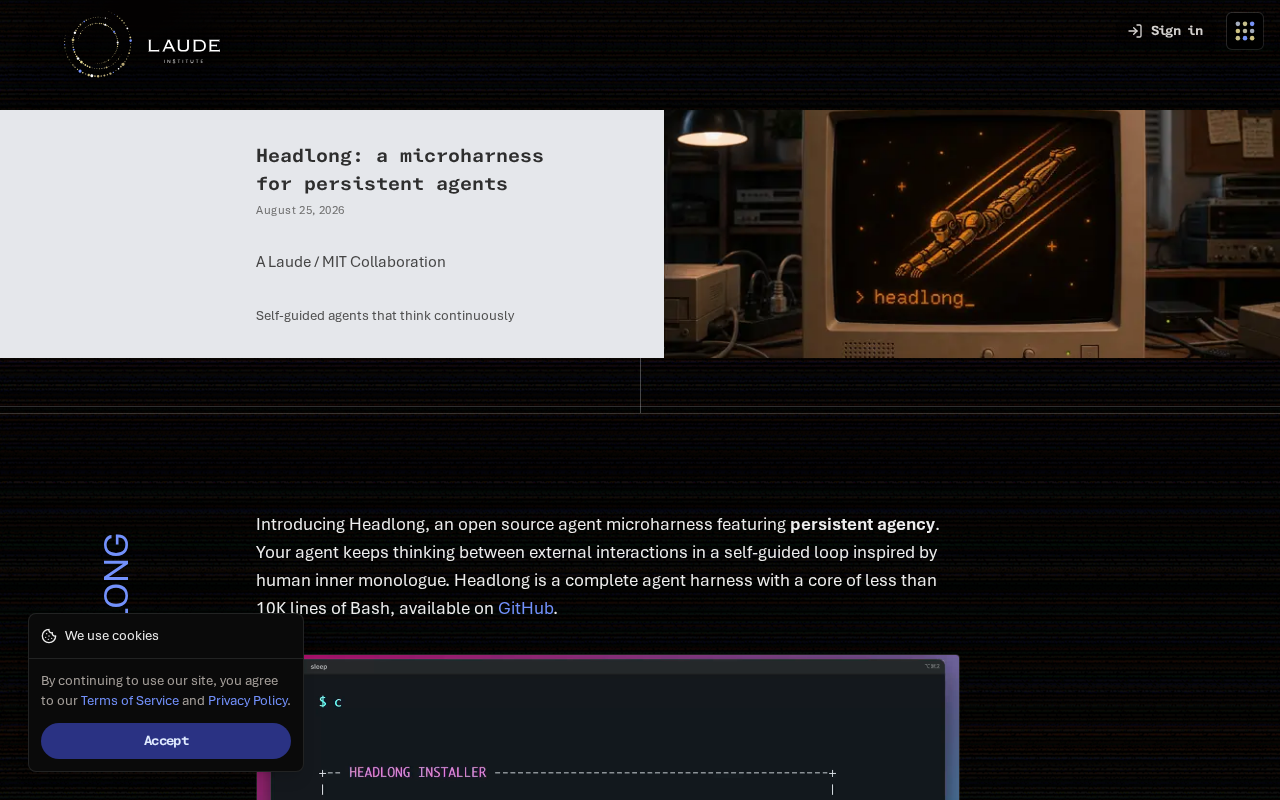
Headlong is a minimalist scaffolding project for persistent AI Agents that addresses core engineering challenges including state serialization, failure recovery, context window management, and autonomy control. Its microharness philosophy offers developers a lightweight alternative to heavyweight frameworks, providing essential structure without sacrificing flexibility or control.
Introduction: A New Paradigm in Agent Engineering
As large language models continue to grow in capability, building AI Agents that can run long-term and maintain state across sessions is becoming a key focus for developers. Recently, a project called Headlong sparked discussion on Hacker News, positioning itself as "A Microharness for Persistent Agents." While still in its early stages of traction (16 upvotes, 6 comments), the technical philosophy behind it touches on a core pain point in current Agent engineering: how to keep Agents coherent and controllable during long-running operations.
This article explores Headlong's design philosophy, the value of "persistent Agents" as a concept, and the role that a "Microharness" plays in Agent architecture.
What Are Persistent Agents
From One-Off Conversations to Long-Running Tasks
Most AI applications people interact with, such as chatbots, are essentially "stateless" or "short-state" — they work within a single session, and context is discarded once the session ends. "Persistent Agents" attempt to break through this limitation: they need to exist continuously over hours, days, or even longer timespans, spanning multiple interactions and task nodes while maintaining continuity of memory and state.
The distinction between stateless and stateful originates from classic concepts in distributed systems design. In traditional web architecture, the HTTP protocol itself is stateless — each request is independent, and the server retains no client context. Session and Cookie mechanisms were introduced precisely to solve this problem. For AI Agents, the complexity of state management far exceeds that of traditional web applications — an Agent's "state" includes not just conversation history, but also reasoning chains, executed tool call results, intermediate goal decompositions, environment perception snapshots, and other multi-dimensional information. The complex dependencies between these elements make simple key-value storage inadequate.
Typical use cases for persistent Agents include:
- Long-running monitoring and automation tasks
- Complex workflows requiring multi-step planning
- Personal assistants that need to accumulate experience and context
Persistence means the Agent must not only "think" but also "remember," and be able to "resume" after interruptions.
Engineering Challenges of Persistence
Implementing persistence isn't as simple as storing conversation history in a database. It involves several thorny problems:
- State serialization and recovery: How can an Agent's internal state be reliably saved and reconstructed?
- Failure recovery: When an Agent crashes or is interrupted, how can it continue from the most recent consistent state?
- Context bloat management: How do you manage the ever-expanding context window during long-running operations?
- Autonomy control: How do you maintain autonomy while preventing the Agent from falling into ineffective loops or drifting from its goals?
Agent failure recovery borrows from checkpoint techniques in database transactions and distributed systems. In the database world, WAL (Write-Ahead Logging) ensures that even if the system crashes, it can recover to a consistent state from the log. For Agents, a similar mechanism means saving a complete Agent state snapshot at every critical decision point, including the current goal stack, completed subtasks, tool call history, and environment state. This is analogous to graceful termination and restart mechanisms for Pods in Kubernetes — the system needs to distinguish between "recoverable interruptions" and "failures requiring a fresh start," and adopt different recovery strategies accordingly.
Regarding context window management, this is one of the core constraints of large language models. GPT-4, for example, has a context window of 128K tokens, while Claude 3.5 supports 200K tokens. While these seem large, for long-running Agents, continuously accumulated interaction history, tool call results, and environment observation data can quickly exhaust available space. Current industry strategies include: summary compression (compressing old conversations into summaries), RAG retrieval augmentation (storing history in vector databases for on-demand retrieval), sliding windows (retaining only the most recent N rounds of interaction), and hierarchical memory architectures (mimicking the human separation of short-term and long-term memory). Each strategy involves trade-offs between information loss and computational cost.
These are precisely the problems that tools like Headlong aim to solve.
The Design Philosophy of a Microharness
Why Choose the "Micro" Route
Headlong calls itself a Microharness, and this naming itself conveys a clear design orientation. The Agent space is not lacking in heavyweight frameworks with extensive features and layers upon layers of abstraction, attempting to cover everything from tool calling and memory management to multi-Agent collaboration. However, heavyweight frameworks often bring high learning costs, debugging difficulties, and limited flexibility.
In the current Agent framework ecosystem, LangChain, AutoGen, CrewAI, and LlamaIndex are representative heavyweight solutions. Taking LangChain as an example, its abstraction layers include dozens of concepts such as Chain, Agent, Tool, Memory, and Callback. While comprehensive in functionality, developers have criticized it for severe "abstraction leakage" — when underlying behavior doesn't match expectations, developers need to penetrate multiple abstraction layers to locate issues. This phenomenon is known in software engineering as the "Inner Platform Effect" — where a framework attempts to reinvent a general-purpose computing platform, ultimately becoming as complex as the underlying system it tries to simplify.
The "micro" approach takes the opposite direction: provide a minimal but sufficient skeletal structure that allows developers to build persistent Agents with extremely low cognitive overhead while retaining full control over underlying logic. This "less is more" philosophy aligns with the recent trend in software engineering against over-abstraction — from microservices architecture decomposing monolithic applications, to Go's embrace of "less is more," to SQLite replacing heavyweight databases in certain scenarios. Lightweight approaches have always been a powerful corrective force in engineering practice.
The Role of a Harness in Agent Architecture
In software engineering contexts, a "harness" (scaffold/test harness) typically refers to a supporting structure around core logic, responsible for handling the runtime environment, lifecycle management, and orchestration of inputs and outputs. For Agents, the core responsibilities a harness needs to handle include:
- Execution loop management: Driving the Agent's "perceive—think—act" loop to keep running continuously
- State persistence and recovery: Ensuring Agent state can be saved to external storage and reconstructed when needed
- Context organization: Intelligently organizing and trimming information within the limited model context window
- Tool and external world interfaces: Enabling the Agent to call tools and access resources
The Agent's "perceive—think—act" loop originates from the classic BDI (Belief-Desire-Intention) architecture in artificial intelligence, first proposed by philosopher Michael Bratman and later formalized as a computational model by Rao and Georgeff. In the modern LLM Agent context, this loop is typically implemented as the ReAct (Reasoning + Acting) pattern: the model first reasons (generating a thought process), then decides to execute an action (calling a tool), then updates its cognition based on the action's result, and so on. OpenAI's Function Calling and Anthropic's Tool Use API provide native support for this pattern. The core challenge of persistence is that any intermediate state of this loop needs to be fully snapshotted and recoverable.
An excellent microharness encapsulates these responsibilities just right — neither overstepping to limit developer freedom, nor leaving developers to reinvent the wheel from scratch.
Technical Value and Industry Significance
Returning to Engineering Fundamentals
Headlong's emergence reflects a healthy introspection within the Agent development community. Over the past two years, the "arms race" in Agent frameworks has produced numerous feature-heavy products, yet truly persistent Agents running stably in production environments remain rare. Many developers have found that rather than being constrained by complex framework abstractions, it's better to start from simple, controllable foundational components and gradually build systems suited to their needs.
This is precisely the value of a microharness: it lowers the barrier to entry for persistent Agents while returning architectural decision-making power to developers. This is especially attractive for engineers who want to deeply understand Agent operating mechanisms rather than merely calling black-box APIs.
Persistence Is a Critical Step Toward Practical Agents
From a broader perspective, for Agents to truly move from demos to production, persistence capability is unavoidable. An Agent that can only work within a single session cannot handle the complex, time-spanning tasks of the real world. Building reliable engineering practices around persistence — including state management, failure recovery, and observability — will be the core competitive advantage of future Agent infrastructure.
Observability is a key concept introduced from the cloud-native domain into Agent engineering, encompassing three pillars: Logs, Metrics, and Traces. For long-running Agents, observability is particularly important — developers need to understand why an Agent made a certain decision, at which step it consumed excessive tokens, and when it fell into a loop. Tools like LangSmith, Langfuse, and Arize Phoenix are attempting to provide Agents with observability capabilities similar to what DataDog provides for microservices. A good microharness should reserve hooks for observability from the initial design, rather than patching it in after the fact.
Lightweight tools like Headlong may be precisely the pragmatic building blocks needed in this evolutionary process.
Conclusion
Although Headlong is currently an early-stage, niche project, the "persistence + minimalism" design philosophy it represents deserves the attention of every Agent developer. Between pursuing grand frameworks and pursuing minimal controllability, the industry is searching for a balance point. For developers who want to build truly long-running, stable, and reliable Agents, starting with a lightweight microharness may be a wiser choice than embracing heavyweight frameworks.
As Agent technology matures, we have reason to expect more pragmatic tools like this to emerge, collectively driving AI Agents from the laboratory into real-world deployment.
Related articles

Chain of Thought Isn't Just for AI: How Humans Can Use CoT to Improve Thinking Quality
Chain of Thought isn't just a prompt trick for large models. Starting from a Hacker News discussion, this article analyzes why CoT works for human thinking too, breaks down actionable ways to transfer it, and highlights the key differences between human CoT and machine CoT.
Cloudflare Teams Up with OpenAI: Closi…
Cloudflare Teams Up with OpenAI: Closing the Loop from Vulnerability Discovery to Defense with AI
Cloudflare uses OpenAI Daybreak to investigate security vulnerabilities and generate reviewable remediation plans, while developers use Codex to boost coding efficiency and quality.

Orca Multi-Agent Orchestration in Practice: A Guide to Parallel Collaboration with Claude and Codex
Orca is Stable AI's free open-source agent workbench supporting 34 agents like Claude Code and Codex in parallel. Learn its Git worktree isolation, multi-model orchestration, and mobile management.