Hearing Aid Adaptive Switching: How Personalized Gain Automatically Adjusts to the Environment

A new paper proposes a hearing aid gain auto-switching mechanism combining one-class VAD, Bayesian change point detection, and environment memory.
The article introduces research on hearing aid personalized gain that automatically switches with the environment. The core problem is that user-preferred gain varies with background environment, while static fitting parameters cannot cover real scenarios. The system first uses a one-class voice activity detector with a consistency check to remove foreground speech and preserve background babble, then performs online environment discovery on pure background segments using Bayesian change point detection combined with environment memory, detecting changes, recognizing returning environments, and discovering new ones without presetting the number of environments. Experiments on 36 background noise types and eight corpus pairings achieved 85.53%–91.98% macro-averaged F1, with ARI of 0.91 and 0.96 on two test streams; under the same-recording return condition, zero erroneous switches occurred across 105 environment changes. The article also notes that compute, power, and productization steps still need evaluation.
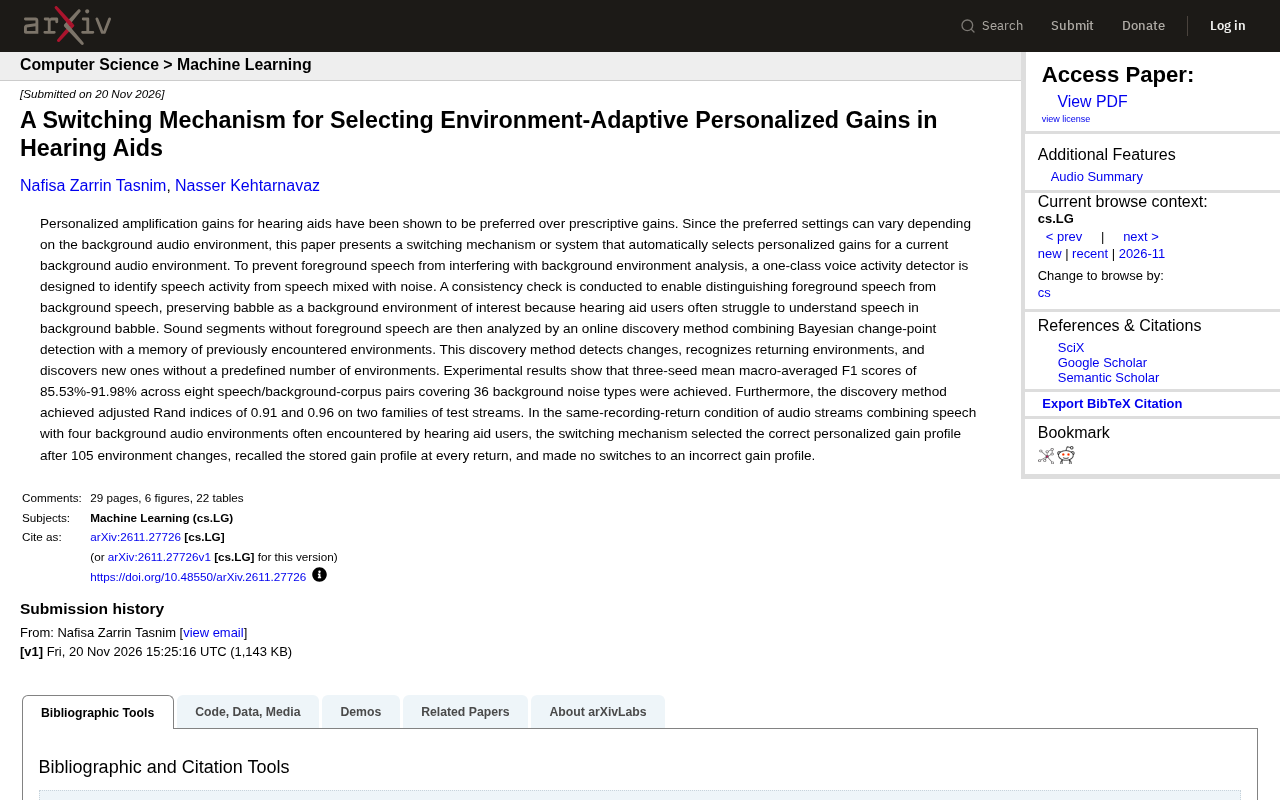
Hearing aid amplification gain has long relied on fitting formulas, but a growing body of research shows that the gain users actually prefer often differs from prescribed values. More complicated still, the ideal gain for the same user differs across a noisy restaurant, a quiet living room, and an outdoor street. A new paper proposes a switching mechanism that lets hearing aids automatically recognize the current background environment and recall the corresponding personalized gain profile.
Why Personalized Gain Needs to "Switch with the Environment"
The paper opens by noting a repeatedly validated phenomenon: personalized amplification gain is preferred by users over prescribed gain. But preferences are not fixed values—when the background audio environment changes, the user's preferred settings change with it. This means that if a system records only one set of static parameters at fitting time, it will struggle to cover the many listening scenarios of real life.
The core challenge is that the system must judge "what environment is this now" in real time, while not mistaking foreground speech for background sound. The paper specifically notes that hearing aid users already have difficulty understanding speech in noisy background babble, so multi-talker background chatter is precisely a target environment that needs to be preserved and recognized—not simply filtered out as interference.
Technical Approach: First Separate Foreground Speech, Then Discover Environments
One-Class Voice Activity Detector
To prevent foreground speech from interfering with background environment analysis, the research team designed a one-class voice activity detector to identify speech activity from noisy speech. Combined with a consistency check, the system can distinguish foreground speech from background speech, thereby preserving background babble as an environment category of interest.
One-class voice activity detection (one-class VAD) differs from common binary speech/non-speech detection in that it models only the "speech" class as the target and does not need to explicitly collect large numbers of non-speech samples as a negative class. A typical approach uses an autoencoder or density estimation model to learn the distribution of speech frames, and at inference time judges whether the current frame belongs to the speech class based on reconstruction error or likelihood score. This setup is especially practical in hearing aid scenarios where background noise types cannot be exhaustively enumerated: the model only needs to have seen "what speech looks like" to treat babble, music, street noise, and so on as anomalies. The "consistency check" in the paper usually refers to temporal smoothing of the detector output or inter-frame consistency constraints, preventing brief misjudgments from letting foreground speech segments leak into background analysis, thereby ensuring that subsequent environment discovery is not polluted by speech.
Bayesian Change Point Detection + Environment Memory
On segments with foreground speech removed, the system employs an online discovery method: combining Bayesian change point detection with memory of past environments. This approach can detect environment changes, recognize returning old environments, and discover entirely new environments—all without predefining the number of environments. This is critical for real-world deployment, because the variety of sound scenarios users encounter cannot be enumerated in advance.
Bayesian change point detection is an online inference method: it maintains a hypothesis that the current segment comes from a certain distribution and computes the posterior probability that "a distribution shift occurs at this moment." A common implementation is the run-length model with priors; when a new sample no longer matches the statistical characteristics of the current segment, the posterior probability rises and triggers a change point. Compared with fixed thresholds or sliding window methods, it provides probabilistic judgments of change point locations and can naturally update online, making it suitable for streaming scenarios like hearing aids. The paper combines it with "environment memory," meaning the system not only detects that "the environment has changed" but also stores the features of each stable environment segment in a memory bank; if subsequent statistical characteristics match a stored entry, it is judged as a returning old environment and the corresponding gain is recalled, and if it matches no memory entry, a new environment entry is created, thus requiring no preset total number of environment categories.
What the Experimental Results Show
The paper reports multiple evaluation datasets. Across 36 background noise types and eight speech/background corpus pairings, the three-seed averaged macro-averaged F1 score reached 85.53%–91.98%. On two test streams, the discovery method achieved Adjusted Rand Index values of 0.91 and 0.96, respectively, indicating that the clustering results are highly consistent with the true environment partition.
A scenario closer to actual use is the "same-recording return" condition: the audio stream combines speech with four background audio environments commonly encountered by hearing aid users. Under this condition, the switching mechanism still selected the correct personalized gain profile after 105 environment changes, recalled the stored gain profile each time an environment returned, and never once switched to an incorrect gain profile.
These results send a signal: environment-adaptive gain switching has already achieved high reliability in controlled tests, and especially the "zero-error switching" performance directly relates to user experience—erroneous switching is more noticeable and more disliked than not switching at all.
Macro-averaged F1 first computes the harmonic mean of precision and recall for each class separately, then takes the arithmetic mean across all classes. Compared with micro-averaging, it treats each class equally and is not dominated by classes with large sample sizes, making it especially suitable for evaluating discovery tasks with "imbalanced environment classes." The Adjusted Rand Index (ARI) measures the consistency between a clustering partition and the true label partition, with values corrected for random partitioning: 1 indicates perfect agreement and 0 indicates no better than random. ARI values of 0.91 and 0.96 show that the environment boundaries the system discovers on its own closely match the manually defined true environments; and the macro-averaged F1 in the 85%–92% range reflects relatively balanced recognition quality across the 36 noise types.
How Far from a Real Product
The methodological value of the paper lies in making "environment discovery" an online process with no preset number of categories, rather than relying on a fixed scene classifier. This reduces dependence on manually labeled scene libraries and leaves room for subsequent continuous learning of user preferences on real devices.
However, the experiments are still based on corpus pairings and test streams. Real hearing aids are constrained by compute, power consumption, and microphone layout, and the computational overhead of online Bayesian change point detection and the memory mechanism needs further evaluation. In addition, the initial source of personalized gain profiles and how users' manual adjustments integrate into the switching logic are not discussed in the paper—yet these are unavoidable steps in productization.
For hearing aid algorithm engineers, the takeaway of this work is: combining voice activity detection, change point detection, and environment memory into a single pipeline, and validating switching accuracy with quantitative metrics; for users, it points toward a more natural direction—the hearing aid is no longer a fixed set of parameters, but a continuously adapting system that quietly adjusts with the sound environment.
Related articles

From 0 to 1: Vibe Coding an AI Knowledge Base — A Practical Retrospective and Tech Stack Breakdown
A retrospective on building the AI knowledge base OilBook from scratch with Vibe Coding: Next.js+Neon stack, Oil Dev Skill workflow, Stripe paywall security, interview-style writing, AI-flavor control, and Vercel deployment.

GLM-5.4 Hands-On: Native Vision Meets a New Vibe Coding Workflow
Hands-on with Zhipu GLM-5.4: native vision tested across a 3D product demo, pure-code video generation, and remote-control Vibe Coding, compared with GPT-6.2 and Gemini Neon.

AI and Humans Claim to Prove the Riemann Hypothesis: Machine-Verified, Yet Nobody Can Understand It
Anthropic mathematician and AI Claude claim to prove the Riemann Hypothesis with 17 million lines of Lean code, machine-verified but unreadable by humans. This article analyzes the event, the zero proportion record from 41.6% to 67.2%, and the gap between machine verification and human understanding.