Hello Robot to Demo Stretch 4 Robot at TechCrunch Disrupt 2026

Hello Robot will demo its next-gen lightweight mobile manipulation robot, Stretch 4, live at TechCrunch Disrupt 2026.
Hello Robot co-founder and CEO Aaron Edsinger will personally demo the Stretch 4 mobile manipulation robot on the Real World AI Stage at TechCrunch Disrupt 2026. Known for its low-cost, lightweight, and research-friendly design, the Stretch series is differentiated from heavy platforms like Boston Dynamics, targeting home assistance, research labs, and light service tasks. The demo arrives as embodied AI becomes the industry's next major frontier, with the "Real World AI" stage name reflecting a broader shift from model capability races toward physical-world deployment. Stretch 4's specific specs and performance improvements have not yet been disclosed — making the live demo the earliest opportunity for the public to assess its next-generation capabilities.
Stretch 4 Takes the TechCrunch Disrupt Stage
Hello Robot co-founder and CEO Aaron Edsinger will take the Real World AI Stage at TechCrunch Disrupt 2026 to deliver a live demonstration of the Stretch 4 mobile manipulation robot. This continues the conference's growing focus on embodied AI and practical robotics in recent years.
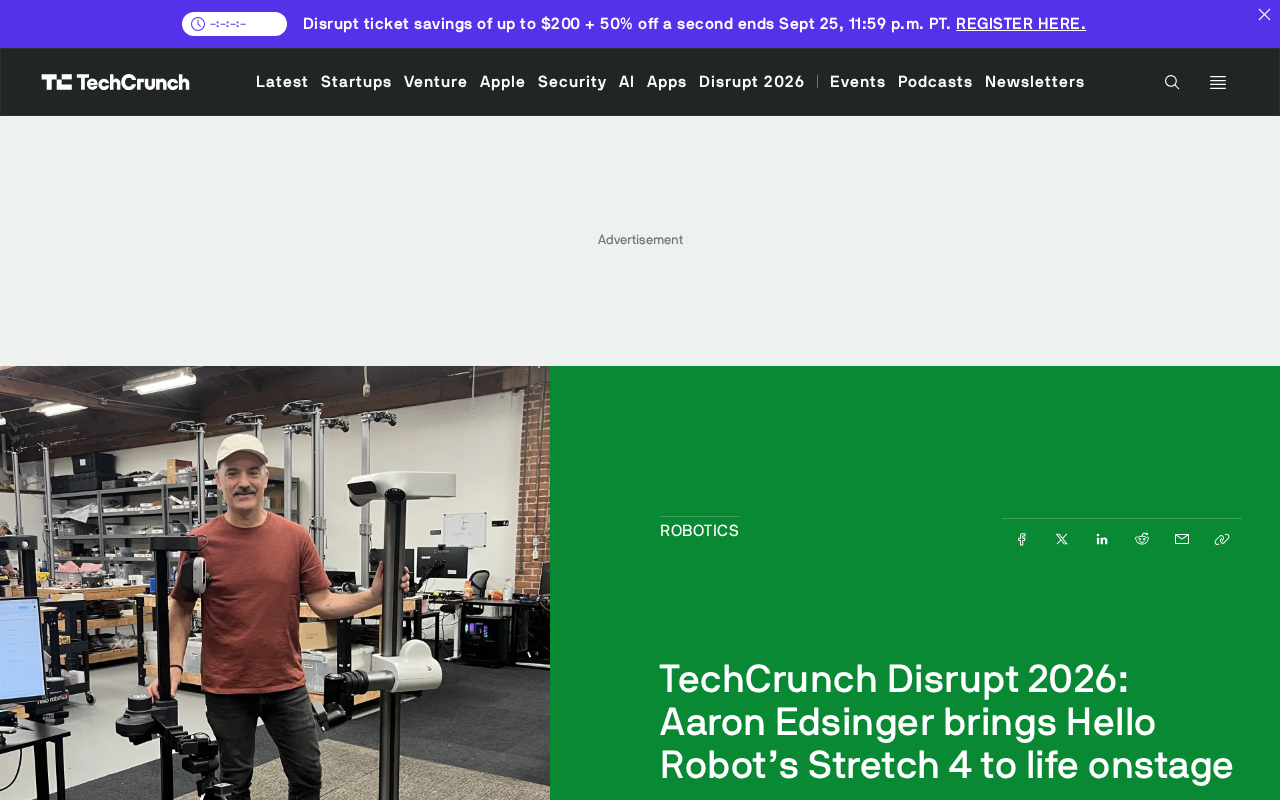
For practitioners focused on the commercial deployment of robotics, a live hardware demo is often more convincing than any marketing material. The Stretch series has long been recognized for its lightweight design, accessibility, and research-friendly architecture. Bringing Stretch 4 to the stage signals that Hello Robot wants to showcase its next-generation platform's real-world manipulation capabilities under the industry spotlight.
Why the Stretch Series Deserves Attention
Hello Robot's Stretch occupies a very different niche from heavy-duty platforms like Boston Dynamics. It prioritizes a relatively low-cost, single-person-portable form factor for mobile manipulation. These robots typically feature a telescoping arm on a mobile base, targeting use cases such as home assistance, research labs, and lightweight service tasks.
From a product evolution standpoint, reaching a fourth generation indicates the platform has been refined through multiple iterations. The value of a live demo lies in its ability to expose the robot's real performance in perception, grasping, and navigation — precisely the areas where robots most often fall short when moving from demo videos to actual deployment. Aaron Edsinger, a seasoned robotics engineer himself, personally conducting the demonstration adds further technical credibility to the showcase.
The fundamental difference between Stretch and platforms like Boston Dynamics' Atlas or Spot comes down to design philosophy: the latter pursues extreme locomotion capabilities at price points typically in the hundreds of thousands of dollars, targeting specialized sectors like defense and industrial inspection. Stretch, by contrast, is designed so that a single researcher or caregiver can transport and deploy it independently — with an overall weight of around 23 kg and a price point in the roughly $20,000 range, along with relatively open ROS (Robot Operating System) interfaces. This "good enough" design philosophy has earned it a real user base in university research, elder care assistance, and warehouse logistics. It also enables the developer community to build and validate manipulation algorithms on the platform, forging an ecosystem path distinctly different from heavy industrial platforms.
The Real World AI Stage and What It Signals
The decision to host this demo on a stage called the "Real World AI Stage" is itself a reflection of a broader industry shift: moving away from pure model capability competitions toward the practical application of AI in the physical world. Embodied AI is emerging as the next major frontier after large language models, and mobile manipulation robots are one of the key proving grounds for whether this direction can translate into real-world deployment.
Placing a live robot demo under the "Real World AI" theme also sends a clear message — the conference is deliberately emphasizing technological practicality and deployability over conceptual showcases.
Embodied AI refers to the integration of perception, reasoning, and physical action capabilities into agents with a physical form, enabling them to complete tasks through interaction with the physical environment — as opposed to traditional AI systems that operate purely in digital space. In recent years, as large language models (LLMs) and vision-language models (VLMs) have matured, researchers have begun using them as the "brain" of robots, endowing machines with the ability to understand natural language instructions and perform open-world reasoning. This direction has produced a series of pre-trained model-based robot control frameworks such as RT-2, PaLM-E, and OpenVLA. As a canonical embodied AI platform, mobile manipulation robots must simultaneously solve dynamic environment perception, 6-DOF grasp planning, and long-horizon task decomposition — challenges that make them widely regarded as a critical benchmark for testing the practical viability of embodied AI.
Attendance Information
According to official information, registering before September 25 unlocks savings of up to $200, plus a second pass at half price. For teams looking to closely track embodied AI developments or evaluate robotics platforms for potential adoption, in-person events like this offer a direct opportunity to engage with both the product and the team behind it.
It's worth noting that specific details about Stretch 4's specs, performance improvements, and pricing have not yet been publicly disclosed. More technical details are expected to be revealed during the live demonstration.
Related articles

Why Does a 35GB Quantized Model Blow Up an 80GB GPU? The Truth About KV Cache VRAM
Why does a 35GB 4-bit quantized LLM still blow up an 80GB GPU? This article breaks down the four components of inference VRAM, provides precise KV Cache formulas, compares GQA vs DeepSeek MLA memory, and offers production-grade OOM prevention like FP8 KV Cache.

Turning Company Workflows into Agent Skills: A Practical Guide
An agency owner turns team workflows into Agent Skills: one command handles article writing, six-platform distribution, and dual human approval. This guide breaks down the Skill file structure, two invocation methods, three-tier storage layout, security review process, and how to turn your own weekly repetitive tasks into executable, auditable skills.

China Releases "Qiusuo" 4.0: The First Evaluation Benchmark Covering the Entire AI Industry Chain
China's CESI releases "Qiusuo" 4.0, the first AI full-industry-chain evaluation benchmark system, covering computing power, LLMs, agents, security governance, and industry applications with 16 evaluation tools and open-source code tools to solve cross-environment incomparability.