Hello World! Meet Luffy Rajput: Building, Coding, and Chasing Dreams

Student developer Luffy Rajput's first self-intro post reveals his digital identity and learning-in-public path.
The article introduces student developer Luffy Rajput's first self-introduction post. He positions himself as a student passionate about web projects and software development, active on GitHub, a GitHub Pages homepage, and Instagram, forming a trinity digital identity. His work focuses on web deployment and version control, and he is learning web tech, technical writing, and personal branding. The article sees this as reflecting the broader trend of developers building visible portfolios through open-source platforms and learning in public, offering a reference template for beginners.
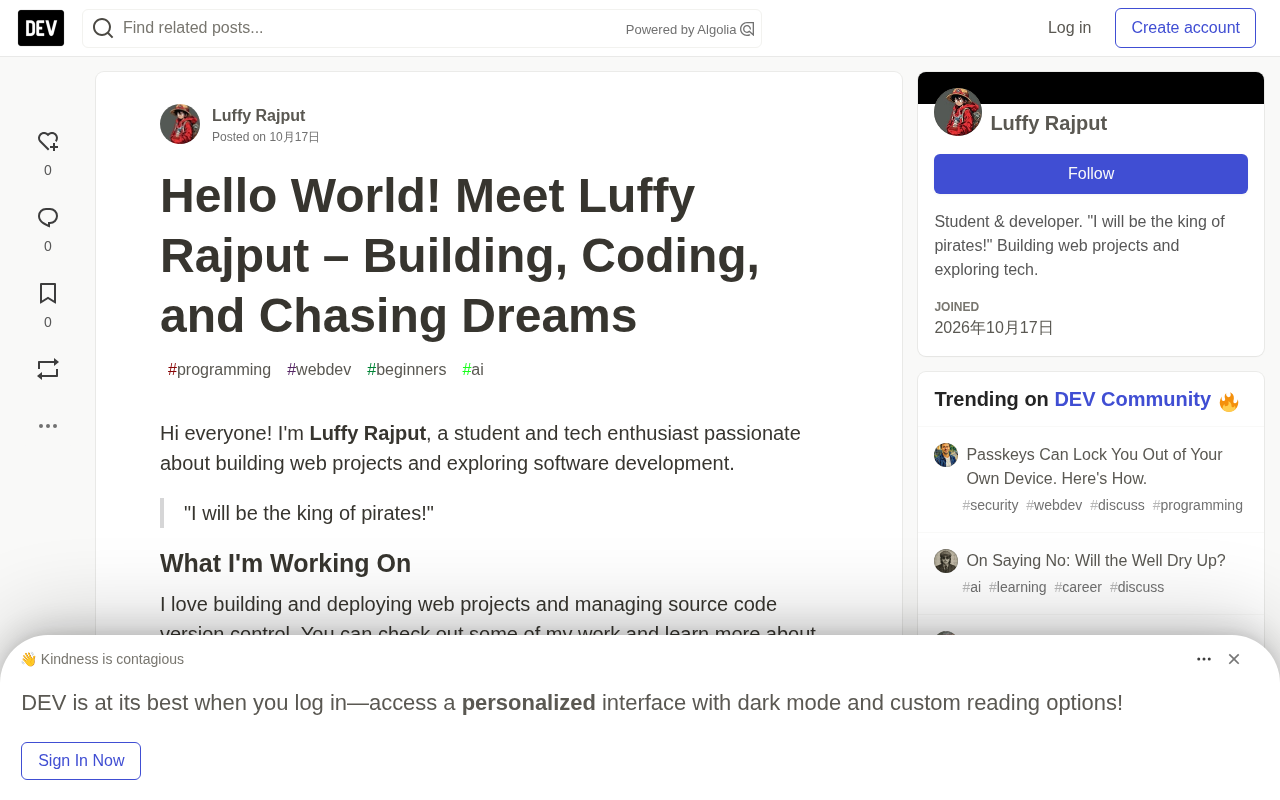
A student and tech enthusiast named Luffy Rajput recently published his first self-introduction post on his blog. At first glance it looks like an ordinary "Hello World"-style personal statement, but it reflects a broader phenomenon: how a new generation of developers builds their identity and influence within the tech community through open-source platforms, personal websites, and social media.
Who Is Luffy Rajput?
Luffy Rajput describes himself as a student and tech enthusiast who is passionate about building web projects and exploring software development. He opens the article with a quote that has a distinctly personal style: "I'm going to be the Pirate King!" — an obvious homage to the protagonist of the anime One Piece, and also a hint at his adventurous mindset toward technology exploration.
Based on public information, he is currently active on three platforms: GitHub, a personal homepage, and Instagram, corresponding respectively to code hosting, information aggregation, and social presentation. This "trinity" digital identity layout is becoming increasingly common among young developers.
What He's Doing: Web Projects and Version Control
According to his own account, his current focus is building and deploying web projects and managing source code version control. He lists three digital entry points:
- GitHub profile (github.com/luffyrajput): code repositories and project showcase
- Personal info page (luffyrajput.github.io/info/): a personal information page built on GitHub Pages
- Instagram (@luffy_rajputt): personal presentation on a social platform
Interestingly, he chose GitHub Pages to host his personal info page — a zero-cost solution that integrates deeply with code repositories, suitable for student developers who want to quickly launch a personal branding page. This also indirectly suggests he already has some hands-on experience with static site hosting and version control workflows.
GitHub Pages is a static site hosting service provided by GitHub. Developers can publish HTML, CSS, and JavaScript files directly from a designated branch of a code repository (usually main or gh-pages), without configuring a server or database. Every GitHub account and project gets a free username.github.io domain, and it supports binding custom domains and automatic HTTPS. For student developers, it is almost always the first choice for launching personal homepages, project documentation, or blogs at zero cost; and because the deployment process is deeply tied to the Git workflow, using it is itself an exercise in the basic concepts of version control and continuous deployment.
Learning Focus: Web Technologies and Technical Documentation
In the article, Rajput mentions that he is diving deeper into web technologies, technical documentation writing, and optimizing his personal brand. Together, these three directions reveal a clear intention: not only to write good code, but also to run "himself" as a project.
Technical documentation skills are often overlooked by beginners, but they are in fact a key skill for open-source collaboration and career development. A developer who can clearly write READMEs and maintain project documentation is more likely to earn trust and collaboration opportunities in the community. Rajput's proactive inclusion of technical documentation as a learning focus shows he has some understanding of the developer growth path.
Technical documentation writing in open-source communities typically revolves around files such as the README, contributing guidelines (CONTRIBUTING), code of conduct (CODE_OF_CONDUCT), and API references. The README is often the first entry point for visitors to a project; it needs to explain the project's purpose, installation steps, a minimal working example, and license information. Clear structure and reproducible examples can significantly lower the onboarding cost for new contributors, and thus become one of the bases on which maintainers assess willingness to collaborate. For beginners, practicing documentation writing for personal projects not only trains the ability to make tacit knowledge explicit, but also leaves a communication sample on GitHub that others can examine.
Personal Branding: A New Required Course for Student Developers
Judging from the act of publishing this article itself, it is an act of personal brand building: using a clearly structured self-introduction to announce his existence and direction to the community. At the end of the article, he promises "more posts to come," covering coding journeys, troubleshooting tips, and project breakdowns.
This "learning in public" model is becoming increasingly popular in developer communities. By continuously publishing learning notes and project retrospectives, developers can both consolidate knowledge and accumulate a visible portfolio. For students, this demonstrates comprehensive ability far better than simply grinding through problems or completing coursework.
Learning in public refers to developers continuously publishing notes, troubleshooting records, and project retrospectives from their learning process on blogs, GitHub, or social platforms, rather than waiting until they have fully mastered something to show results. This approach turns the learning trajectory itself into a searchable portfolio: readers can see how problems were located and how solutions were iterated, thereby judging the author's true ability. It also brings external feedback and community connections, but requires the author to accept that early content is imperfect and to be careful not to leak others' privacy or unauthorized work content.
A Signal, Not a Story
Frankly, this article contains limited information — it is a standard personal introduction that does not disclose specific projects, tech stack details, or verifiable results. But it is still worth recording, because it shows the starting point of a typical student developer: from GitHub repositories to a personal homepage, from version control to technical writing, from code building to personal branding.
For developers who are also at the starting stage, Rajput's path offers a reference template: first establish a digital identity, then continuously publish content, and let the learning process itself become the work. As for whether he can deliver on his promise of "more posts," only time will tell.
One-line Summary
Student developer Luffy Rajput publishes his first self-introduction, showcasing his digital identity and learning-in-public path.
Paragraph Summary
The article introduces student developer Luffy Rajput's first self-introduction blog post. He positions himself as a student passionate about building web projects and software development, active on GitHub, a GitHub Pages personal homepage, and Instagram, forming a trinity digital identity of code hosting, information aggregation, and social presentation. His current work focuses on web project deployment and source code version control, and his learning directions include web technologies, technical documentation writing, and personal brand optimization. The article argues that this self-introduction, despite its limited content, reflects the broader trend of a new generation of developers building visible portfolios through open-source platforms and learning in public, and that his path can serve as a reference template for developers at the starting stage.
Related articles

Chain of Thought Isn't Just for AI: How Humans Can Use CoT to Improve Thinking Quality
Chain of Thought isn't just a prompt trick for large models. Starting from a Hacker News discussion, this article analyzes why CoT works for human thinking too, breaks down actionable ways to transfer it, and highlights the key differences between human CoT and machine CoT.
Cloudflare Teams Up with OpenAI: Closi…
Cloudflare Teams Up with OpenAI: Closing the Loop from Vulnerability Discovery to Defense with AI
Cloudflare uses OpenAI Daybreak to investigate security vulnerabilities and generate reviewable remediation plans, while developers use Codex to boost coding efficiency and quality.

Orca Multi-Agent Orchestration in Practice: A Guide to Parallel Collaboration with Claude and Codex
Orca is Stable AI's free open-source agent workbench supporting 34 agents like Claude Code and Codex in parallel. Learn its Git worktree isolation, multi-model orchestration, and mobile management.