Hermes Agent Advanced Guide: 10 Configurations to Build a Super Assistant

Ten core configurations transform Hermes Agent from a passive chat box into a cyber assistant with stealth scraping, layered memory, and automated skill accumulation.
Based on a Bilibili creator's hands-on roadmap, the article breaks down Hermes Agent's five-stage, ten-step upgrade path from environment infrastructure to advanced evolution. The environment layer emphasizes installation key pitfalls, the Camoufox stealth browser, and the appeal mechanism for high-risk commands; the core shaping layer strengthens Agent capabilities through Soul.md persona injection, primary/secondary model separation for cost reduction, dynamic context compression, and turning on all three layers of memory; the boundary expansion layer introduces Exa transparent search, eight-hook security auditing, and Docker sandbox fallback; the advanced evolution layer covers Swarm multi-Agent debate, three-layer data backup, and automated skill accumulation. Ultimately, it argues that the capability boundary of an Agent depends on engineering investment at the configuration layer, not the model itself.
Title
Hermes Agent Advanced Guide: 10 Configurations to Build a Super Assistant
Meta Description
Don't just chat after installing Hermes Agent. This article breaks down 10 core configurations tested on Bilibili: Camoufox stealth scraping, Soul.md persona injection, primary/secondary model cost reduction, three-layer memory, Docker sandbox isolation, Swarm multi-Agent collaboration, and automated skill evolution—helping you transform your initial Agent into a full-stack digital employee.
Article Content
When Hermes Agent is first installed, many people stare at that plain chat box and assume it's just another wrapper around a conversational tool. That judgment will make you miss its true potential—through ten core configurations, you can transform an initial Agent that only passively responds into a cyber assistant equipped with stealth scraping, layered memory, sandbox isolation, and automated skill accumulation.
This article is based on a Bilibili creator's complete hands-on roadmap, breaking down the five-stage upgrade path from "environment infrastructure" to "advanced evolution," and supplementing the technical logic and risk boundaries behind key configurations.
Environment Infrastructure: From Running Naked to a Defended Starting Point
The Hidden Trap During Installation
The first command already hides a pitfall. When executing the installation command in the terminal, if you paste the model key directly, the screen may give no feedback. Beginners easily paste repeatedly, eventually triggering an error. The correct approach is: once you notice an anomaly, immediately stop repeating the operation and manually modify the environment variables via the command line. This detail seems trivial, but it is the foundation for all subsequent configurations—if the key is wrong, everything downstream fails.
Using Camoufox to Give the Agent an Invisibility Cloak
Web anti-scraping mechanisms are becoming increasingly unfriendly to ordinary browser engines. The creator recommends configuring Camoufox as the browser backend, which is equivalent to adding a layer of invisibility coating to the Agent. After configuration is complete, whether reading articles or automatically executing web tasks, it can bypass conventional Chromium interception.
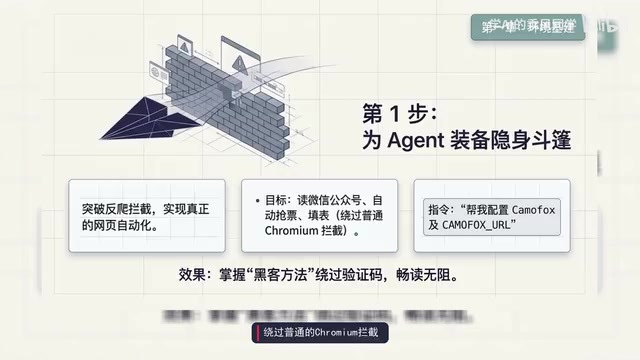
A judgment needs to be added here: stealth capability is a double-edged sword. It can help you penetrate anti-scraping walls, but it also means the Agent's web behavior is harder for target sites to trace. It is recommended to use it only in clearly authorized scenarios to avoid crossing compliance red lines.
Camoufox is an anti-detection browser built on a secondary development of Firefox. It simulates a real user environment by modifying low-level fingerprint features (such as Canvas, WebGL, font lists, time zones, etc.), thereby reducing the probability of being identified as an automation tool by websites. Compared with Chromium driven by conventional Playwright/Puppeteer, Camoufox is less likely to trigger challenges from anti-scraping systems such as Cloudflare and DataDome under default configurations. Hermes Agent uses it as a pluggable browser backend, meaning the Agent's web reading and interaction behavior can bypass most interception based on browser fingerprints. Note, however, that stealth does not equal anonymity; target sites can still track through IP, behavioral patterns, and other dimensions, so the premise of compliant use is obtaining clear authorization.
The Appeal Mechanism for High-Risk Commands
When traditional terminals encounter dangerous operations, they often throw out a bunch of red errors. Hermes Agent handles this more elegantly: when the Agent attempts to execute high-risk commands such as modifying system configurations, it pops up a clear appeal request for you to decide whether to approve or reject. Control always remains in the user's hands, which is especially important in multi-Agent collaboration scenarios.
Core Shaping: Memory Reinforcement and Cost Control
Injecting a Dedicated Persona with Soul.md
The problem with general models is that they feel too "machine-like." The creator's solution is to modify the Soul.md file and set dedicated rules, letting the system read conversation history precisely like a funnel and automatically summarize your thinking patterns and output discipline. Essentially, this is behavior cloning—letting the Agent truly understand your expression habits instead of applying default templates.
Cost Reduction Strategy by Separating Primary and Secondary Models
Smart brains burning money is the norm. The core of the third step is architectural separation: leave logic judgments requiring deep reasoning to the expensive primary model; deploy a cost-effective attachment model (the creator gives qwen3.5-plus as an example) to handle dirty work such as web scraping and context compression. After separation of primary and secondary models, the Token consumption structure will be significantly optimized.
The core idea of primary/secondary model separation (Router-Executor architecture) is to layer tasks by cognitive load: the primary model handles planning, reasoning, and final decisions, while the attachment model handles subtasks with high determinism and repeatability. This pattern is especially effective in Agent systems because operations such as web scraping, context compression, and format conversion have low requirements for model reasoning ability but high invocation frequency and large Token consumption. By routing such tasks to cheap models (such as qwen3.5-plus), unit task cost can be significantly reduced without sacrificing the overall intelligence level. Implementation usually relies on a lightweight routing layer that dynamically selects models based on task type or confidence rather than fixed binding.
Dynamic Context Compression
Faced with lengthy text of millions of Tokens, the system dynamically calculates through a funnel mechanism and extracts compressed context. The key is "adjusting the summary ratio according to the ultimate intelligence of different models"—this means Token allocation is more reasonable and the Agent's memory can remain online persistently.
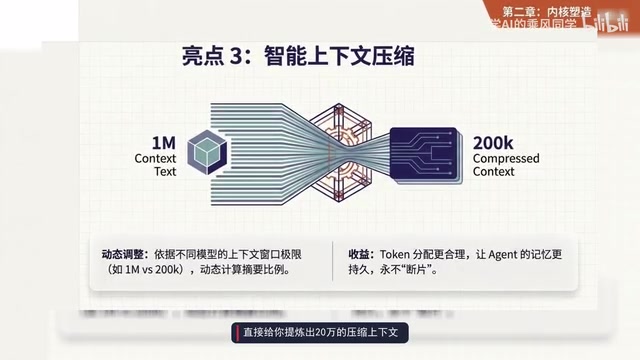
Suddenly losing track mid-conversation is the reason many people give up on long-conversation Agents. The compression strategy directly alleviates this pain point.
Turning On All Three Layers of Memory
The fourth step fully activates the memory system: the first layer is built-in environment and user profile storage; the second layer supports external professional memory libraries (such as Memstore); the third layer enables local SQL drawing search by default with millisecond-level retrieval. With the three layers stacked, the Agent basically has a photographic memory.
Boundary Expansion: Search, Audit, and Sandbox
Transparent Execution Traces of Exa Search
Configuring Exa search requires only one instruction, and the Agent will automatically request the key and restart the gateway. What the creator praises most is the completely transparent execution trace: from initializing the request, selecting the proxy, to extracting information, every tool call is neatly printed in the chat interface. Black-box operations are completely broken, and you don't need to guess when troubleshooting.
Eight-Hook Security Audit
If it can access the internet and call tools, it must be equipped with auditing. Hermes Agent has eight built-in lifecycle hooks at the underlying level, which can intercept dangerous operations in all directions. The creator demonstrated having the Agent write a port command audit plugin itself, writing all operation content, execution results, and timestamps into the audit log.
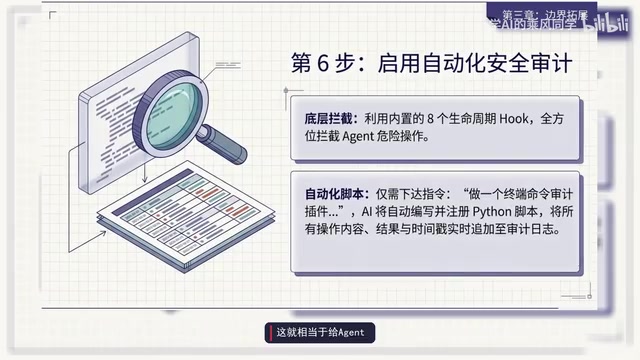
Interestingly, having the Agent write security plugins itself is inherently risky—if the audit code is polluted by malicious prompts, it may instead become a blind spot. It is recommended to manually review generated audit scripts before enabling them.
Lifecycle Hooks are interception and injection points reserved by Agent frameworks at key execution nodes (such as before tool calls, after model responses, and at session end). Hermes Agent's eight built-in hooks cover the complete chain from initialization to exit, allowing developers to insert auditing, permission verification, or logging logic at these nodes. The so-called "appeal mechanism" is implemented based on hooks: when the Agent attempts to execute high-risk commands, the hook pauses the execution flow and pops up a confirmation request. This design moves security control from "post-event remediation" forward to "pre-event interception," and is key infrastructure for preventing unauthorized operations in multi-Agent collaboration scenarios.
The Ultimate Fallback of Docker Sandbox
The seventh step is Profile Sandbox with Docker. The effect is straightforward: weld a completely enclosed transparent cage around the Agent. Even if it suddenly goes haywire and executes rm -rf-level destructive commands, all impact is confined within the container, and the host machine remains unharmed. This is the last line of defense in the entire security system.
Docker sandbox achieves isolation of processes, file systems, networks, and resources through namespaces and control groups (Cgroups). In Hermes Agent's Profile Sandbox configuration, the Agent's terminal execution environment is restricted to an independent container, and only necessary mount points are shared between the container and the host machine. Even if the Agent executes destructive commands such as rm -rf / or modifies system configurations, the scope of impact is confined within the container, and the host file system and processes are unaffected. This isolation level is higher than simple privilege downgrading, but it is not absolutely secure—container escape vulnerabilities still exist, so it is recommended to also use read-only mounts and network policy restrictions to form defense in depth.
Advanced Evolution: Legion Collaboration and Self-Accumulation
Swarm Multi-Agent Debate
The eighth step introduces the Swarm architecture. Summon multiple clones in the same session and issue the instruction "generate three child nodes to discuss a certain topic"; the three AI roles of affirmative side, negative side, and judge will debate in the background and organize documents. You observe, then harvest the results. This multi-agent collaboration is significantly more efficient in tasks such as solution evaluation and decision assistance.
Three-Layer Data Backup
The ninth step builds three-layer backup: local Git real-time tracking; offsite scripts periodically package configurations, databases, and plugins; remote automatic synchronization pushes to private cloud drives.
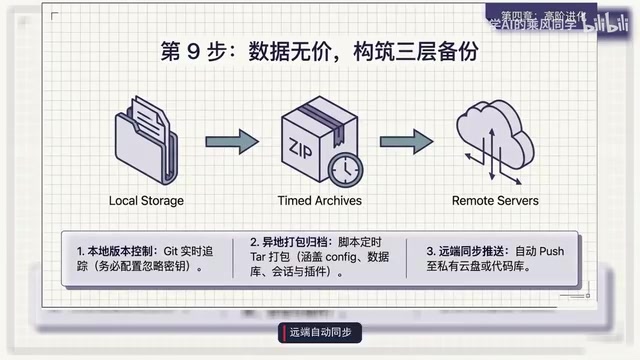
The creator also mentions an easily overlooked detail: the system has 20 exit trigger points, covering normal exit and abnormal crashes. When the network is interrupted or power is lost, conversation messages and system state will not be lost. This disaster recovery design is highly valuable in long-running tasks.
Automated Skill Evolution
The tenth step is the most core mechanism of the entire system. Relying on a self-driven loop, normal use is training it—the built-in review module observes valuable trial-and-error processes in the background, automatically writes code, and solidifies it into permanent skills. The more you use it, the smarter it becomes, with no manual teaching required.
Architectural Logic from Tool to Digital Employee
Combining the ten configurations reveals an architecture with three layers of characteristics: a highly available disaster recovery foundation, a security gateway and isolated environment, and an adaptive learning mechanism. The creator summarizes it as a "full-stack digital employee," but a more accurate description is—it pieces together fault-tolerant design, highly decoupled configurations, and automated skill accumulation.
The value of this roadmap is not how flashy each step is, but that it demonstrates a way of thinking: the capability boundary of an Agent largely depends on how much engineering thought you are willing to invest at the configuration layer. Between a bare chat box and a fully armed assistant, the difference is not the model itself, but these ten layers of infrastructure.
One-line Summary
Ten core configurations transform Hermes Agent from a passive chat box into a cyber assistant equipped with stealth scraping, layered memory, and automated skill accumulation.
Paragraph Summary
Based on a Bilibili creator's hands-on roadmap, the article breaks down Hermes Agent's five-stage, ten-step upgrade path from environment infrastructure to advanced evolution. The environment layer emphasizes installation key pitfalls, the Camoufox stealth browser, and the appeal mechanism for high-risk commands; the core shaping layer strengthens Agent capabilities through Soul.md persona injection, primary/secondary model separation for cost reduction, dynamic context compression, and turning on all three layers of memory; the boundary expansion layer introduces Exa transparent search, eight-hook security auditing, and Docker sandbox fallback; the advanced evolution layer covers Swarm multi-Agent debate, three-layer data backup, and automated skill accumulation. Ultimately, it argues that the capability boundary of an Agent depends on engineering investment at the configuration layer, not the model itself.
Related articles

FastAPI: A High-Performance Python Framework and a Production-Ready API Development Powerhouse
FastAPI is a high-performance web framework based on Python type hints, supporting async and automatic OpenAPI docs. With over 100k GitHub stars, this article analyzes its core strengths, production readiness, and selection advice.

Tesla Optimus Begins Mass Production: Can the Goal of 20,000 Units Per Week Be Achieved?
Tesla Optimus officially begins mass production as Musk sets a target of 20,000 units per week. This article analyzes the supply chain challenges behind mass production, the real gap in capacity ramp-up, and the competitive landscape for humanoid robots.

PCL: A Minecraft Launcher with 8.5k Stars — Why Was It Written in VB.NET?
An in-depth analysis of PCL, the GitHub Minecraft launcher with 8,500+ stars: why it chose VB.NET, its features and China network advantages, and the limits of Windows-only.