Hermes Agent Beginner's Guide: An AI Framework That Uses Far Fewer Tokens Than OpenClaude

Hermes Agent integrates Claude Code and Codex into one AI Agent framework with lower Token costs and self-evolving Skills.
Hermes Agent is an AI Agent framework for individuals and developers, similar in scope to OpenClaude but with clear advantages in code capability, Token efficiency, and ease of setup. It ships with Claude Code and Codex, supports 200+ model providers, runs on Linux, macOS, Windows (via WSL), and Docker, and integrates with platforms like WeChat and Telegram — enabling remote computer control from your phone. Its standout feature is automatic Skill generation: the framework identifies repeated workflows and distills them into reusable skills, creating a self-evolution loop. Token consumption is dramatically lower than OpenClaude in testing, near zero when idle. On the safety side, since the Agent can directly manipulate local files, users must carefully read every operation confirmation prompt and are advised to deploy in an isolated environment rather than on their primary machine.
What Is Hermes Agent
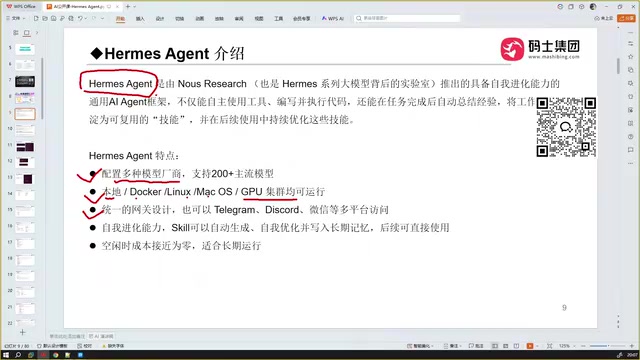
Hermes Agent is an AI Agent framework. Its positioning is similar to OpenClaude (nicknamed "crawfish" by some users), but based on hands-on testing, Hermes Agent delivers a noticeably more polished experience in both setup and day-to-day use.
Under the hood, it has better model tuning, higher accuracy in framework-level code generation, and faster response times. Some describe it as "Claude Code plus OpenClaude rolled into one" — a rough analogy, but it captures the capability range reasonably well: it handles code like Claude Code and connects to external platforms like OpenClaude.
In short, don't get too hung up on definitions. Just think of it as an AI Agent framework you can use to do almost anything.
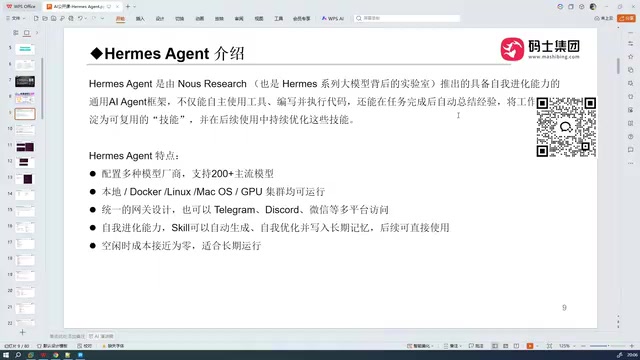
An AI Agent framework is a type of AI system capable of autonomously planning tasks, calling external tools, and executing multi-step operations. What sets it apart from a standard conversational AI is agency: it doesn't just output text — it can manipulate files, call APIs, browse the web, run code, and more. OpenClaude (an open-source Agent implementation built on Claude) was one of the first frameworks of this kind to gain traction among users in China, popular for its relatively low setup barrier and multi-platform support, though it has notable weaknesses in code capability and Token efficiency. Claude Code is Anthropic's official terminal-based coding Agent for developers, known for its strong code comprehension and execution. Hermes Agent can be understood as a systematic integration of the strengths of both.
Core Capabilities: From Writing Code to Controlling a Browser
Hermes Agent ships with Claude Code and Codex built in, which means its coding support is significantly stronger than OpenClaude's — a well-known weak point for the latter.
Beyond code, it comes with a rich set of built-in tools. For browser automation, for example, it doesn't need to open an actual browser window the way OpenClaude does. Instead, it uses an internal browser toolset to directly access web pages, scrape content, and extract information. Everything OpenClaude can do, Hermes Agent can handle — plus additional web tooling on top.
Users can also write their own Skills or download pre-built skill packages from the internet and call them directly. This extensibility dramatically expands the framework's capability ceiling.
Memory Layering and Self-Evolution
Two standout features of Hermes Agent are its memory layering architecture and its self-evolution capability.
Self-evolution means its internal Skills can be generated automatically. When you repeatedly execute the same type of workflow across multiple conversations — step one, step two, and so on — the framework identifies the pattern and automatically generates a corresponding Skill. The next time it encounters a similar task, it calls that self-generated skill directly, with no need to re-describe the process.
Memory layering is an architectural design for how Agent frameworks manage contextual information. It typically involves three levels: working memory (short-term context within the current conversation window), episodic memory (historical interaction fragments saved across sessions), and knowledge memory (long-term experience stored in structured form, such as Skills). Because large language models have limited context windows, naively stuffing all historical information into a prompt quickly exhausts the Token budget. The core value of memory layering is allowing an Agent to "remember" user habits and operational patterns over longer time horizons — without blowing through the context limit. The automatic Skill generation mechanism is essentially the process of extracting procedural knowledge (how to do something, step by step) from working memory and distilling it into reusable knowledge memory — a textbook application of memory layering in practice.
Multi-Platform Support and Token Efficiency
Hermes Agent supports over 200 model providers, covering virtually every major model API available today. Deployment environments are flexible too: it runs locally on Windows, Docker, Linux, and macOS, as well as in cluster environments.
For external integrations, it supports a wide range of chat platforms: internationally, Telegram and Discord; domestically, WeChat, WeCom (Enterprise WeChat), DingTalk, Feishu, and more — all with a simpler configuration process than OpenClaude. In many cases, a QR code scan is all it takes to complete the binding.
This opens up an interesting use case: if you connect WeChat to Hermes Agent while the Agent runs silently on your local Windows machine, you can use your phone's WeChat to remotely operate your computer and complete tasks on the go.
Token efficiency is another major selling point. When idle, Hermes Agent consumes virtually no Tokens. Comparative tests with OpenClaude in multi-turn conversation scenarios show that Hermes Agent's total Token consumption is significantly lower. This is especially critical for heavy multi-turn use cases like DeepAgent, which are notorious for burning through Tokens quickly. (Note: this comparison is based on a single source's real-world testing and should be taken as a reference rather than a definitive benchmark.)
Installation Environment and Practical Tips
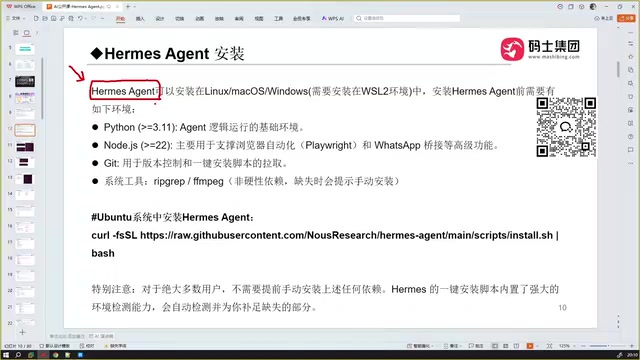
Hermes Agent can be installed on Linux, macOS, and Windows — though Windows requires the WSL environment. The author's personal choice is to deploy on Linux (Ubuntu), and the reasoning is worth understanding.
Why You Shouldn't Install It Directly on Your Main Windows Machine
This framework can operate on your local file system. While its safety mechanisms are more robust than OpenClaude's — it shows a "Dangerous" confirmation prompt before executing file operations, similar to Claude Code's confirmation flow — the risk is still real.
There have been cases where users, relying too heavily on the Agent and clicking through confirmation dialogs without reading them, ended up with modified environment variables or deleted files that were difficult or impossible to recover. This isn't fearmongering. Every time a dialog appears, read carefully what operation is about to be executed. This is the single most important safety habit for long-term use.
WSL (Windows Subsystem for Linux) is a compatibility layer built into Windows 10/11 that lets you run Linux distributions (such as Ubuntu) directly within Windows, giving you a native Linux command-line environment and file system without needing a virtual machine. For frameworks like Hermes Agent, which are primarily designed around Linux, WSL provides a relatively isolated runtime environment — by default, the Agent's file system operations occur within WSL's internal Linux partition, rather than directly on your Windows host system's C drive or user directories. This reduces (but does not eliminate) the risk of accidentally affecting critical files on your main system. It's important to note that WSL and the Windows file system share cross-access paths (such as /mnt/c mount points), so if the Agent is directed to access those paths, the isolation breaks down.
Dependency Checklist
Installing Hermes Agent requires the following base environment:
- Python 3.11
- Node.js (approximately version 22)
- Git
- Several system utility dependencies (file search, screenshot, image processing, etc.)
You don't need to manually track all of these — the framework will auto-detect missing components during installation and install them. That said, it's recommended to install them manually beforehand so you know exactly where each component is and what version is running, which saves headaches later.
Installation Process
On Ubuntu, installation is a single copy-paste command. The whole process typically takes under 10 minutes and does not require a VPN.
During installation, you may see error messages or warnings about certain dependencies failing to download. These generally don't affect normal use — the framework will retry those installations when the relevant features are actually needed. You can safely skip past them.
After installation completes, the framework will prompt you to log in to an official account (the service provider's platform) for subscription and access to officially hosted models. If you don't have an account or don't need this right now, press Ctrl+C to skip the login step — you'll then be taken directly to the configuration interface to continue setup.
Summary
As an Agent framework, Hermes Agent's most noteworthy differentiators come down to three things: strong coding capability from its built-in Claude Code and Codex, a self-evolution mechanism through automatic Skill generation, and significantly lower Token consumption. Combined with broad multi-platform support, it genuinely enables imaginative use cases like controlling your computer remotely through WeChat.
But the flip side of that convenience is file operation risk. Regardless of which system you install it on, developing the habit of reading confirmation dialogs carefully is a prerequisite for safe, long-term use.
Related articles

Felix Rieseberg Personal Homepage
Felix Rieseberg's personal homepage sparks attention on Hacker News. This article covers the Slack engineer's technical background, the rise and fall of nativefier, and the value of a developer homepage as a tech calling card.

@ai-sdk/vue 3.0.306 Patch Release Syncs with [email protected] Update
@ai-sdk/vue 3.0.306 released, synced with [email protected]. A routine patch release for the Vercel AI SDK ecosystem with no public API changes; the Vue adapter layer stays version-aligned with the core package.

Gemini 4 Argon API Launches: The Era of Million-Token Output Begins
Google launches Gemini 4 Argon with sparse MoE architecture, up to 1M output tokens, and a 68.90% Vals Index score, available across API, AI Studio, and the Gemini app.