Hermes Agent Deep Dive: The Open-Source AI Agent Framework That Evolves Itself

Hermes Agent hits 120K GitHub stars with lower token costs, persistent memory, and auto-generated skills.
Hermes Agent is an open-source autonomous AI Agent framework that surpassed 120,000 GitHub stars in under two months. Compared to OpenClaude, it offers lower token consumption and cross-session long-term memory that survives restarts. Its standout feature is a built-in self-learning loop that automatically distills reusable Skills from completed tasks — no manual setup required. Designed to run on your own server and connect to messaging apps like QQ, WeChat, and Feishu, it acts as a persistent, ever-improving personal agent.
What Is Hermes Agent
Hermes Agent is an open-source autonomous AI Agent framework. According to a Bilibili content creator, it crossed 121,000 GitHub stars within less than two months of launch — and is still growing fast. That kind of community momentum is rare in the open-source world, and it reflects just how hot the autonomous agent space has become.
In terms of positioning, it's similar to the previously viral OpenClaude (affectionately nicknamed "little lobster" by the community). Unlike AI tools like Doubao or DeepSeekAd — which mostly brainstorm ideas and draft plans — Hermes Agent actually rolls up its sleeves and executes: organizing documents, creating files, sending and receiving emails, scraping information from the web, and more. In other words, it's not just a "brain" — it's a hands-on executor.
How It Compares to OpenClaude
A short anthropomorphized comparison video online highlighted two key differences, which the content creator confirmed through personal testing.
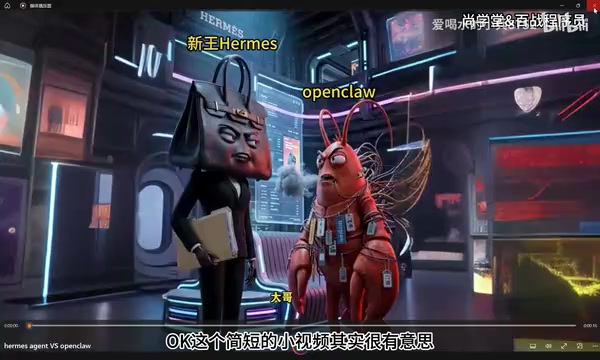
The first difference is lower Token consumption. Having used both tools, the creator noted a clear difference in Token usage — Hermes Agent consumes noticeably fewer tokens than OpenClaude. For users running agents frequently over the long term, this directly translates to lower operating costs.
The second difference is long-term memory. When you close OpenClaude's chat window or restart your machine, it essentially resets to a blank slate — all prior context is gone. Hermes Agent, by contrast, retains historical memory and maintains continuity across sessions. The creator considers this one of its most important differentiators.
What are Tokens? Tokens are the basic unit of text that large language models process — roughly 1 token per 1.5 Chinese characters, or 1 token per 4 English characters. Every inference consumes tokens based on both input and output length, and most commercial APIs charge by token count. Agent-based tools tend to burn through far more tokens than regular chat, since they repeatedly call the model, pass context, and relay tool outputs. For users running automated tasks at high frequency, consuming fewer tokens for the same result means more work done within the same budget — which is a key reason Hermes Agent is seen as more practical.
Core Positioning: A Partner That Evolves With You
The official positioning of Hermes Agent is "an agent that carries the load with you," and its defining feature is self-evolution.

It's designed to be deployed on your own server, connected to your messaging accounts (QQ, WeChat, Feishu, etc.), becoming a persistent personal agent. In the team's own words, it's "not a chatbot, not a code completion tool — it's an intelligence that lives on your machine and gets smarter every day."
"Gets smarter" means: the longer you use it, the better it understands your preferences, the more memory it accumulates, the more skills it masters, and the smoother the experience becomes. The creator describes typical AI tools as having a "7-second memory," while Hermes Agent is a "partner that evolves" — and that word evolves is the whole point.
Why self-hosted? Deploying an agent on a user's own server — rather than a cloud SaaS platform — is an architectural approach known as "local-first" or "self-hosted." The main advantages are threefold: data sovereignty (your memory, skill library, and preferences stay on your machine, never passing through third-party servers); persistent uptime (a server can run 24/7, allowing the agent to execute scheduled tasks without you actively initiating a conversation); and flexible integration (direct access to internal enterprise systems or private databases via local networking). The trade-off is that users must handle deployment, maintenance, and model API configuration themselves — which is why the creator mentioned that a full installation and deployment tutorial is coming.
The Core Innovation: A Built-In Self-Learning Loop
Hermes Agent's core innovation is its built-in self-learning loop — rather than simply calling a large language model, it continuously optimizes itself through an internal learning mechanism. This manifests in four concrete ways:
- Automatically generates Skills from interactions: No manual configuration needed — Skills are distilled from conversations and become reusable.
- Iteratively refines Skills through use: Skills are updated and improved with every repeated use, getting sharper over time.
- Automatically persists knowledge and user preferences: Your habits are gradually recorded during use, enabling personalization.
- Builds deep user understanding across sessions: Through integration with WeChat, QQ, Feishu, and other channels, it deepens its understanding of you over the long term.
How does this differ from traditional agents? Conventional AI agents are typically "stateless" — once a session ends, all intermediate reasoning and user preferences are discarded, requiring you to re-provide context next time. The "built-in self-learning loop" draws inspiration from the concept of "experience replay" in reinforcement learning: after a task is completed, the system automatically distills reusable action patterns and stores them as structured "Skills." The next time a similar task arises, it calls the existing Skill directly rather than re-reasoning from scratch. The key value here: as usage grows, calling an existing Skill consumes far fewer tokens than generating from zero, while success rates improve through repeated iteration. This gives Hermes Agent the characteristics of a "seasoned professional" — faster and more accurate the more you use it, rather than starting from the same baseline every time.
Live Demo: Auto-Generating Skills Through a QQ Conversation
The creator walked through a complete hands-on test. He chatted with Hermes Agent via QQ, first confirming its identity — the agent replied that it was "an AI assistant running on QQ" and listed its capabilities: writing code, debugging, running scripts, web search, browsing, file management, scheduled tasks, content generation, and more.

He then issued a compound task: search the web for trending AI Agent projects, summarize them into a document with links to official websites, blogs, and GitHub repos, generate a sci-fi-styled static display webpage, and run it locally. The agent handled the entire flow autonomously — fetching information, generating the document, building the webpage — with no back-and-forth, no "try again" cycles.

The final output was a list of notable AI Agent products from the past two years, including Cursor, Claude Code, OpenClaude, and others, complete with official website links and data descriptions — with reasonably high accuracy. The webpage ran on a local address (localhost:8080) and could be viewed directly in the browser.
The most noteworthy detail came after the task was done: the system automatically created a new Skill ("skills created") and updated the user profile. The creator emphasized that he never explicitly asked it to generate a skill — this is the self-learning loop in action, and it's the fundamental reason Hermes Agent keeps getting more useful over time.
Wrap-Up and What's Next
Based on this overview, Hermes Agent's differentiated value proposition comes down to three things: lower Token consumption, long-term memory that persists across sessions, and a self-evolution mechanism that automatically generates and iterates on Skills.
It repositions the "agent" from a one-off task tool into something more like a long-term companion that grows with you.
One caveat: this article is primarily based on a single content creator's introduction and personal testing. Data points like the star count and Token usage comparisons haven't been independently cross-verified, so readers are encouraged to check the official GitHub repository directly. The creator has also teased a full installation and deployment tutorial for Hermes Agent — developers interested in the framework can keep an eye out for that.
Related articles

Chain of Thought Isn't Just for AI: How Humans Can Use CoT to Improve Thinking Quality
Chain of Thought isn't just a prompt trick for large models. Starting from a Hacker News discussion, this article analyzes why CoT works for human thinking too, breaks down actionable ways to transfer it, and highlights the key differences between human CoT and machine CoT.
Cloudflare Teams Up with OpenAI: Closi…
Cloudflare Teams Up with OpenAI: Closing the Loop from Vulnerability Discovery to Defense with AI
Cloudflare uses OpenAI Daybreak to investigate security vulnerabilities and generate reviewable remediation plans, while developers use Codex to boost coding efficiency and quality.

Orca Multi-Agent Orchestration in Practice: A Guide to Parallel Collaboration with Claude and Codex
Orca is Stable AI's free open-source agent workbench supporting 34 agents like Claude Code and Codex in parallel. Learn its Git worktree isolation, multi-model orchestration, and mobile management.