Hermes Agent in Practice: A Comprehensive AI Framework Compared to OpenClaude
Hermes Agent: A powerful AI framework outperforming OpenClaude with coding, memory, self-evolution & cost efficiency
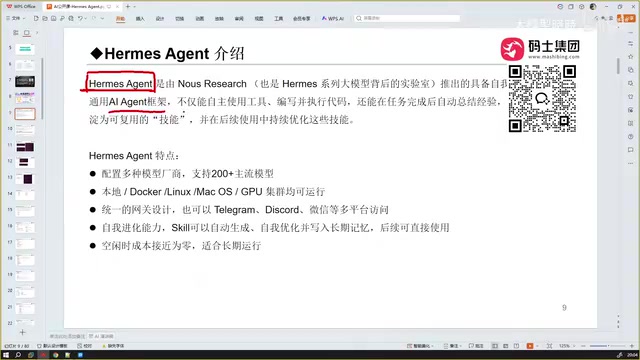
Hermes Agent is a comprehensive AI Agent framework that surpasses OpenClaude in multiple dimensions. It features built-in Claude Code and Codex for superior programming capabilities, advanced layered memory for long conversations, automatic Skill generation for self-evolution, support for 200+ models, and seamless integration with chat platforms like WeChat. Most notably, it achieves significantly lower token consumption than OpenClaude while maintaining higher performance.
What is Hermes Agent: More Than Just Another AI Agent Framework
If you're already familiar with the AI Agent space, understanding Hermes Agent is straightforward—it's essentially an Agent framework. An AI Agent framework refers to a software system that provides the underlying architecture and toolchain for building autonomous intelligent agents. Unlike traditional chatbots, Agents don't just converse—they can autonomously plan tasks, call external tools, and execute multi-step operations. Over the past two years, as large language model capabilities have rapidly advanced, the Agent framework landscape has seen numerous competitors emerge, including LangChain, AutoGPT, CrewAI, OpenClaude, and others. You can think of Hermes Agent as analogous to the widely-used OpenClaude (colloquially known as "Little Crayfish"), but from actual experience, Hermes Agent outperforms in multiple dimensions.
Hermes means "Hermès" (the luxury brand), and some in the community jokingly call it the "Hermès Agent." The name aside, what matters is its positioning: an AI Agent framework that can help you accomplish virtually any task. Some consider it equivalent to Claude Code + OpenClaude integrated, and this characterization isn't an exaggeration. After hands-on setup and use, you can clearly feel the deep optimization in model tuning and framework design—responses are more accurate and faster.
What Hermes Agent Can Do: Complete Coverage of Programming and Toolsets
Built-in Claude Code and Codex: Programming Capabilities Maximized
In the core scenario of code writing, Hermes Agent delivers impressive performance. OpenClaude's support for code writing isn't particularly robust, whereas Hermes Agent has Claude Code and Codex built-in, making it perfectly capable for direct code development.
It's worth explaining the background of these two core components: Claude Code is Anthropic's command-line programming tool based on the Claude model, excelling at understanding codebases, writing code, and debugging in terminal environments—considered a benchmark product in AI-assisted programming. Codex, originating from OpenAI, is a model series specifically optimized for code generation and understanding; early versions of GitHub Copilot were built on Codex. Having both major programming AI capabilities built into a single framework means developers can flexibly choose the optimal code generation engine based on task characteristics without switching between different tools. Whether simple scripts or complex projects, developers can efficiently complete coding tasks with it.
Rich Built-in Toolset
Beyond programming capabilities, Hermes Agent includes an extensive array of practical tools. Take browser operations as an example: it doesn't need to actually open a browser window like OpenClaude does. Instead, it accesses web pages, scrapes content, and reads information internally through its toolset. This "headless" approach to web operations is more efficient and resource-conserving.
Headless browser technology refers to controlling browser engines programmatically without a graphical interface. Common implementations include Puppeteer (based on Chromium) and Playwright (open-sourced by Microsoft, supporting multiple browser engines). Compared to traditional approaches of opening visual browser windows for operations, headless mode doesn't need to render page visual elements, resulting in significantly lower CPU and memory usage and faster execution. This approach is widely applied in scenarios like web scraping, automated testing, and data collection.
Simply put, almost everything OpenClaude can do, Hermes Agent can do too, plus it additionally provides Web tools and user-customizable Skill capabilities.
Three Core Highlights: Memory, Evolution, and Compatibility
Layered Memory Mechanism: Long Conversations Without "Amnesia"
During extensive real-world testing, one of Hermes Agent's most impressive features is its exceptionally well-implemented memory layering. This allows it to maintain contextual coherence when handling complex, multi-turn, long-cycle tasks, rather than progressively "losing memory" like some AI frameworks do during extended conversations.
Memory management for AI Agents has always been a recognized technical challenge in the industry. Large language models inherently have context window length limitations—even models supporting 128K or 200K tokens experience information loss and attention decay in ultra-long conversations. Layered memory mechanisms borrow from the human memory model of "sensory memory - short-term memory - long-term memory": short-term memory preserves the immediate context of current conversations, while long-term memory persistently stores key information in vector databases or structured storage, recalling relevant content through Retrieval Augmented Generation (RAG) techniques when needed. This design enables Agents to continuously maintain awareness of historical information in cross-session, long-cycle complex tasks, substantially improving multi-turn interaction quality.
Self-Evolution: Automatic Skill Generation
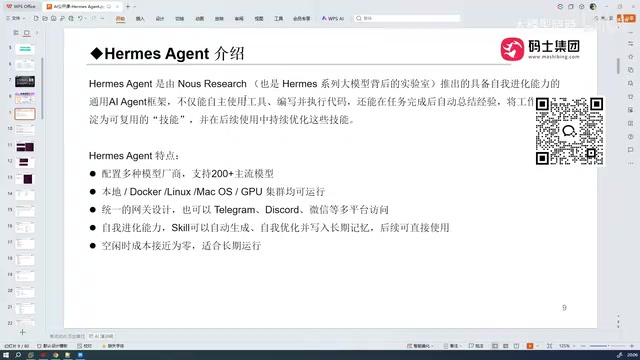
This is Hermes Agent's most imaginative capability. Skills are what we commonly call "abilities"—users can write their own or download ready-made skill packages from the web. But more crucially—Hermes Agent can self-evolve.
As you repeatedly converse with it and complete certain types of tasks, if it detects repetitive, pattern-based operations (like "do this first, then this, then this"), it will automatically generate a Skill for you. When similar needs arise subsequently, it will directly invoke the self-generated Skill to complete the task.
Automatic Skill generation's core concept derives from Meta-Learning and Program Synthesis fields. When an Agent detects users repeatedly executing similar workflows, it abstracts these operational steps into reusable functions or workflow templates, solidifying them as Skills. This parallels the "design patterns" philosophy in software engineering—extracting universal solutions from repetitive practices. Similar approaches have been validated in research projects like Voyager (a GPT-4-based Minecraft Agent): by continuously accumulating skill libraries, Agents achieve sustained capability growth rather than reasoning from scratch each time. This "the more you use it, the smarter it gets" mechanism dramatically reduces long-term usage costs and learning curves.
Support for 200+ Models and Cross-Platform Deployment
Hermes Agent has virtually no weaknesses in compatibility:
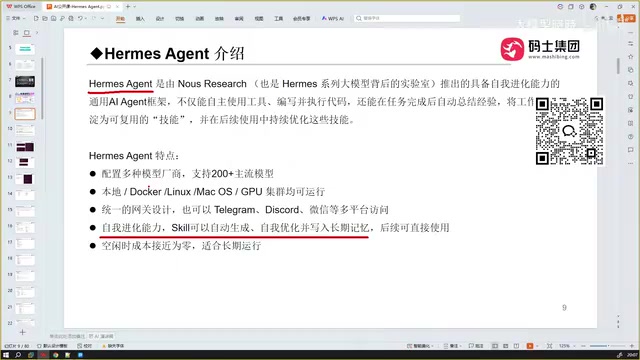
- Supports over 200 models: It basically supports all mainstream model providers on the market.
- Flexible deployment: Supports local deployment, compatible with Windows, Docker, Linux, macOS, and even cluster environments.
Seamless Chat Platform Integration: Ready with a QR Code Scan
Like OpenClaude's integration with WeChat and Feishu, Hermes Agent can similarly connect to virtually any chat software or platform—domestic options like WeChat, Enterprise WeChat, DingTalk, and international platforms like Telegram, Discord, with very rich support.
More notably, configuration is remarkably simple. Compared to OpenClaude's cumbersome integration process, Hermes Agent often only requires scanning a QR code to complete binding, significantly lowering the usage threshold.
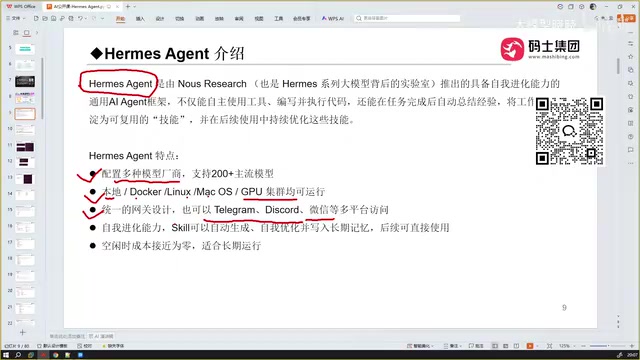
This integration enables a highly practical use case: if you run Hermes Agent silently on your home Windows computer and bind it to WeChat, then while out, you can remotely operate your computer through mobile WeChat conversations, having it complete various tasks for you. It's equivalent to turning your entire computer into an AI assistant you carry with you.
Token Consumption Comparison: An Economic Choice Far Below OpenClaude
For heavy AI Agent users, token consumption has always been an unavoidable pain point. Let me explain the background: tokens are the basic unit for large language model billing and text processing; one Chinese character corresponds to approximately 1.5-2 tokens. In Agent scenarios, token consumption far exceeds ordinary chat—each tool call, each chain of thought round, and each context concatenation generates substantial token overhead. Taking Claude 3.5 Sonnet as an example, input token pricing is $3 per million tokens, output is $15 per million tokens. A complex multi-turn Agent task can easily consume tens of thousands or even hundreds of thousands of tokens, with costs reaching several dollars or more. Therefore, an Agent framework's token efficiency optimization directly relates to users' actual usage costs.
Hermes Agent's performance in this regard is surprisingly good:
- Nearly zero consumption when idle: When not in use, token consumption is extremely low.
- Overall consumption far below OpenClaude: Testers who conducted long-duration, multi-turn conversation comparisons between the two found that Hermes Agent's total token consumption is far lower than OpenClaude's.
This cost advantage likely stems from smarter context pruning strategies, cache reuse mechanisms, and optimized design that avoids redundant tool calls. For Agent application scenarios requiring frequent multi-turn conversations with high token consumption, Hermes Agent is a more economical choice.
Summary: Who Should Use Hermes Agent
Overall, Hermes Agent is an AI Agent framework with clear positioning and comprehensive capabilities. It demonstrates strong capabilities in programming abilities (built-in Claude Code/Codex), tool ecosystem, memory layering, self-evolution, and cross-platform integration, while maintaining a clear advantage in token costs. Worth mentioning is that Hermes Agent also supports MCP (Model Context Protocol) configuration—an open standard protocol proposed by Anthropic in late 2024, designed to establish unified communication interfaces between AI models and external tools/data sources, analogous to what the USB protocol means for hardware devices. A unified "port" standard dramatically reduces tool integration complexity.
The following user types are especially worth trying:
- Developers: Need an Agent framework with built-in programming capabilities to boost development efficiency.
- OpenClaude veterans: Find OpenClaude's configuration cumbersome or token consumption too high, seeking better alternatives.
- Remote work needs: Want to remotely control computers to complete tasks through chat tools like WeChat.
Whether for local deployment, MCP configuration, or remote invocation through platforms like WeChat or Telegram, Hermes Agent provides a relatively user-friendly onboarding experience. If you've previously used OpenClaude and found it lacking, Hermes Agent is worth trying.
Related articles

Learning AI Large Language Models from Scratch: A Systematic Learning Path from Principles to Practice
A systematic guide to learning AI LLMs from scratch — covering principles, Prompt Engineering, API calls, RAG, fine-tuning, and Agent development across three progressive stages.
Theos RFM Review: How 3D Digital Twins Are Reshaping Facility Management
In-depth analysis of how Theos RFM uses 3D digital twins, real-time IoT data, and multi-role collaboration to solve information silos and communication challenges in facility management.
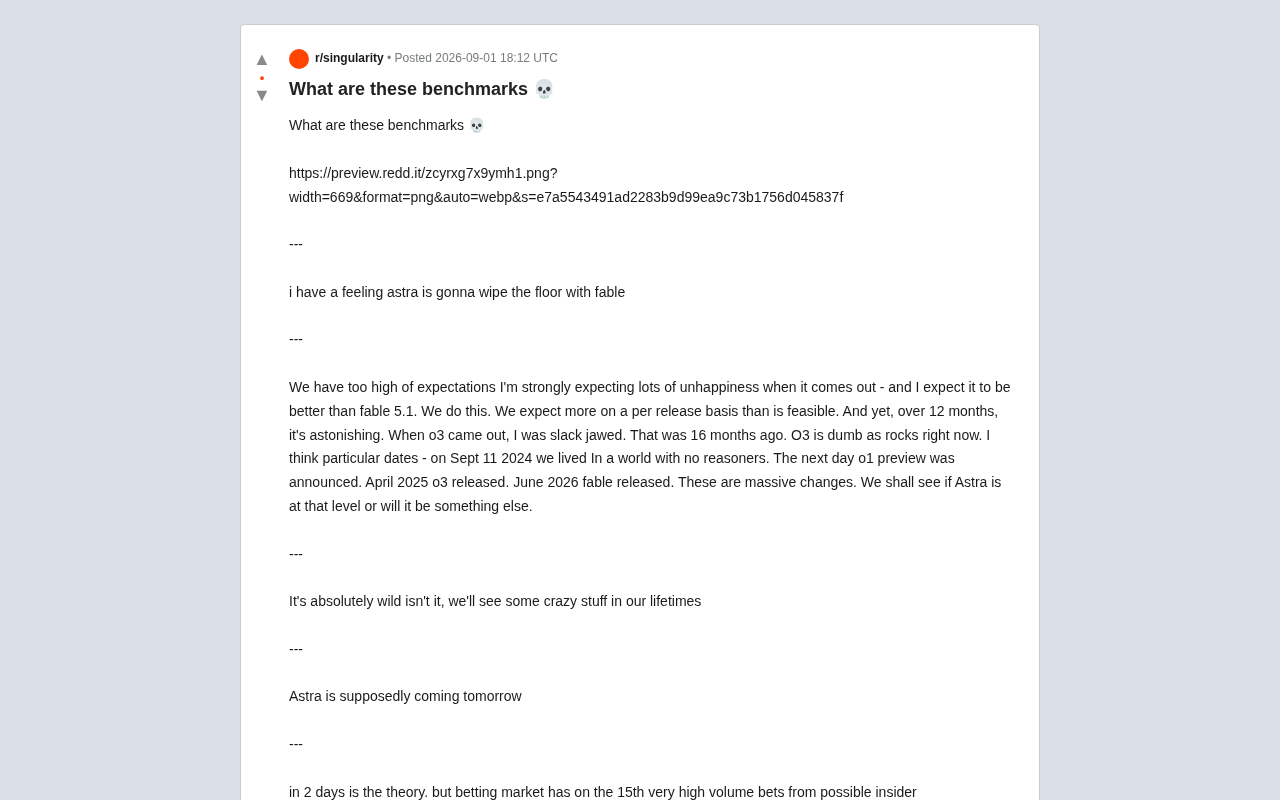
AI Models Iterate Too Fast: Community Anxiety Under Expectation Inflation from o3 to Astra
Reddit community debates AI model iteration speed: o3 considered outdated after just 16 months, Astra launch sparks expectation inflation debate. From reasoning model birth to capability leaps, how to rationally view AI's accelerating progress versus psychological adaptation mismatch.