Hermes Agent Practical Guide: From Installation to Real-World Projects

Hermes Agent is an orchestrable AI agent tool for developers, supporting Feishu, MCP, news bots, and code review automation.
Hermes Agent is an intelligent agent tool for developers with a programming background, designed to unify repetitive tasks — news aggregation, blog generation, code review — into an orchestrable AI agent framework. The learning path spans three layers: architecture understanding, environment setup, and real-world project implementation. It supports CLI and desktop panel interaction, integrates with Feishu for team collaboration, and connects to external tool ecosystems via the MCP protocol. Hands-on projects include a scheduled news delivery bot, fully automated technical blog generation, and a periodic code review assistant. Hermes can also be embedded as a Python library into existing projects.
What Can Hermes Agent Actually Do
Hermes Agent is an intelligent agent tool built for developers. Its core value lies in delegating repetitive daily tasks to AI agents for automatic completion. Whether it's news delivery, code review, or automated technical blog generation, all of this can be achieved through configuration. This article is based on a structured tutorial series from Bilibili, outlining a complete learning path for Hermes Agent — from beginner to hands-on practitioner — to help you quickly decide whether it's worth your time.
From a curriculum perspective, learning Hermes Agent breaks down into three layers: foundational concepts and architecture understanding, environment setup and feature configuration, and real-world project implementation. This progressive structure follows the typical learning curve for tool-based skills — first understand what it is and how it fits together, then build real, working applications.

Foundations and Overall Architecture
When learning any Agent tool, understanding its overall architecture is the critical first step. Hermes is designed around the idea of making AI agents composable, schedulable units of work. Users interact with them through multiple entry points including the command line and a desktop panel.
Core Components
According to the tutorial curriculum, the introductory section first helps learners build a mental model of the overall structure before diving into the details. This "framework first, details later" approach avoids the trap of memorizing scattered commands in isolation. Once you understand the architecture, common commands and the logic behind the desktop panel all start to feel natural.
Installation and Commands
The hands-on section begins with installation, covering common Hermes commands and how to install the desktop panel. For beginners, being comfortable with both the command-line interface and the graphical interface gives you flexibility across different scenarios — CLI is better suited for automation scripts and batch processing, while the desktop panel is more intuitive for everyday interaction and visual workflows.
Integrating Hermes Into Your Work
Hermes Agent's real value becomes clear when it's woven into actual workflows. The tutorial highlights several high-frequency integration scenarios.
Connecting with Feishu (Lark)
Integrating Hermes with Feishu is a classic collaborative use case. Through this integration, teams can invoke AI agent capabilities directly inside Feishu, embedding intelligent automation into the tools they already use for daily communication — no need to switch between multiple platforms.

Configuration and Extension
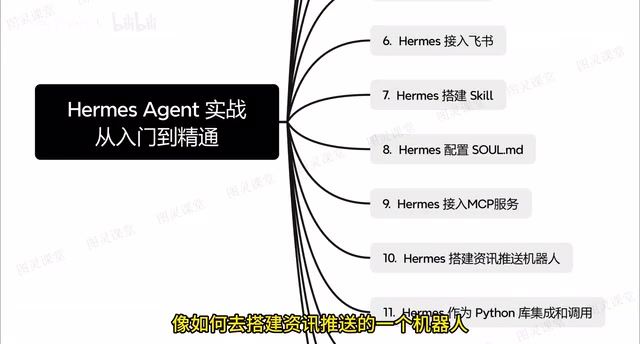
The tutorial also covers building skills on top of Hermes, configuring Markdown documents, and connecting to MCP (Model Context Protocol). MCP support means Hermes can work alongside a broader ecosystem of external tools and context sources — a key indicator of a modern Agent tool's extensibility. The ability to integrate with MCP signals that Hermes is not a closed system, but an open platform with ecosystem compatibility.
What is MCP? MCP (Model Context Protocol) is an open protocol standard introduced by Anthropic in late 2024, designed to give AI models a unified way to access external context. Its core idea is to abstract external tools, data sources, and API services as standardized "context providers," so that an Agent doesn't need to build a custom adapter for every external system — just follow the MCP protocol and interoperability is achieved. Think of MCP for AI Agents the way USB is for peripherals: a universal interface that dramatically lowers integration costs. MCP is now supported by major AI tools including Claude and Cursor, and is becoming foundational infrastructure for Agent ecosystem interoperability. Hermes' MCP support means users can directly reuse existing MCP toolkits from the community, without writing integration code from scratch.
Real-World Project Implementation
The most valuable part of the curriculum is the hands-on project section. The case studies cover some of the most common automation needs developers face.
News Delivery Bot
The first project is building a news delivery bot that automatically pushes trending AI news to a Feishu group on a schedule. This kind of application is highly practical for content creators and technical teams — it automatically aggregates and distributes content, eliminating the time spent manually curating and forwarding information.
Integration as a Python Library
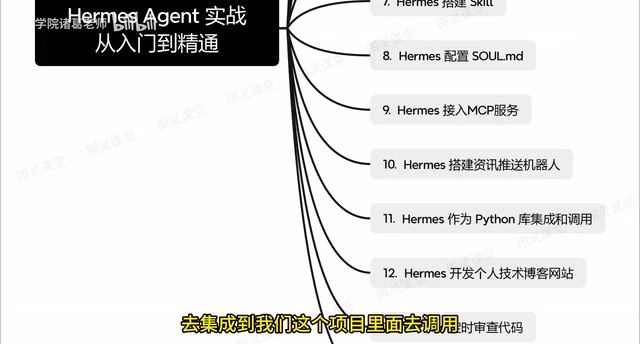
Hermes can be embedded directly into existing projects as a Python library. This is especially important for developers — it means Hermes isn't just a standalone tool, but a capability component at the code level, capable of being deeply integrated into custom application development workflows.
Why "library-first" matters: Exposing an Agent framework as a Python library is a design pattern widely adopted by mainstream Agent tools like LangChain and AutoGen. The advantage is that developers can trigger Agent behavior through function calls within their own code, without relying on a separate process or HTTP service — shorter debugging chains, fewer dependencies. This library-first integration style also makes it easy to embed Agent capabilities into CI/CD pipelines, scheduled task scripts, or FastAPI backends, enabling finer-grained business orchestration. For teams already working with a Python stack, this approach carries far lower migration costs than spinning up a standalone Agent service process.
Fully Automated Blog and Code Review
The other two projects are: fully automated generation of a personal technical blog site, and scheduled code review that delivers improvement suggestions. The first demonstrates Hermes' potential for content production automation. The second puts AI agents to work in code quality assurance — periodic scanning and proactive improvement suggestions, effectively acting as an around-the-clock code review assistant.
Tips and Learning Recommendations
The tutorial wraps up with a collection of Hermes usage tips. For developers looking to get started, the recommended path is: architecture understanding → environment setup → single-feature validation → combined real-world projects. Don't try to tackle complex integrations right out of the gate.
Looking at the overall curriculum design, Hermes Agent is best suited for technically-minded professionals with some development background who want to use AI agents to improve their productivity. Its learning value lies in unifying several scattered automation needs — news aggregation, blog generation, code review — under a single, orchestrable framework.
One important caveat: this article is based on a single tutorial source. It lacks hands-on benchmark data on Hermes' specific performance, stability, or how it compares to similar Agent tools. Before committing significant time, it's recommended to consult the official documentation and community feedback for a more comprehensive evaluation.
Related articles

JobRunner MCP Server: AI Agents Can Now Fix Failed Java Jobs
JobRunner launches an open-source MCP server enabling AI agents to view cluster status, diagnose failures, and recover Java jobs—incident response from any cloud coding environment or existing agent.

MLAI Digital Launches 9 Security Agents: MCP Server Safeguards the Full Lifecycle of Agentic AI
MLAI Digital launches Security MCP Server with nine built-in specialized security agents covering vulnerability discovery, attack simulation, prompt injection detection, API and infrastructure assessment, and accelerated remediation—embedding security validation across the full Agentic AI lifecycle from development to production.

Running Isaac Lab on H100 GPUs: Exploring Better Approaches
Exploring optimization methods for running Isaac Lab on NVIDIA H100 GPUs, including MIG configuration, mixed precision, TensorRT acceleration, and community experience to improve robotics simulation and reinforcement learning efficiency.