Hermes Agent Practical Tutorial: From Beginner to Mastery

Outlines the content structure and practical value of Bilibili's 13-episode paid Hermes Agent course.
Based on the public introduction of Bilibili's 13-episode paid course "Hermes Agent Practical: From Beginner to Mastery," this article organizes its content structure and core value. The course covers Hermes fundamentals, overall architecture, installation and configuration, integration into real work scenarios like Feishu and Scale, and hands-on projects including news push bots, Python library integration, automated blog development, and scheduled code review, as well as MCP protocol configuration. The article notes the course suits developers wanting to quickly get started with Hermes and helps build complete understanding from architecture to implementation, but it is paid content with unclear technical depth and maintenance status; those already familiar with Agent frameworks may find some basics redundant, and learners should continue following official docs and community.
Hermes Agent Practical Tutorial: From Beginner to Mastery
Hermes Agent is an emerging AI Agent framework that has recently attracted attention in the developer community. A 13-episode paid course, "Hermes Agent Practical: From Beginner to Mastery," has appeared on Bilibili, claiming to help learners avoid detours. Based on the course's public introduction, this article organizes its content structure and core value for readers interested in Agent development.
Course Content Overview: From Basics to Practice
The course is divided into several main modules: Hermes fundamentals, overall architecture explanation, installation and configuration, integration into real work scenarios, and multiple hands-on projects. The course emphasizes "from beginner to code practice development," covering the complete chain from environment setup to project implementation.
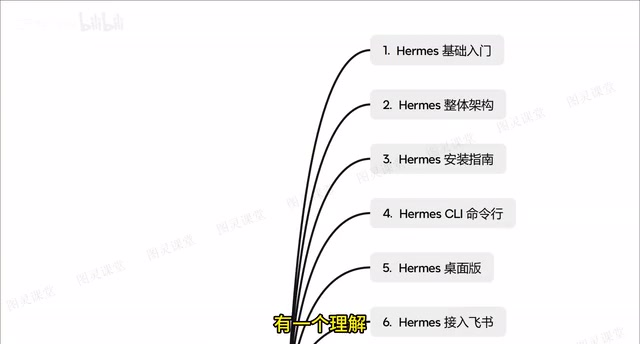
From the course outline, the instructor attempts to let learners first build an overall understanding of Hermes, then master specific usage through hands-on practice. This structure is relatively friendly to beginners, avoiding getting lost in details from the start and losing direction.
Architecture and Installation: Building a Solid Foundation
The course first guides learners to understand Hermes's overall architecture, including its component modules and operating mechanisms. Architectural understanding is a prerequisite for subsequent practical work; only by understanding how an Agent schedules tools and manages context can one apply it flexibly in actual development.
The installation section covers common Hermes commands and desktop version installation methods. For users unfamiliar with command-line tools, the desktop version lowers the barrier to entry. The course also covers Hermes configuration details, such as the "受点 MD" configuration (possibly referring to some Markdown-related configuration), and how to integrate MCP (Model Context Protocol). MCP is a hot protocol in the AI field recently, allowing Agents to connect to external tools and data sources; this part of the content is highly cutting-edge.
AI Agent and Tool Calling Mechanisms
An AI Agent refers to an intelligent entity that can perceive the environment, make autonomous decisions, and execute actions to accomplish goals. Unlike single-turn Q&A chatbots, an Agent typically uses a large language model (LLM) as its reasoning core, combined with three major components: Planning, Memory, and Tool Use. In frameworks like Hermes, the LLM breaks down task steps according to user goals, then requests external tools via Function Calling or protocol interfaces, such as searching, reading/writing files, or sending messages. The framework maintains conversation and task context, feeds tool return results back to the model, forming a "think—act—observe" loop. Understanding this scheduling mechanism is necessary to understand why architectural understanding is a prerequisite for projects like Feishu integration and scheduled task writing.
MCP (Model Context Protocol)
MCP is a protocol proposed and open-sourced by Anthropic in late 2024, aimed at standardizing the connection between AI applications and external data sources and tools. It adopts a client-server architecture: the Agent acts as an MCP client, connecting to various MCP servers through a unified JSON-RPC interface, with the latter encapsulating resources such as file systems, databases, and APIs. Compared to writing separate adapter code for each tool, MCP allows Agents to extend capabilities in a "plug-and-play" manner, also analogized as the USB-C interface of the AI field. The course's explanation of Hermes integrating MCP means learners can let the Agent reuse the existing MCP server ecosystem in the community without developing integration logic from scratch, which is why this part of the content is cutting-edge.
Real Work Scenarios: Feishu and Scale Integration
The course demonstrates Hermes's application in real work, such as using Hermes in Feishu. As an enterprise collaboration platform, integrating AI Agents into Feishu can enable capabilities such as message processing and task automation.

Additionally, the course explains how to build a "scale" (possibly referring to some extended service or scaled application) based on Hermes. Although specific details are not elaborated in the introduction, it is clear that the course focuses on embedding Agent capabilities into daily toolchains rather than demonstrating technology in isolation.
Feishu Open Platform and Bot Integration
Feishu (Lark) is an enterprise collaboration platform launched by ByteDance, providing Open Platform APIs and Bot capabilities. Developers can create custom apps on the Feishu Open Platform, configure permissions, and then receive group chat message events via Webhook or call message sending APIs to push content to groups. Integrating Hermes into Feishu typically requires handling event subscription, signature verification, and message format conversion, converting Feishu messages into Agent input and then returning Agent output as Feishu cards or text. Such integration is a typical form of enterprise-level Agent implementation, involving authentication, callback URL configuration, and permission scope management, which is also the technical background of the course's mention of "message processing and task automation."
Hands-on Projects: News Push and Automated Development
The core highlight of the course is multiple hands-on projects. The first is a news push bot: regularly pushing real-time AI hot news to groups such as Feishu groups.
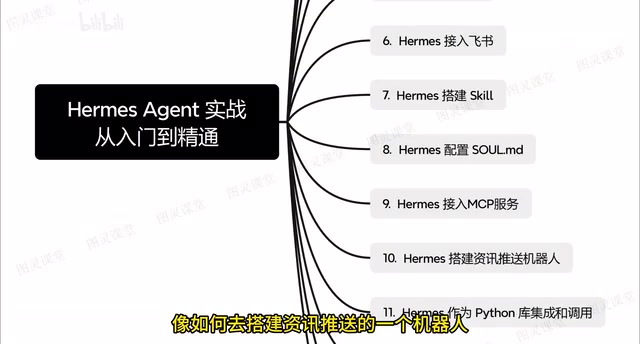
This project involves scheduled tasks, data scraping, and message push, a typical Agent automation scenario. Learners can use this to understand how to make the Agent execute tasks on schedule and interact with external systems.
The second project is integrating Hermes as a Python library into existing projects for invocation. This provides developers a path to embed Agent capabilities into their own applications rather than only using them through independent services.
The third project is fully automated development of a personal technical blog website. This project is comprehensive, possibly involving code generation, file operations, and deployment processes, demonstrating the Agent's auxiliary role in the development phase.
The fourth project is scheduled review of project code with correction suggestions. Code review is a hot direction in AI-assisted development; the Agent can analyze code quality, discover potential issues, and improve development efficiency.
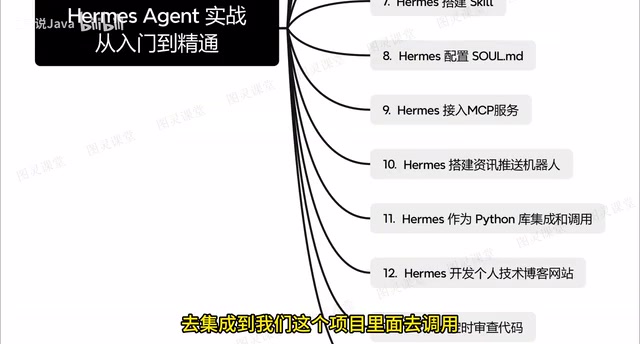
Finally, the course shares Hermes usage tips to help learners avoid common pitfalls.
Calling Agent as a Python Library
Integrating Hermes as a Python library means importing the framework-provided SDK via import in your own Python project, programmatically creating Agent instances, registering tools, initiating tasks, and obtaining results, rather than treating Hermes as an independently running service. This mode allows developers to call Agent capabilities on demand within existing backends, scripts, or data pipelines, reusing the project's existing configuration, logging, and exception handling systems. It typically involves interface designs such as asynchronous calls, callbacks, or streaming output, suitable for scenarios where the Agent needs to be embedded in business processes rather than independent chat interfaces, and is also a concrete manifestation of the course's emphasis on "toolchain embedding."
Course Value and Target Audience
This course is suitable for developers interested in AI Agent development who want to quickly get started with Hermes. The course content is broad, from architecture to hands-on projects, helping learners build a complete knowledge system. However, note that the course is paid content, and the introduction does not mention the depth of specific technical details and update/maintenance status. For developers already familiar with Agent frameworks, some basic content may seem redundant; for beginners, the guidance value of the hands-on projects is relatively high.
Overall, as an emerging tool, Hermes Agent's ecosystem and documentation may not yet be complete, and systematic course learning can save exploration time. But technology iterates rapidly, and learners still need to keep up with official documentation and community practices.
Related articles

Prompt Engineering for Beginners: From Writing Prompts to Engineering Thinking
Starting from the essence and four functions of prompts, this article systematically explains the six-step process, four success criteria, learning value, and practical limitations of prompt engineering to help you build a complete understanding.

Anthropic Launches Nasdaq IPO: AI Giant's Listing and Risk Disclosures
Anthropic officially launches its Nasdaq IPO under ticker ANT, with market valuation expected to potentially exceed SpaceX's record. The prospectus devotes nearly 100 pages to AI risks, while first-half revenue grew over 14x but net losses widened sharply, reigniting the AI bubble debate.

Rust cURL Clone Uses 4,832 unsafe Blocks—Is the Memory Safety Myth Broken?
A Rust cURL clone uses 4,832 unsafe keywords, challenging Rust's memory safety narrative. We analyze what unsafe really means, compare Fil-C, and examine rewrite motives.