Heterogeneous Asynchronous Multi-Player Bandits: Greedy Algorithm Achieves Near-Optimal Approximation

Research proves optimal allocation in heterogeneous asynchronous multi-player bandits is NP-hard and gives 1/e and 1/√e greedy approximation guarantees.
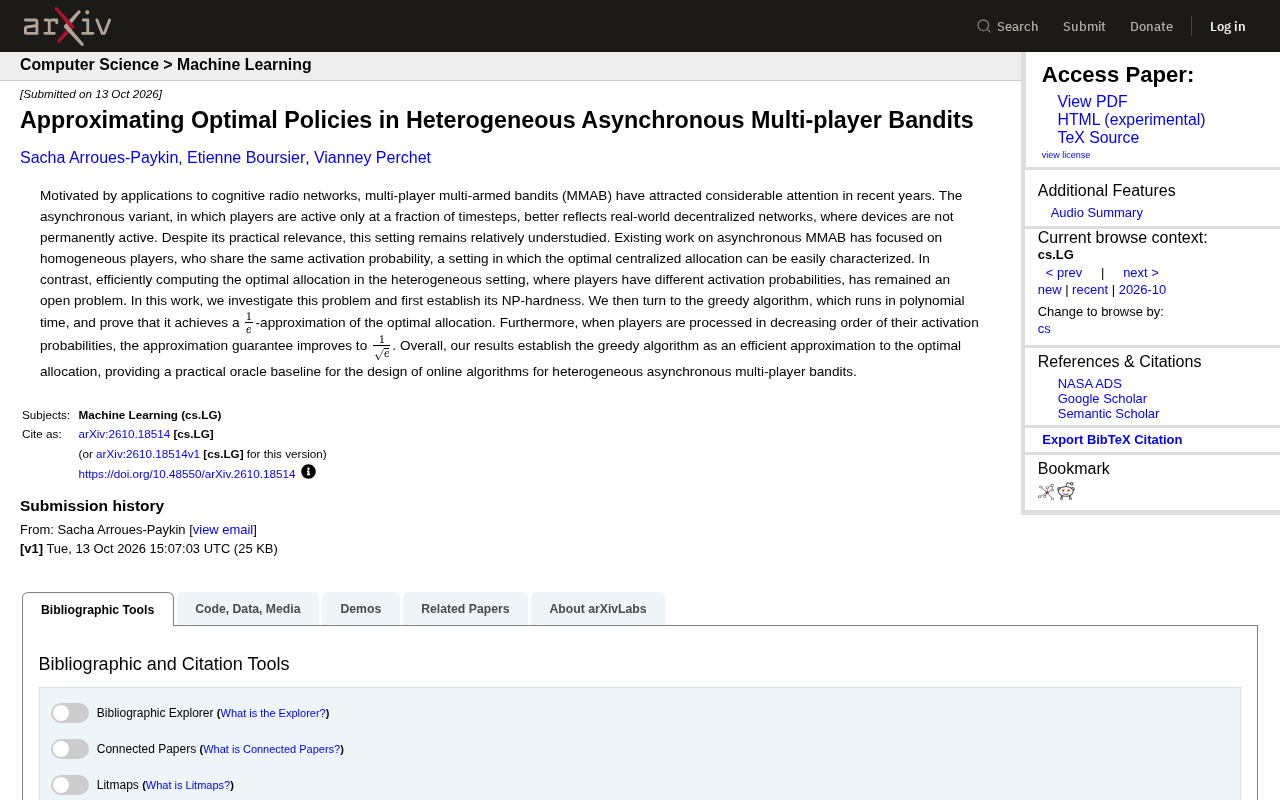
This study addresses the heterogeneous asynchronous multi-player multi-armed bandit problem in decentralized networks, where players have different activation probabilities. It proves that computing the optimal centralized allocation is NP-hard, so no polynomial-time exact algorithm exists. It then analyzes a natural polynomial-time greedy algorithm, showing it achieves a 1/e approximation, improved to 1/√e when players are processed in decreasing activation probability order. These constants provide clear performance bounds and an oracle baseline for online algorithms.
In decentralized scenarios such as wireless networks and cognitive radio, multiple devices are often active only during certain time steps, and their activation probabilities differ. This "heterogeneous asynchronous multi-player multi-armed bandit" problem has long lacked an efficient method for computing the optimal centralized allocation. A recent study proves for the first time that the problem is NP-hard and provides approximation guarantees for a greedy algorithm.
Background: From Cognitive Radio to Asynchronous Bandits
The multi-player multi-armed bandit (MMAB) model was originally inspired by cognitive radio networks: multiple players must each choose a channel to maximize cumulative reward without colliding with one another. Most traditional studies assume that all players are active at every time step, but real decentralized networks are not like this—devices may participate in decisions only at certain time steps due to sleep, energy, or scheduling reasons.
Asynchronous variants are therefore closer to real scenarios. However, existing asynchronous MMAB work almost exclusively focuses on the homogeneous player assumption, that is, all players share the same activation probability. Under this assumption, the optimal centralized allocation can be characterized simply, and the problem difficulty is greatly reduced. Once players' activation probabilities differ, computing the optimal allocation becomes difficult, and this had remained an open problem.
What Are Multi-Armed Bandits (MAB) and Multi-Player Multi-Armed Bandits (MMAB)?
Multi-armed bandits are a classic framework in reinforcement learning and online decision-making: a player faces K "arms" (which can be understood as channels, resources, or options), each arm's reward follows an unknown distribution, and the player must choose one arm at each time step, trading off "exploration" of unknown rewards against "exploitation" of known high rewards, with the goal of minimizing cumulative regret, that is, the gap from the best fixed choice in hindsight. Multi-player multi-armed bandits (MMAB) extend a single player to M players and add a "collision" constraint: if multiple players choose the same arm at the same time step, usually only one of them obtains reward and the rest receive zero. This model naturally captures spectrum sharing scenarios—multiple wireless devices compete for the same set of channels and must avoid collisions to transmit successfully. Centralized allocation means that a central scheduler can know all players' information and uniformly assign each time step's arm choices; its optimal solution is the upper-bound benchmark for measuring the performance of distributed online algorithms.
Core Contributions: NP-hardness and Greedy Approximation
This study provides theoretical results at two levels for the heterogeneous asynchronous setting.
Computational Complexity: NP-hard
The authors first prove that in asynchronous MMAB with different player activation probabilities, solving the optimal centralized allocation is NP-hard. This means that no polynomial-time exact algorithm exists (unless P=NP), and one must turn to approximation methods. This conclusion also explains why the heterogeneous setting long lacked efficient solutions.
Approximation Guarantees of the Greedy Algorithm
The research team then analyzes a natural polynomial-time greedy algorithm and proves that it achieves a 1/e approximation to the optimal allocation. A more refined result is that when players are processed in decreasing order of activation probability, the approximation ratio improves to 1/√e. Although these two constant factors are not large, they provide a clear theoretical performance boundary and also offer a usable oracle baseline for online algorithm design.
The greedy algorithm runs in polynomial time and becomes an efficient approximation tool in heterogeneous asynchronous MMAB, laying the foundation for the design of subsequent online strategies.
The Meaning of Approximation Ratios and 1/e, 1/√e
An approximation ratio measures the worst-case gap between an approximate algorithm's solution and the optimal solution: if an algorithm guarantees that its objective value is no less than α times the optimal value (α≤1), then α is called the approximation ratio, and the closer α is to 1, the better. The 1/e≈0.368 obtained here means that the greedy solution can still achieve about 36.8% of the optimal centralized allocation in the worst case; when players are processed in decreasing activation probability order, this improves to 1/√e≈0.607, or about 60.7%. These two constants are not accidental: 1/e and 1/√e often appear in greedy or submodular maximization analyses (such as the classic "maximum coverage" and randomized greedy bounds), and their source is usually taking limits after expanding term-by-term products. It is worth noting that the greedy algorithm here is a centralized offline algorithm: it requires knowing all players' activation probabilities and can complete allocation in polynomial time. Therefore, it does not directly solve the distributed online learning problem, but serves as a performance benchmark (oracle baseline) for evaluating whether the regret of other online strategies approaches that baseline.
Analysis and Implications
Methodologically, this work introduces "heterogeneity" into asynchronous MMAB, filling a gap beyond the homogeneous assumption. The NP-hardness result delineates the boundary of exact solvability, while the greedy algorithm's approximation guarantee shows that even if the problem is difficult, simple and scalable strategies can still achieve bounded performance.
For practical deployment in cognitive radio and decentralized networks, this oracle baseline can be used to evaluate the performance of online learning algorithms and can also serve as an approximate substitute for a centralized scheduler. Future work may focus on tighter approximation ratios, more general activation models, and regret bounds for distributed online algorithms.
The Methodological Place of NP-hard and Oracle Baselines
NP-hard is a collective term for a class of computational complexity results: if a problem is NP-hard, then as long as P≠NP (which is generally believed to hold), no polynomial-time exact solution algorithm exists, so researchers turn to approximation algorithms, heuristics, or adding extra assumptions to the problem. In the context of online learning, an "oracle baseline" refers to an idealized reference algorithm—it is allowed access to the centralized optimal or approximately optimal solution, thereby providing a comparable performance yardstick for distributed online algorithms. Its value lies in this: an online algorithm's regret is usually defined as the difference in cumulative reward from the optimal fixed strategy. If one can prove that its regret is sublinear relative to an oracle with a bounded approximation ratio, then the online strategy asymptotically approaches optimality over long runs. Therefore, the polynomial-time greedy approximation given in this paper not only answers the static question of whether the centralized optimum can be efficiently approximated, but also provides a reliable comparison standard for subsequently designing distributed online algorithms.
Key Takeaways
- In heterogeneous asynchronous MMAB, computing the optimal centralized allocation is proven to be NP-hard.
- A polynomial-time greedy algorithm can achieve a 1/e approximation.
- When players are processed in decreasing order of activation probability, the approximation ratio improves to 1/√e.
- This result provides a practical oracle baseline for online algorithms in heterogeneous asynchronous multi-player bandits.
The above results all come from the paper's abstract; complete proofs and experimental details require consulting the original paper.
Additional Background
The Exact Meaning of Activation Probability and "Asynchronous"
In asynchronous MMAB, not all players participate in decisions at every time step: player i is "active" at that step with probability p_i. Only active players choose arms and may obtain reward; inactive players neither act nor receive reward. When all p_i are equal, this is the homogeneous case; when the p_i differ, it is called heterogeneous. Why does the difference in activation probabilities significantly increase difficulty? In the homogeneous case, because players are symmetric, the optimal allocation is often just a structurally simple rule such as "spread active players evenly across different arms," which is easy to characterize analytically. Once the p_i differ, however, some players appear more frequently and others more rarely, and the optimal strategy must weigh "who should preferentially occupy scarce arms." This is equivalent to a combinatorial optimization problem with collision constraints, and its feasible allocation space grows exponentially with the number of players and arms. It is precisely this combinatorial explosion that leads to the NP-hard conclusion.
One-line Summary
Research proves that optimal allocation in heterogeneous asynchronous multi-player bandits is NP-hard and gives 1/e and 1/√e approximation guarantees for a greedy algorithm.
Paragraph Summary
This study focuses on the "heterogeneous asynchronous multi-player multi-armed bandit" problem in decentralized networks, where players have different activation probabilities. Previous asynchronous MMAB work was mostly limited to the homogeneous player assumption, under which the optimal centralized allocation is easy to characterize; once activation probabilities differ, computing the optimal allocation had long been an open problem. The authors first prove that solving the optimal centralized allocation is NP-hard, showing that no polynomial-time exact algorithm exists. They then analyze a natural polynomial-time greedy algorithm and prove that it achieves a 1/e approximation to the optimal allocation; if players are processed in decreasing order of activation probability, the approximation ratio improves to 1/√e. These two constants provide clear performance boundaries and also offer a scalable approximate scheduling tool. This oracle baseline can be used to evaluate online learning algorithms or serve as an approximate substitute for a centralized scheduler, laying the foundation for future research on tighter approximation ratios, more general activation models, and regret bounds for distributed online algorithms.
Related articles

Chain of Thought Isn't Just for AI: How Humans Can Use CoT to Improve Thinking Quality
Chain of Thought isn't just a prompt trick for large models. Starting from a Hacker News discussion, this article analyzes why CoT works for human thinking too, breaks down actionable ways to transfer it, and highlights the key differences between human CoT and machine CoT.
Cloudflare Teams Up with OpenAI: Closi…
Cloudflare Teams Up with OpenAI: Closing the Loop from Vulnerability Discovery to Defense with AI
Cloudflare uses OpenAI Daybreak to investigate security vulnerabilities and generate reviewable remediation plans, while developers use Codex to boost coding efficiency and quality.

Orca Multi-Agent Orchestration in Practice: A Guide to Parallel Collaboration with Claude and Codex
Orca is Stable AI's free open-source agent workbench supporting 34 agents like Claude Code and Codex in parallel. Learn its Git worktree isolation, multi-model orchestration, and mobile management.